

Sports Equipment Manufacturer

A pre-signing checklist for comparing sports flooring proposals. Match the quoted system to its evidence, define site and installation responsibilities, and put warranty and handover terms in writing.
By LDK Sports Editorial Team
LDK Sports Equipment is the publisher and a supplier of sports flooring. This checklist is for comparing any bidder; confirm project-specific commitments in the written offer.
Use this buying sports flooring guide to compare each proposal against the venue’s primary sport, required standards, and written scope. Before signing, require a written proposal that names the complete sports floor system, ties performance evidence to that system, assigns site and installation duties, and states quote inclusions, acceptance, warranty, and maintenance. Facility owners, schools, clubs, and contractors can use the questions below to turn supplier answers into terms the project team can compare line by line.
Start with the primary sport, then list every secondary use of the room. A supplier cannot make a useful recommendation from “gym floor” alone; the proposal should identify the sport mix, indoor or outdoor setting, competition needs, activity zones, and equipment that will move across the floor.
| Put this in the brief | Ask the supplier to state | Keep in the proposal |
|---|---|---|
| Primary and secondary sports | Which named floor system is proposed for each activity? | Model, intended use, and any different system or zone |
| Competition or recreational use | Which project requirement or governing-body specification is being used? | The applicable specification and its edition |
| Indoor, outdoor, or mixed-use venue | How does the proposed system suit this location and schedule? | The recommendation and stated site assumptions |
| Fixed or changing room use | Which markings, equipment, or conversions are part of the scope? | Included items, exclusions, and any alternate |
The best answer is a named system tied to your actual sports and venue, not a universal claim that one surface is “best.” The general flooring families, including wood, synthetic or vinyl, rubber, turf, and modular products, serve different facility plans. The supplier’s explanation should say why the proposed construction fits the primary use and what changes if the room also hosts assemblies, fitness, or other sports. For basketball, FIBA describes hardwood as a traditional court material; FIBA Level 1 competition requires an approved wooden or glass floor, while Level 2 may also use synthetic flooring. The FIBA Venue Guide lists polyurethane, PVC, and polypropylene tiles as synthetic court-floor types. For another sport or setting, match the system to its governing requirements and intended uses before comparing supplier offers. If the venue moves seating tribunes across or onto the court, FIBA’s guide says their load should be distributed and supports should be non-marking; it also notes that a mobile backstop may need extra weight protection. For these or other rolling equipment, ask the supplier to state any protection and use limits for the quoted system.
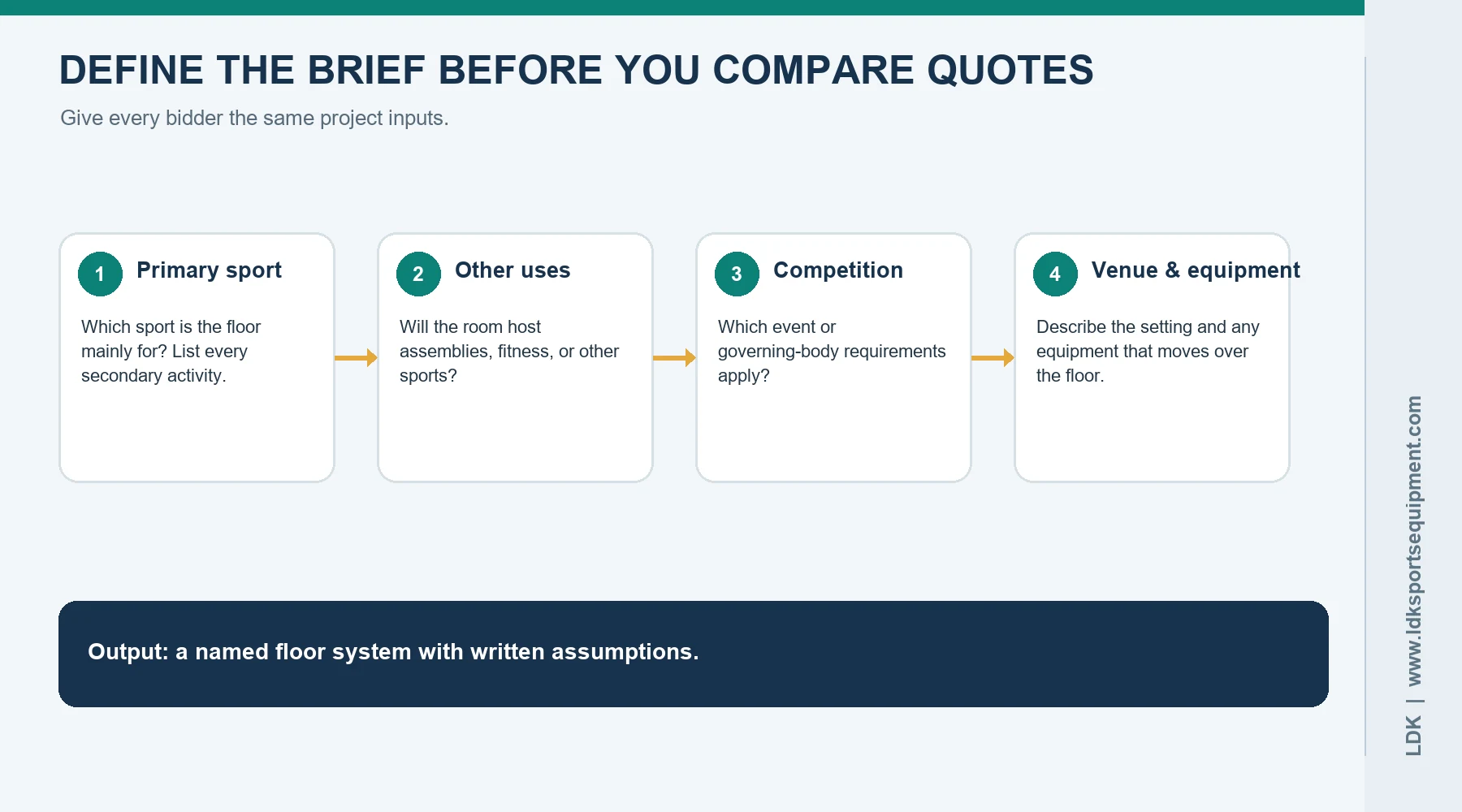
Every supplier should quote the same scope before you compare totals. Each bidder should identify the model and show the full assembly, from playing surface through supporting layers, along with the options included in the offer.
Use this item list when comparing proposals:
The performance report, drawings, and quote should all refer to the same model and configuration. If the seller substitutes a surface, underlayment, finish, or other component, request a revised drawing and document list before approving the change. A catalog page may describe a product family; the purchase order should name the actual configuration being sold. If your options include wood, see LDK’s guide to wood species for sports floors.
The proposal should identify whether court layout, markings, and equipment positions are included; keep the accepted drawing with it.
A standard name is a starting point; the useful evidence is the report for the system the supplier has actually proposed. Request the exact edition, report identifier, tested model or assembly, and report scope, then compare those details with the project specification.
The British Standards Institution lists BS EN 14904 as a specification for indoor surfaces for multi-sports use. ASTM identifies F2772-24 as a specification for athletic performance properties of multipurpose indoor sports floor systems; its public scope excludes turf and materials specific to running tracks and tennis courts. Use the BSI catalogue listing and ASTM’s public scope to confirm which standard and edition your project names, then compare the supplier’s full report with that requirement. The BSI listing for BS EN 14904 and ASTM F2772-24 scope describe the public source information available for each reference. A report matters only when its tested assembly matches the quoted construction, so use the sports floor comparisonsports floor comparison to keep bids aligned.
For basketball flooring, FIBA describes these performance characteristics: a firm, level surface that supports grip and ball response; consistent performance across the court; resilience and avoidance of permanent deformation; and shock absorbency. Ask the supplier to show which results in the report address the requirements named for your project, and make sure the tested assembly matches the quoted system. If the supplier proposes a second support layer, require the report and drawing to identify that configuration in the double joist sports flooringdouble joist sports flooring offer.
For each document, ask:
Treat the documents as one chain: project specification and edition → quoted model and assembly → report scope and tested configuration → approval listing, if required → drawings and documents attached to the order.
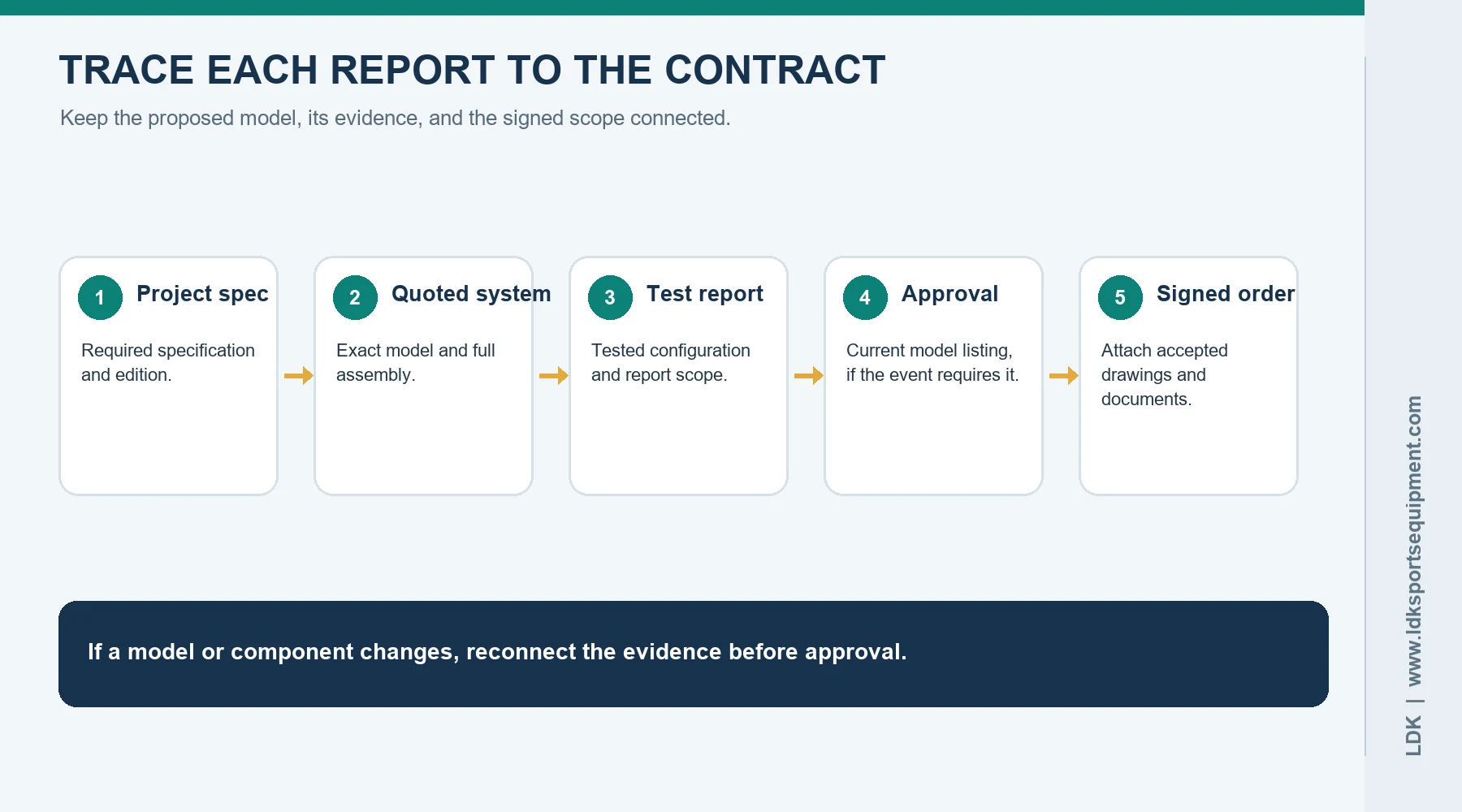
If the project invokes FIBA, begin by checking the event requirement and model listing. FIBA’s Venue Guide says Level 1 approved equipment is required for all FIBA national-team and club competitions, plus other elite-level competitions. For basketball flooring, it specifies that FIBA competition Level 1 must use an approved wooden or glass surface; Level 2 FIBA competitions may also use synthetic flooring. Require the supplier to identify the exact quoted model on the current list and show how it meets the event requirement. A broad phrase such as “built to FIBA standards” does not prove that a model is listed as FIBA Approved. See the FIBA Venue Guide for the competition-level requirements. When the report names a particular assembly, compare it with the quoted drawing for the single joist sports flooringsingle joist sports flooring system.
For a plain-language background on one of the standards, see LDK’s sports floor standards overview. The contract should still name the requirement that applies to your venue and attach the supplier’s supporting documents.
The agreement should name who surveys and accepts the site, who supplies and installs each component, and what counts as completed handover. Give the owner, supplier, and installer separate responsibilities so an open item does not disappear between teams.
| Project stage | Ask who is responsible | Record before signing |
|---|---|---|
| Site review | Who reviews the drawings and site conditions before work starts? | Required information, assumptions, and written approval |
| Preparation | Who completes and accepts the substrate or other preparatory work? | Acceptance criteria and who signs the record |
| Installation | Who supplies each part, installs it, and handles markings or interfaces? | Named company, scope, exclusions, and coordination contact |
| Changes | How are substitutions or site changes priced and approved? | Written change process and required revised documents |
| Handover | What inspection, records, and owner training are provided? | Completion checklist, care instructions, and sign-off record |
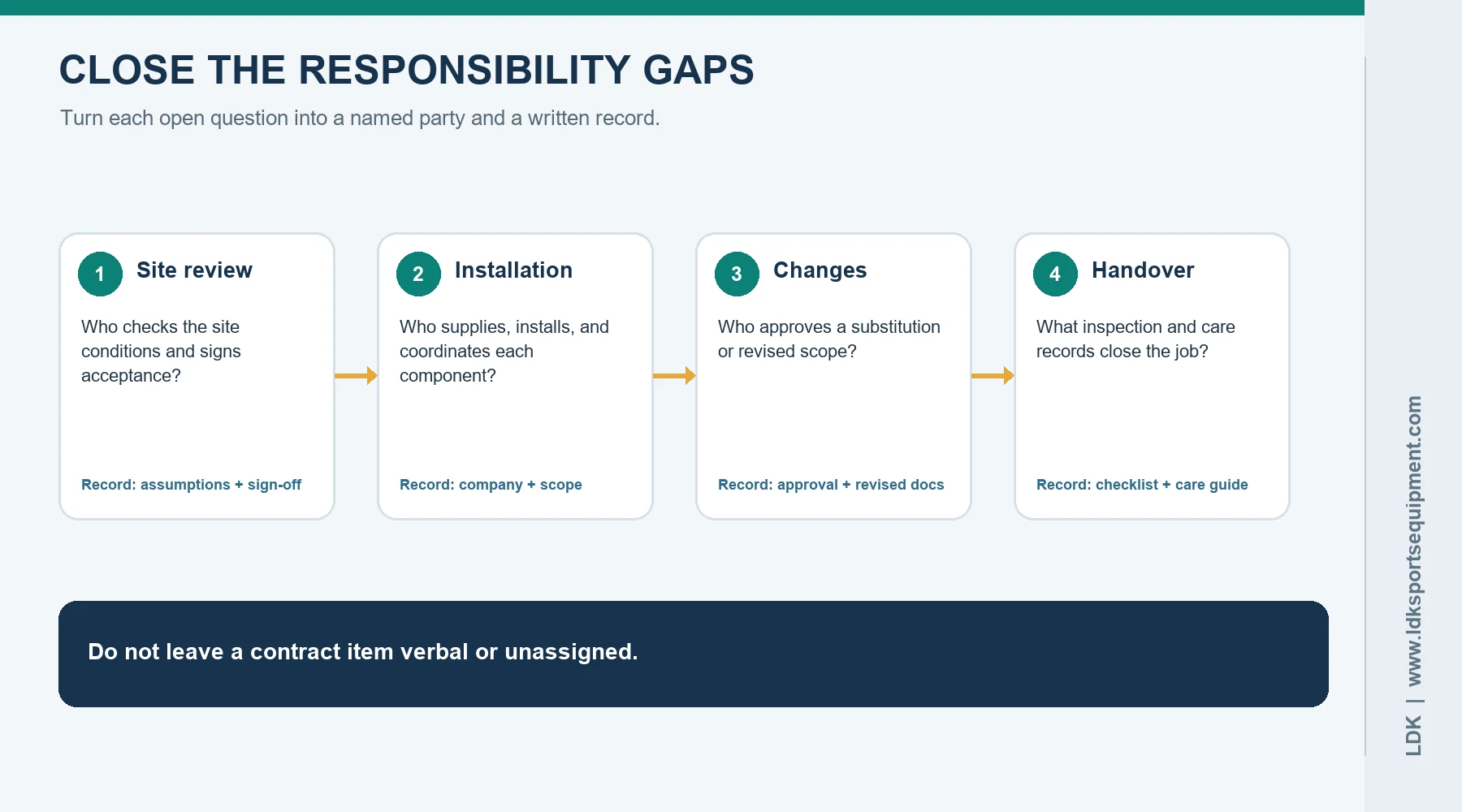
The supplier should state the site conditions the offer assumes, including any subfloor checks or acclimation requirements. Put the required checks, the party who performs them, and the approval point in the agreement. Keep the request at the level of the project specification; do not rely on an informal conversation or a separate document that the contract does not identify.
The offer should state whether remote installation guidance or a local installation team is included, which channels and languages are available, and which company is responsible on site. Put current availability and the arrangement in the written proposal.
Get the warranty wording and care plan before signing. The contract should identify who is responsible for product defects, installation work, and service requests, and it should point to the maintenance instructions that the facility team will receive.
Put these items in writing:
Do not accept a verbal warranty summary as a substitute for the document. If the supplier cannot provide the warranty before signing, mark it as an open contract item and wait for the written terms before comparing that offer with a bidder whose terms are already clear.
Compare proposals only after they describe the same floor area, system, documents, installation split, exclusions, acceptance criteria, and quote validity. A lower total may simply leave more work outside the supplier’s scope.
| Comparison field | Proposal A | Proposal B | What must match |
|---|---|---|---|
| Named system and drawing | Same model and assembly | ||
| Test documents and standard | Same requirement and relevant scope | ||
| Included materials and accessories | Same items, markings, and interfaces | ||
| Site and installation duties | Same owner/supplier/installer split | ||
| Acceptance and handover | Same inspection and records | ||
| Warranty and maintenance | Written coverage and care documents | ||
| Exclusions and quote validity | Same boundary and current written terms |
Before signing, close the gaps in this order:
If a supplier’s answer changes the proposed system or scope, request a revised offer and compare it again. Keep the accepted drawing, report list, and responsibility schedule with the signed order so the project team is working from the same package.
Send the supplier the primary and secondary sports, venue setting, dimensions or floor plan, required standards or approvals, installation split, and target schedule. The project quotation should list the named system, supporting documents, inclusions and exclusions, warranty, and handover terms. To start that conversation, contact LDK for a project quotation.
The contractor should identify the exact system and model, show which performance documents match it, define the site and installation tasks they own, list exclusions, and state which inspection and handover records you will receive. Request the warranty and maintenance instructions before signing.
For basketball, hardwood is a traditional starting point; FIBA’s Venue Guide describes hardwood court flooring and sets additional requirements by competition level. A FIBA competition at Level 1 requires a FIBA Approved wooden or glass surface; Level 2 FIBA competitions may also use synthetic flooring, including polyurethane, PVC, or polypropylene tile types listed in the guide. For another sport or venue, the right floor depends on the primary activity, any secondary uses, and the project requirements. Request the relevant report and current approval listing for the quoted model. These competition requirements do not establish approval for a particular supplier or model.
