
Sports Wood Flooring Manufacturer
Gym Floor Resurfacing Cost: Project Estimate Guide
Plan the information a contractor needs to scope gym floor resurfacing and identify assumptions that affect a written estimate. Use the blank worksheet to compare work, quantities, exclusions, access and schedule on the same basis.
Meta title: Gym Floor Resurfacing Cost: Project Estimate Guide
Meta description: Plan and compare gym floor resurfacing costs line by line. Use our scope checklist and worksheet to evaluate contractor bids side by side on a shared scope.
When you request a gym floor resurfacing estimate, the useful question is not just “What is the price per square foot?” It is “What exact work, measured area, site conditions and schedule does this proposal cover?” A total without those details is difficult to compare with another bid.
Use this guide to assemble a clear request for estimate, then compare written proposals line by line. It focuses on budget inputs and bid scope. For the separate decision about screen and recoat, full sanding, repairs, replacement or maintenance timing, see the gym floor sanding and refinishing guide.
What a gym floor resurfacing estimate covers—and what this guide leaves to the scope guide
“Resurfacing” can describe different work packages. One proposal may include finish removal, sanding, repairs, game-line work and new finish; another may cover a narrower renewal scope. A cost estimate is meaningful only when the work package is stated clearly.
MFMA’s existing-maple guidance describes components that can be part of complete resurfacing, including removing finish and game lines, repairing damaged boards, sanding, sealing, court lining and finishing. That list is a useful prompt for bid questions; it does not mean every project requires every item. Ask each bidder to mark what is included, excluded or dependent on inspection. (MFMA existing maple floor guidance)
Keep the two decisions separate. First, have qualified bidders describe the work needed for the floor’s current condition. Then compare the cost of that same scope. If you still need to decide between screening, sanding, repair or replacement, use the linked scope guide rather than assuming the word “resurfacing” means the same thing in every proposal.
What changes the cost of gym floor resurfacing?
There is no single number that can be applied responsibly to every gym. The estimate changes with the area, the condition found on site and the work included. Give bidders the same starting information and ask them to identify their assumptions.
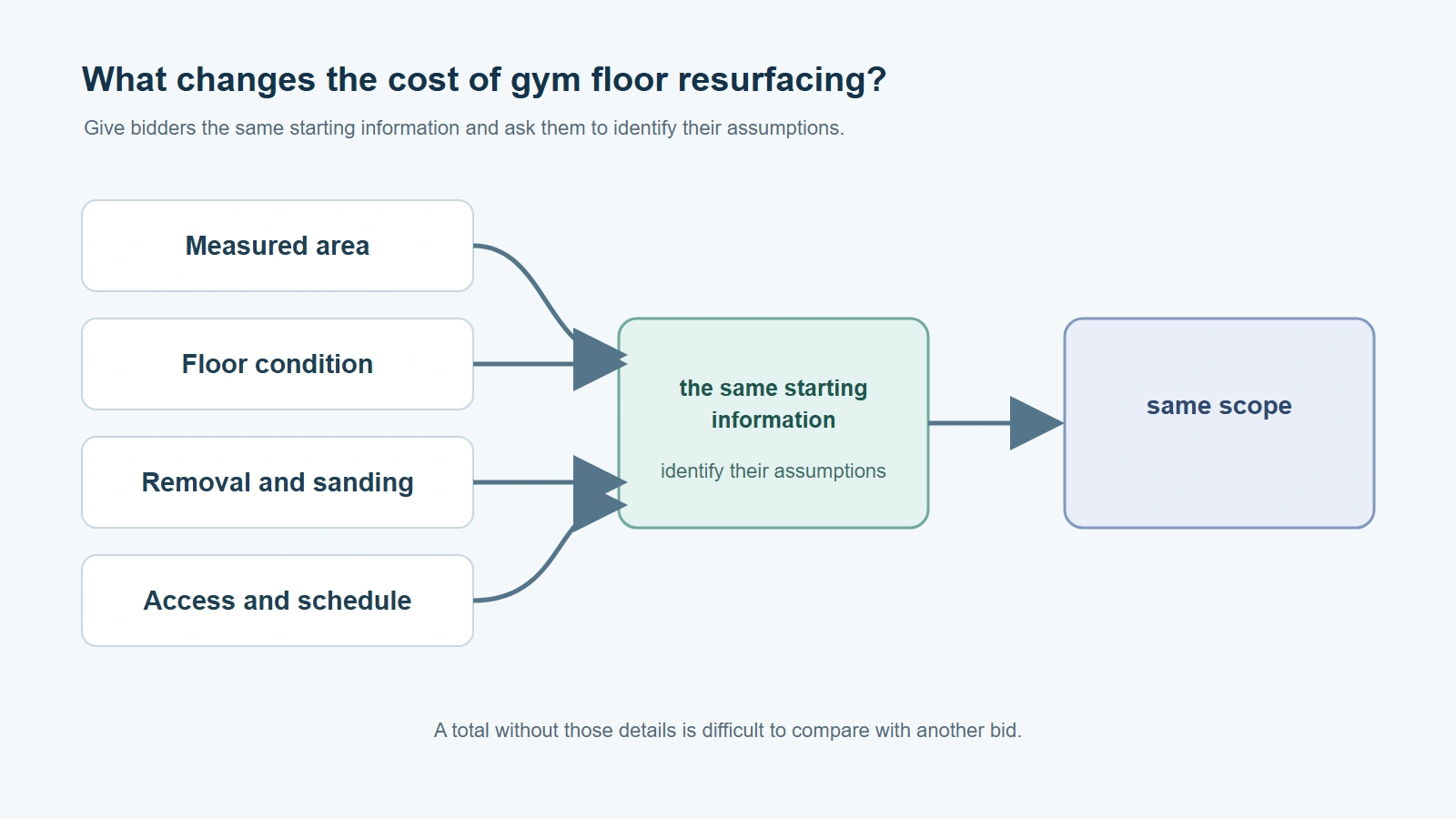
| Estimate factor | Information to provide | Bidder assumption to confirm |
|---|---|---|
| Measured area | Floor plan, dimensions or the area you have on record | Whether the bidder measured or used the owner’s figure; which rooms or margins are included |
| Floor condition | Photos, inspection notes, known damaged or loose boards, and prior work records | Whether repairs are included, provisional or excluded pending inspection |
| Removal and sanding | Existing finish and game-line history if known | What is removed, how far the work extends, and what condition could change the scope |
| Court lines and graphics | Required court markings, colors, logos and any planned changes | Whether removal, layout, painting and protection are included as separate items |
| Sealer and finish | The requested finish package, if already specified | Product or system description, number of included coats if stated in the proposal, and any exclusions |
| Access and schedule | Venue hours, school calendar, loading route, staging limits and target work window | Work-hour assumptions, owner coordination needs and schedule dependencies |
Treat these as quote variables to document, not universal price multipliers. If the site survey changes a quantity or repair assumption, ask for the revised scope and amount in writing so you can compare the same version across bidders.
The Town of Trumbull’s 2024 school-gym bid is one local example of project-specific documentation: it refers to drawings and specifications and asks the contractor to inspect and verify existing conditions. It is not a national price benchmark or a current market average. Use it as a reminder to give bidders a defined project package and a chance to state what they verified. (Town of Trumbull bid document)
What should you collect before requesting a gym floor refinishing estimate?
A short, consistent intake package helps contractors respond to the same project. It also makes missing information visible before proposals arrive.
Before you send the request, collect:
- Venue location and the name of the facility contact.
- A floor plan or measured area, with the measurement source identified.
- Current-condition photos and notes about visible damage, loose boards, water events or areas that need inspection.
- Existing court lines, logos and graphics, plus any changes requested for the project.
- Available records about past maintenance or refinishing, if you have them.
- Access details: doors, loading route, staging area, operating hours and any occupied-space restrictions.
- The target work window and dates the venue cannot be closed.
- The scope you want priced, with items you are unsure about marked as questions.
Do not fill gaps with guesses. If you do not know the exact area or floor construction, say so and ask bidders how they will verify it. MFMA notes that subfloor designs differ and recommends consulting an MFMA sport-floor contractor before complete resurfacing; that is a reason to identify unknown conditions, not to claim a remote estimate can resolve them. (MFMA existing maple floor guidance)
Which line items should every comparable resurfacing bid spell out?
Ask for a written scope that lets your team see what each total buys. The table below is a blank normalization worksheet; have each bidder complete the same fields or map its proposal into these rows.
| Work item | Bidder A: included / excluded | Bidder B: included / excluded | Quantity or assumption | Clarification needed |
|---|---|---|---|---|
| Mobilization, site verification and protection | ||||
| Removal of existing finish or game lines | ||||
| Board repair or other identified repairs | ||||
| Sanding and surface preparation | ||||
| Sealer and finish work | ||||
| Court lines, logos or graphics | ||||
| Cleanup, waste handling and handback | ||||
| Access, work hours and schedule assumptions |
The work items reflect questions raised by MFMA’s existing-maple guide, not a mandatory package for every floor. A contractor may need an inspection to determine whether a repair or additional preparation is appropriate. The important point for comparison is that a proposal labels the item as included, excluded, provisional or subject to site verification.
A public bid can also show how a buyer defines a specific job. In the 2024 Trumbull example, drawings and specifications describe the project, and bidders are asked to verify conditions. That is a single municipal example; it does not establish a universal procurement format. (Town of Trumbull bid document)
How do access and timing affect the estimate you receive?
Access and timing belong in the request because they shape how a contractor plans the project. They are not automatic surcharges. Give each bidder the same schedule and site facts, then ask what the proposal assumes.
Confirm the following before comparing bids:
- Which dates or calendar periods are available for the work?
- Can the gym be closed for the full proposed work period, or are there fixed reopen dates?
- What hours can crews work, and are there noise or occupancy limits?
- Which entrance, loading route and staging area can the crew use?
- Who coordinates keys, alarms, building access and other trades?
- Does the bidder need a site visit or additional measurements before finalizing quantities?
MFMA says the appropriate refinishing schedule depends on facility use, abuse and maintenance. That supports a condition- and use-based conversation; it does not establish a fixed resurfacing interval or project duration. Keep schedule promises and maintenance timing tied to the specific site and the contractor’s written proposal. (MFMA annual maintenance and refinishing guidance)
How do you compare totals without choosing the lowest number blindly?
A low total may describe less work, a different measured area or unresolved assumptions. A higher total may include items another bidder left out. Normalize the proposals before deciding which one fits the project.
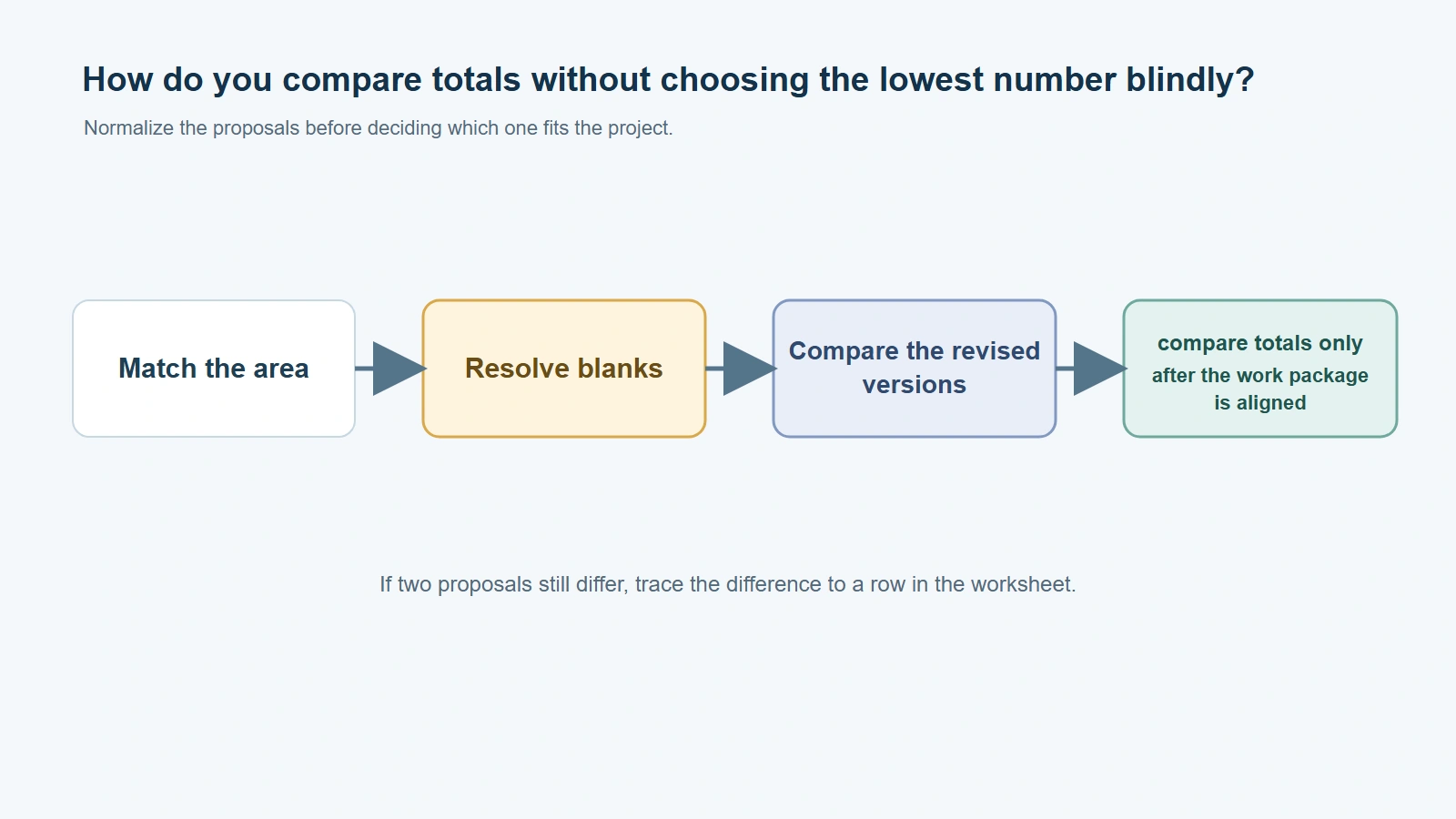
- Match the area. Confirm whether bidders priced the same floor and used the same measurement basis.
- Match the work. Compare removal, repair, sanding, finish and court-line work. Mark every exclusion and provisional item.
- Compare quantities and assumptions. Check how each proposal treats site verification, damaged boards, access and work hours.
- Resolve blanks. Send each bidder the same written question about missing scope, quantities or schedule dependencies.
- Compare the revised versions. Keep the original and revised proposals together, and compare totals only after the work package is aligned.
If two proposals still differ, trace the difference to a row in the worksheet. Ask what condition or task accounts for it and whether it is included, excluded or subject to verification. Do not infer that a contractor is overcharging or that a missing item will be added later; get the scope clarified directly.
For floor-condition decisions, refer technical questions to a qualified sports-floor contractor who can inspect the site. MFMA’s general guidance notes that subfloor designs differ. The bid should identify what has been inspected and what remains an assumption, so your procurement team can make a decision on stated information.
FAQs about gym floor resurfacing estimates
Should I expect a more detailed estimate than this?
Ask the bidder to identify the measured area, included work, quantities, exclusions, site assumptions and items that still need clarification.
What is national average for hardwood floor refinishing?
National averages mislead athletic-floor buyers because facility size, board damage, line work, access and the work package vary from project to project. Define those inputs first, then compare contractor totals against the same scope.
Is this a fair price for hardwood floor refinishing?
Compare written scope, quantities, finish and line items, exclusions, access and schedule across proposals before judging the total.
I would like some help trying to determine what should I pick? Also would like opinions about the prices in general.
Select the proposal that covers the documented project scope and resolves material assumptions, rather than relying on an unverified price opinion.
My question is can these sections be blended in nicely or not.
Ask bidders to define the work-area boundary and any transition assumptions in writing; a proposal cannot predict visual matching without evaluating the specific floor and scope.
Conclusion: Prepare a Comparable Request
Send bidders the same measured area or floor plan, condition notes, requested line work, access limits and target work window. Ask them to return an itemized scope that identifies what is included, excluded and still subject to inspection. That gives your team a clear basis for comparing proposals and deciding what needs a site-level answer.
For a project inquiry, share the venue location, measured area or floor plan, visible condition, requested scope and target work window through the contact page.