

Sports Equipment Manufacturer

A practical guide to sprung wood dance-floor assemblies, surface and footwear choices, fixed versus portable systems, and specification checks.
A sprung wood floor for dance is a complete assembly: a dance surface over a resilient support system, selected for the way dancers move and the way the venue operates. The surface and resilient support work together to shape how the floor responds to movement.
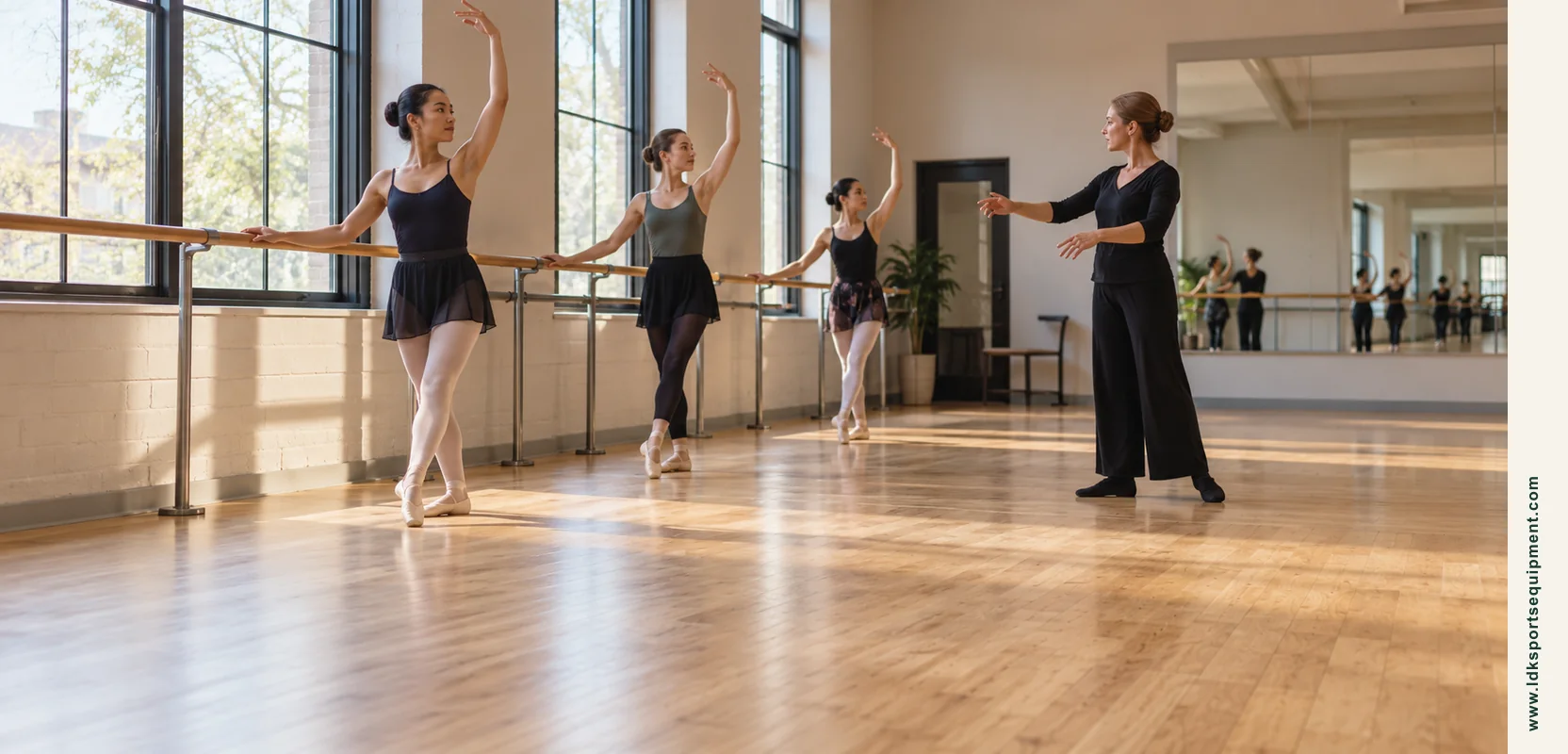
AI-generated concept illustration for studio context.
A sprung dance floor pairs a stable surface with a support layer that flexes under impact. The surface is where dancers balance, slide, turn, and land; the support construction beneath it manages how the floor responds to that movement. Dance guidance describes this general arrangement as an area-elastic floor: a stable deck floats over a cushion, spring, or other resilient suspension [1].
A buyer should therefore specify the full assembly, not just “wood flooring.” Depending on the system, the resilient support may use battens, pads, foam, or another engineered construction. Some studios also specify a dance-surface vinyl overlay over a sprung base; list the overlay and the support system separately in the bid [1]. These are system examples, not interchangeable parts. Include the proposed assembly in the supplier’s drawings and test documentation.
| Part of the assembly | What it does | What to include in the specification |
|---|---|---|
| Dance surface | Provides the contact surface for shoes or bare feet | Material, finish, intended dance styles, and any overlay |
| Resilient support | Determines how the floor flexes under impact | System type, support layout, and tested configuration |
| Existing subfloor | Carries the assembly and affects installation | Construction, condition, levelness, and moisture information |
| Perimeter and transitions | Connect the floor to doors and adjacent areas | Finished height, edge details, and transition treatment |
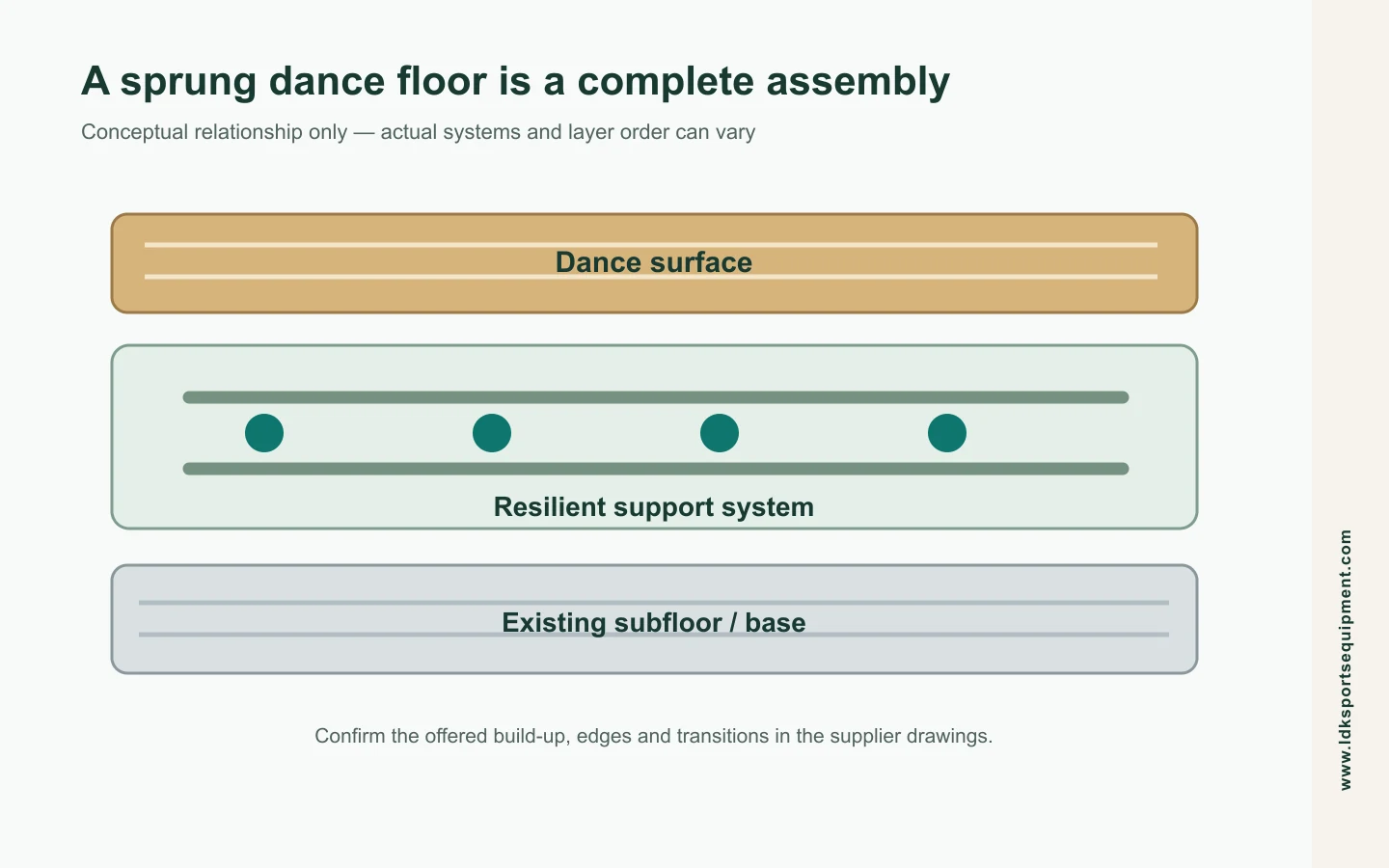
Concept diagram for explanation only; it does not show a verified product or construction detail. Actual systems and layer order can vary.
A dance floor and a sports floor answer different use cases. A sports-floor test report describes the named system and sports criteria; a dance specification should separately identify the intended dance use, surface, footwear, and supporting assembly.
Dance places particular demands on the interaction between the performer’s foot and the surface. Ausdance’s dance-floor guidance notes that surface finish can vary with technique: ballet needs grip while allowing controlled sliding, while barefoot work needs a fine surface that still provides enough grip for movement [1]. By comparison, sports-floor programs may include criteria such as ball behavior that do not answer how a dance surface feels under a dancer’s footwear.
| Dance-floor specification | Sports-floor specification |
|---|---|
| Names the dance styles, footwear, and surface interaction the room must support | Names the court-sport activities and sport-specific performance requirements |
| Describes the offered surface finish and support assembly | Identifies the tested sports-floor assembly and applicable sports criteria |
| Evaluates dance-use documentation for the quoted configuration | Uses sports test data within the scope of that sports method |
For a mixed-use project, list dance and court sports as separate activities and request documents for the quoted configuration against each intended use. ANSI E1.34-2009 (R2024) measures the slipperiness of floor-surface materials used by performers in live venues. Its procedures assess a surface property; they do not specify the complete floor assembly or installation scope, so review those documents separately [3].
Choose the surface around the movements and footwear used most often in the room. A floor that feels right for one style may not provide the same glide, grip, sound, or wear behavior for another, so list the studio’s primary activities before comparing materials.
Choose wood species alongside the surface finish, support assembly, installation, care, and the studio’s actual dance use. Ask the supplier to describe the proposed system for your use case and provide documentation tied to that configuration.
A fixed system is usually the more direct fit for a dedicated dance room used regularly; portable panels are useful when the floor must be removed, stored, or moved between venues. The choice depends on the room’s schedule and building constraints, not just the floor’s appearance.
| Choose a fixed system when… | Choose a portable system when… |
|---|---|
| Dance is a regular, long-term use of the room | The venue changes function between events |
| The floor can remain installed | The floor must be stored or transported |
| A continuous room-wide installation is planned | A defined area needs temporary coverage |
| The building project can coordinate finished floor height and transitions | Setup, removal, storage, and panel joints need to be part of the operating plan |
| Verify the quoted build-up includes the resilient support required for the intended dance use | Verify the panels include a resilient support system; portability alone does not establish that a floor is sprung |
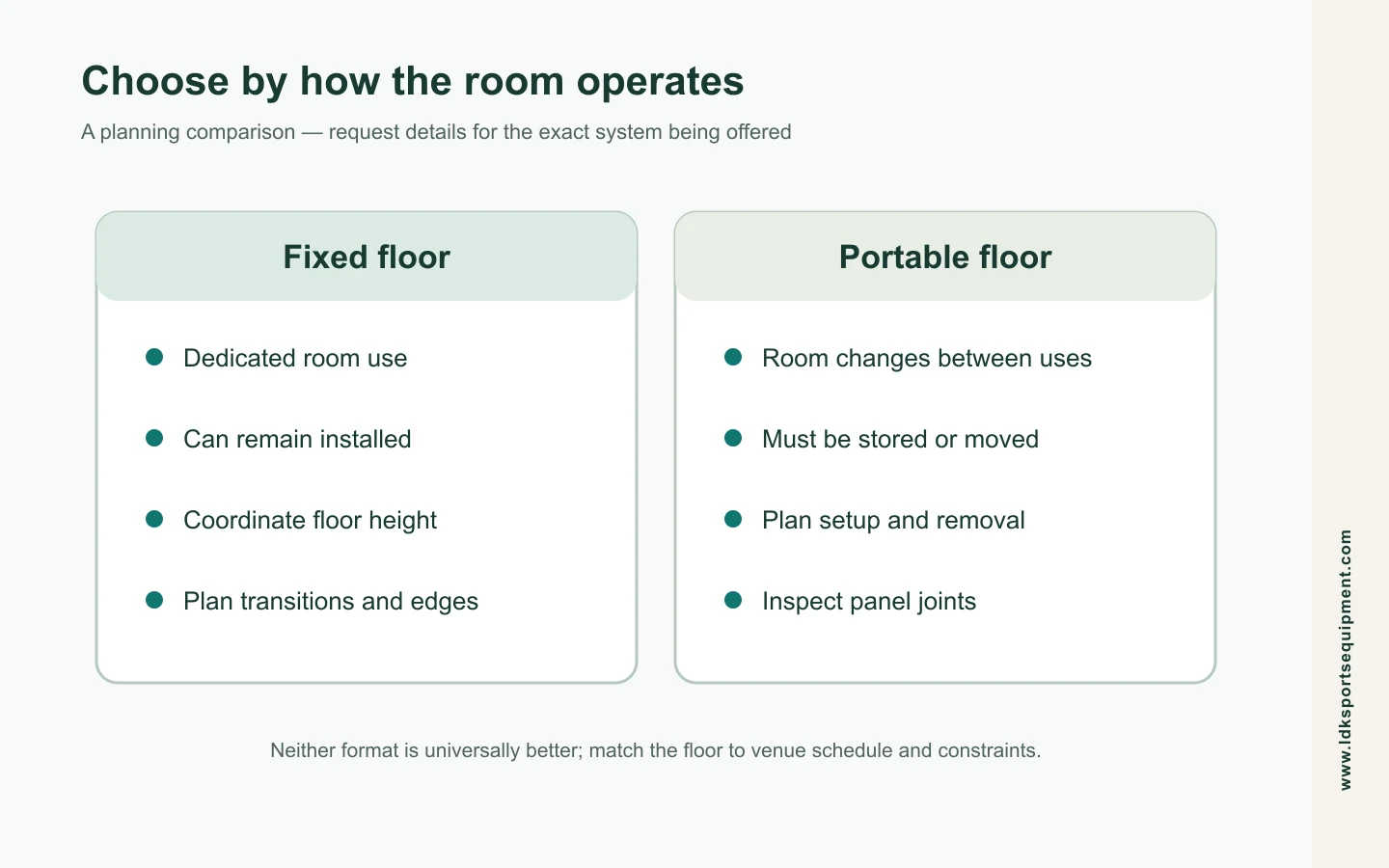
Planning illustration only; this compares venue-use considerations and does not represent a specific floor system.
For portable options, include panel connections, edge transitions, storage conditions, installation responsibility, and inspection of joints in the scope. For a permanent floor, coordinate the floor build-up with doors, adjacent floor levels, and other building services before installation. These details are easier to resolve on drawings than after the room is finished.
A useful specification describes the room, the dance use, the floor assembly, and the documents needed to verify the offer. Put the following details in the request for quotation:
Compare technical documents by their scope: a slipperiness method describes one surface property, while drawings and installation details describe the assembly and work being offered [3]. Dance/USA’s older venue-planning article also recommends coordinating the intended activity, room, and permanent versus portable use during specification; it was written by a flooring-industry representative and is a planning prompt, not an independent standard [2]. For shared dance and court use, list each activity separately and assess the room-level requirements in the multi-sport hall flooringmulti-sport hall flooring plan.
Use the same checklist for every bidder so that a test result can be matched to the system actually offered. If a line is unanswered, ask for the missing detail before comparing totals.
| Bid item | What every bidder should state |
|---|---|
| Intended use | Dance styles, footwear, frequency, and secondary activities |
| Dance surface | Material, finish, and any overlay |
| Resilient support | Named construction and system drawing |
| Subfloor assumptions | Required substrate condition and preparation scope |
| Fixed or portable | Installation, removal, storage, and panel-joint details |
| Test documents | Method, tested assembly, and how it maps to the offered system |
| Finished height | Build-up, door clearances, and transitions |
| Handover | Installation records, care instructions, and maintenance responsibility |
LDK’s published wood-floor portfolio focuses on sports flooring and does not establish a dance-specific system. For a shared dance and court-sport venue, evaluate each use separately: the solid versus engineered sports flooring guide explains wood-format considerations for sports floors, but it is not a dance-floor approval. If you need the court-sport scope, review the indoor hardwood basketball flooring system and contact LDK with the planned court activities, dimensions, substrate, and installation requirements. For dance-specific surfaces and support, request documentation for the exact assembly from a dance-floor supplier. Browse LDK’s Wood Flooring Guides archive for its sports-flooring articles.
It is a floor assembly with a dance surface over a resilient support construction. The surface and support work together, so buyers should review the complete system rather than the wood finish alone [1].
Maple is a common wood-surface option, but it is not best for every studio [4][5]. Choose based on dance styles, footwear, finish, maintenance needs, and compatibility with the proposed support system; ask the supplier to document the exact assembly.
Studios may use fixed or portable sprung systems, with wood or another dance surface selected for the studio’s activities. The right configuration depends on dance style, footwear, room use, and whether the floor needs to move.
No. Portable describes how a floor can be moved or stored; check the offered assembly to confirm whether it includes resilient support. Ask for a system drawing and dance-use documents that identify the surface and support together [1][2].
Include the dance styles and footwear, room and substrate conditions, surface and resilient support, finished height and transitions, installation scope, maintenance, and documents for the exact assembly. A slipperiness result covers one surface property, so pair it with the system drawing and installation details [2][3].
For a dance studio, specify the full floor assembly around the actual styles, footwear, room, and substrate. Compare every bid using the same system drawing, test evidence, installation scope, finished height, and maintenance terms. If a document names a different assembly, ask how it applies before treating it as evidence for the proposed floor.
Planning a wood-floor project for dance, court sports, or shared use? Contact LDK with the room’s planned activities, dimensions, substrate, and whether the floor will remain installed. LDK’s published wood-floor portfolio focuses on sports flooring. For dance-specific surfaces and support, request documents for the exact assembly from the floor supplier; contact LDK about any court-sport scope in your project. For court-sport scope, distinguish the support layers from dance-specific surface needs when reviewing sports floor subfloor systemssports floor subfloor systems.
