

Sports Equipment Manufacturer

Neither solid hardwood nor engineered sports boards are automatically better for every gym. Compare the exact wear layer, floor assembly, facility conditions, and system test documents.
A solid vs engineered gym floor comparison should start with the exact board and complete system, not a blanket “stronger versus weaker” claim. Both constructions can be used in sports-floor systems, but the labels describe the wood board—not the complete floor’s athletic performance. Compare the actual wear layer, support assembly, humidity requirements, repair plan, and test documents for the specific system.
Quick answer: Solid hardwood gives you a board made from one piece of wood; an engineered sports board bonds a hardwood wearing surface to one or more backing layers. Neither label alone tells you how the assembled court will absorb shock, return a basketball, or respond to a facility’s climate.
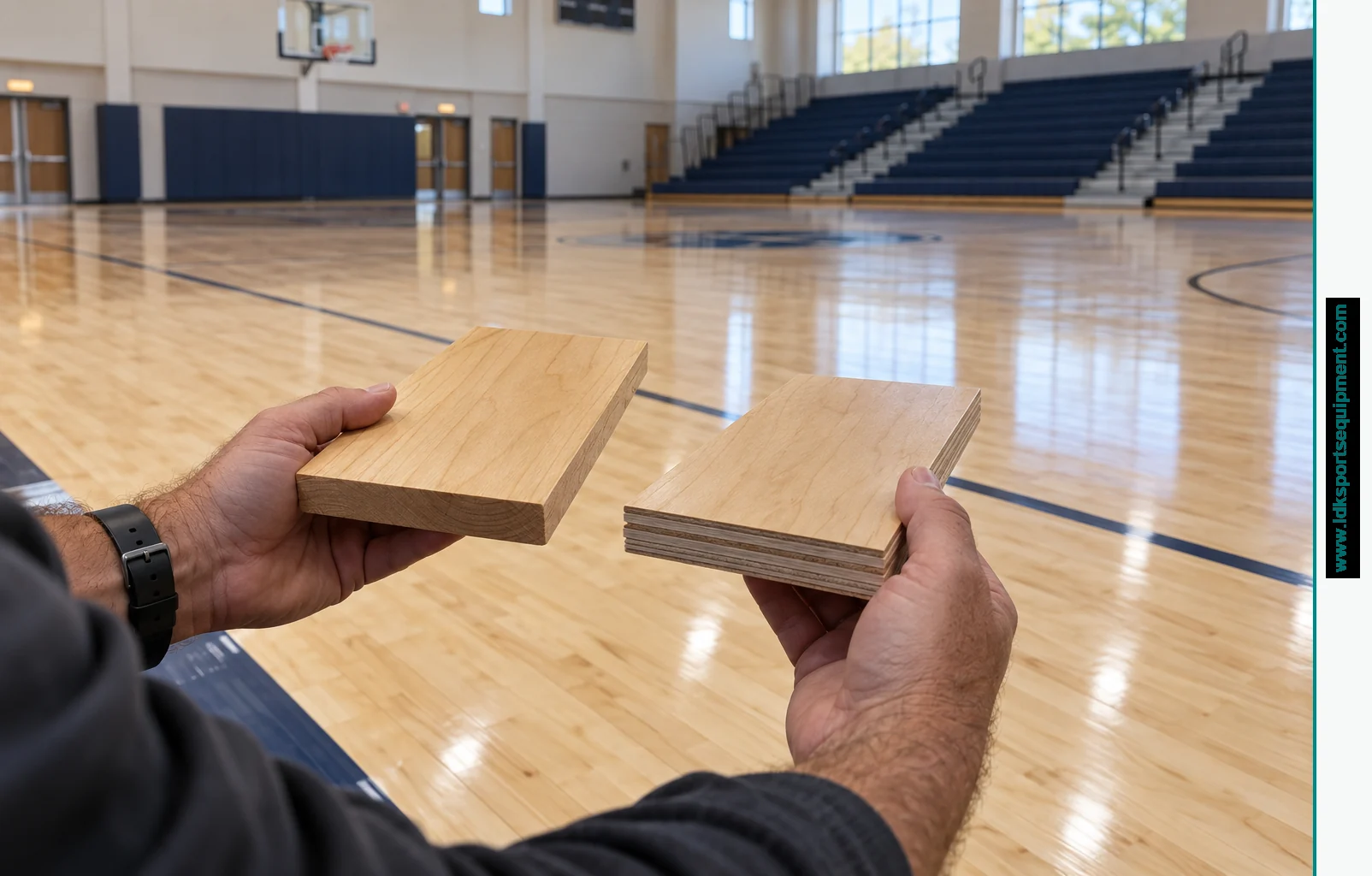
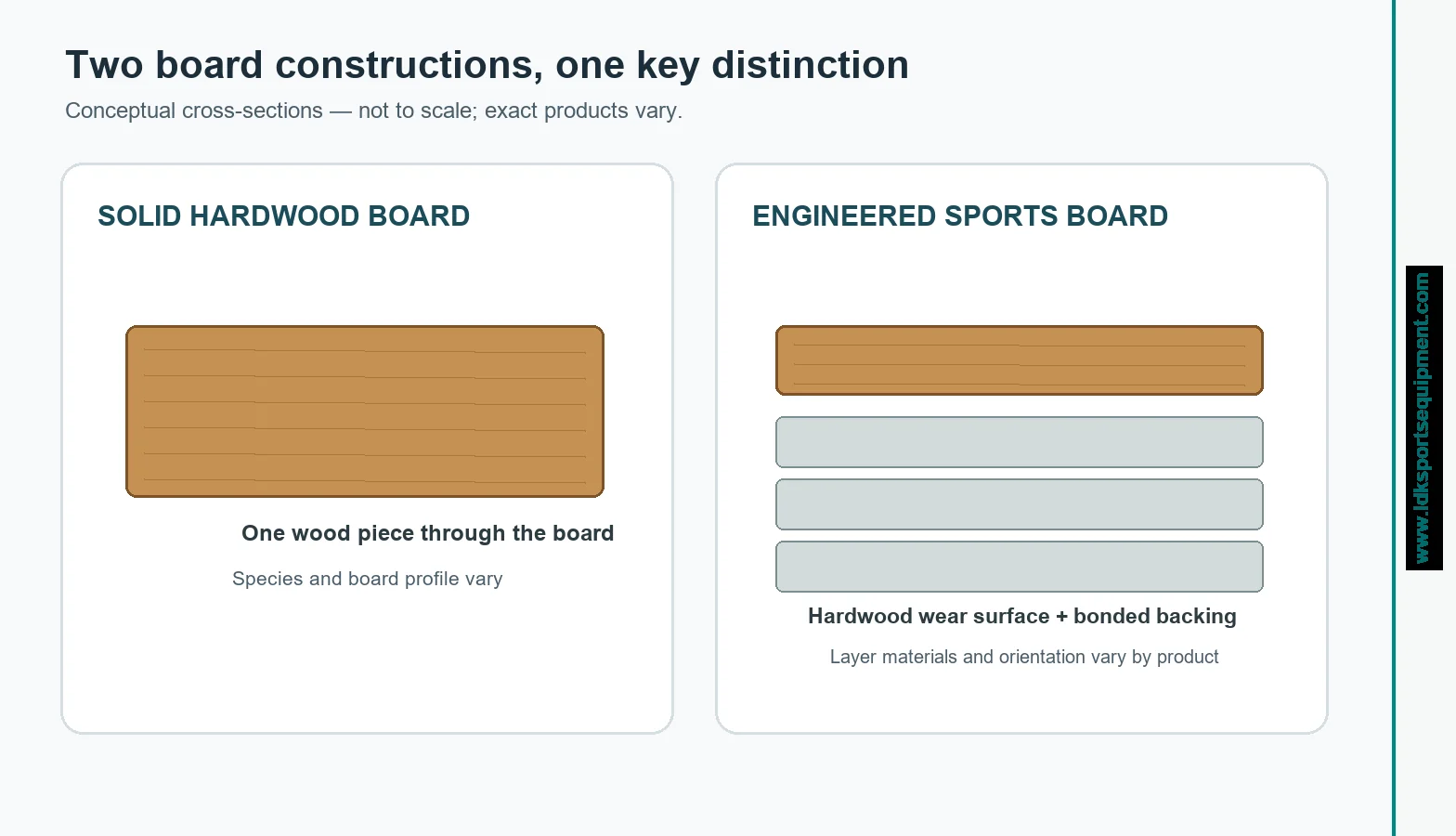
A solid hardwood board is milled from one piece of wood. A traditional sports floor may place those boards over resilient supports and a subfloor. The surface board and the resilient assembly are separate parts of the design.
An engineered sports board combines a hardwood wearing surface with a bonded core or backing layers. Construction differs by manufacturer. For example, Tarkett describes its Flexlock as a 22 mm multilayer sports-floor board with a 3.5 mm solid-wood wear layer, installed as part of a 67 mm total system in the described configuration. Those figures describe that Flexlock build-up; they are not standard dimensions for engineered sports flooring.
“Engineered” can also describe a floor’s support or subfloor construction. A plywood or LVL layer under a hardwood surface does not, by itself, mean the wearing board is engineered hardwood. When two proposals use the same word differently, compare drawings and cross-sections before comparing performance claims.
Some engineered sports boards use a multilayer plywood core. DYNAMIK says this construction provides high dimensional stability in its own product comparison; that is a supplier statement about its board design, not a universal result for every engineered sports floor. The useful takeaway is to ask for the exact core construction and supporting test or installation documents.
| What to compare | Solid hardwood board | Engineered sports board |
|---|---|---|
| Board construction | One wood species through the board thickness | Hardwood wear surface bonded to a core or backing; exact layers vary |
| Main wear-surface question | How much sound hardwood remains above the tongue or support joint? | What is the hardwood wear-layer thickness, and how does the maker define the sandable depth? |
| Humidity response | Wood movement still needs to be managed through the facility environment and installation details | Layer arrangement may affect movement, but the exact board, system, and installation requirements govern |
| Repair and refinishing | Depends on board profile, remaining wood, floor history, and the maker’s instructions | Depends on the actual hardwood wear layer, bonding, condition, and the maker’s instructions |
Wood exchanges moisture with the air around it. Seasonal indoor humidity changes can make boards expand or shrink, so a solid surface still needs a suitable operating environment, expansion details, and an installation plan. An engineered label does not remove those requirements; the construction may change how a particular board responds, but the manufacturer’s limits for that system are what matter.
For maple athletic floors, the Maple Flooring Manufacturers Association (MFMA) recommends maintaining indoor relative humidity within a 15-percentage-point range at 55–75°F. It also says the target range should be centered on the seasonal wood-moisture conditions expected for the project location. This is MFMA guidance for maple floors, not a universal setpoint for every sports-floor system. Use the selected manufacturer’s written requirements and the facility’s HVAC plan.
Ask both suppliers to state the permitted temperature and relative-humidity range, how they expect the building to be conditioned before installation, and what monitoring the operator must continue after handover. Also ask how the system handles the project’s slab moisture and vapor-control requirements. Compare the answers in writing rather than assuming the board category settles the issue.
Sometimes, but the word “engineered” does not tell you how many future sanding or refinishing cycles a floor can take. The usable amount depends on the actual hardwood layer, its position relative to joints or fasteners, the permitted sanding depth, previous refinishing, and the manufacturer’s maintenance instructions.
A solid board may leave more hardwood available for future sanding, but that is not guaranteed by the label alone. A thick engineered wear layer may be serviceable too; a thin one may limit the amount of material that can be removed. Junckers similarly frames repairability and refinishing as construction- and system-dependent considerations.
Before purchase, get these details for the proposed board:
Do not compare a residential engineered-floor veneer measurement with a sports board’s wear-layer specification unless both suppliers define the measurement in the same way.
The sports floor performs as an assembly. The wood surface works with the supports, subfloor, resilient components, slab, and installation details. Junckers notes that a universal winner cannot be selected from the board label alone; Tarkett’s Flexlock description also illustrates why it matters to distinguish the wearing board from the full system build-up.
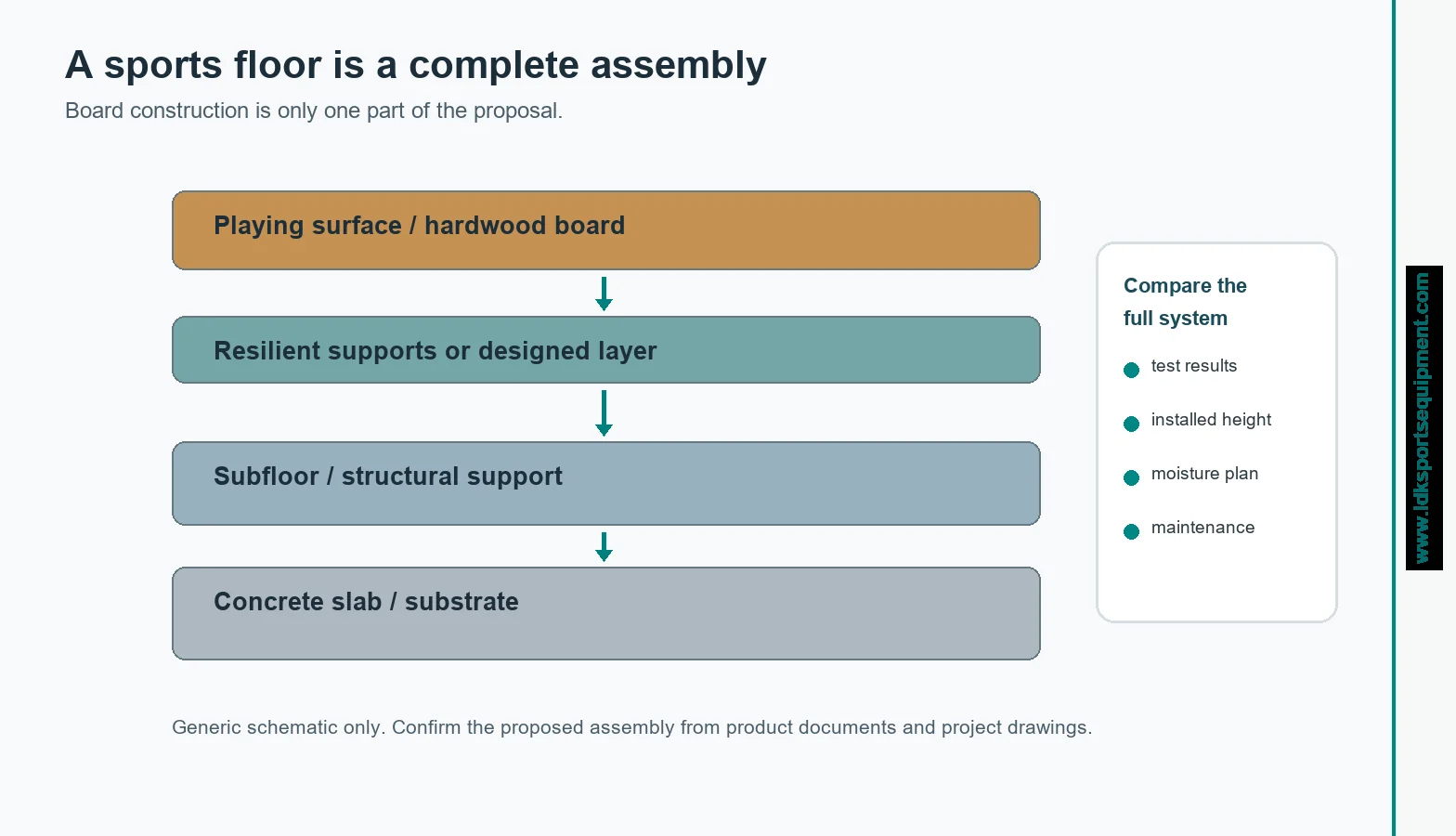
For sports use, ask for performance results tied to the exact proposed system and test configuration. FIBA’s venue guide identifies a firm, level surface, consistent performance, ball bounce, and shock absorption as basketball-court flooring considerations. ASTM F2772-24 establishes performance levels for multipurpose indoor sports-floor systems. Depending on the project, relevant characteristics may include shock absorption, vertical deformation, area deformation, basketball rebound, and surface friction. A result for a different board, subfloor, pad, or test specimen is not an apples-to-apples comparison.
Compare the following items on the same basis:
Start with the venue and the complete proposal, then use the surface construction as one selection factor.
For related system decisions, see our guides to wood species for sports floors, fixed-resilient versus floating wood sports floors, and single versus double batten layouts. A project team comparing proposals can contact LDK with the venue use, climate conditions, slab information, and system drawings.
Neither is automatically better. Compare the exact board construction, usable wear layer, facility conditions, repair plan, and performance documents for the complete sports-floor system.
Sports halls may use wood, vinyl, rubber, or other surfaces depending on the sport and venue. A wood court is a complete assembly, so compare its surface board together with the resilient supports and subfloor.
For a sports floor, the main concern is not the label but whether the specific board has enough documented wear material for the venue’s repair plan and whether the full system meets the project’s performance and environmental requirements. Residential engineered flooring specifications do not establish suitability for an athletic court.
Some engineered sports boards are designed to manage movement differently from solid boards, but there is no universal advantage that applies to every product. Compare the exact manufacturer’s humidity limits, installation details, and complete-system documentation.
