
Sports Wood Flooring Manufacturer
Hardwood Floor Basketball Court: A Buyer’s Guide to System Selection
Use the facility brief to compare a hardwood court’s full assembly, installation format, and site requirements. Build an RFQ that lets suppliers quote matching scope, documents, schedule, and maintenance responsibilities instead of comparing headline totals alone.
Choosing a hardwood floor basketball court starts with the facility brief, not a species name or a product photo. Define who will use the court, the competition level, the event schedule, the available installation format, and the condition of the slab. Then compare complete sports-floor systems against those requirements and request a quote with the same scope from every supplier.
“Hardwood court” can describe the playing surface, while a “floor system” includes the surface and the supplied or installed assembly. Those are different decisions. A maple surface, for example, does not tell you whether a project needs permanent or portable construction, what substrate work is included, or which documents support the proposed system.
1. Start with the court’s use and competition level
Write down the court’s operating brief before comparing systems. Include the sports and activities, competition level, number of courts, event turnover, daily use, access windows, and who will own routine maintenance. These details shape the system questions a supplier and project team need to answer.
For a competition venue, identify the governing requirements before choosing a floor. The FIBA Venue Guide describes different playing-surface requirements for Level 1 and Level 2 competitions. Ask the supplier for the applicable test report for the proposed system and competition use. Match the test report to the exact system configuration in the quote, then compare it with the venue’s competition requirements.
| Project input | What to record | Why it belongs in the brief |
|---|---|---|
| Use and competition | Sports, competition level, training and non-sport uses | Sets the performance and documentation questions to verify |
| Operating schedule | Daily use, event calendar, changeovers, installation window | Helps compare permanent and portable formats |
| Facility | New build or renovation, number of courts, access route | Affects coordination, delivery, and work sequencing |
| Project team | Owner, architect, engineer, installer, maintenance lead | Gives each site and operating question a responsible reviewer |
| Procurement | Drawings, target date, scope boundaries, quote format | Makes supplier responses comparable |
If the venue will host more than one activity, list each one. Basketball, volleyball, assemblies, and community events may create different scheduling and layout needs. The project team should decide which uses define the system and which are secondary before suppliers prepare a proposal.
Separate requirements from preferences. Mark the competition use, operating schedule, and floor format as required or preferred, then attach the current drawings and any renovation notes. This keeps the first supplier conversation focused: bidders can identify missing project inputs before they price a system, and the owner can see which decisions still need an architect, engineer, or facility manager.
2. Compare hardwood and modular or synthetic court systems
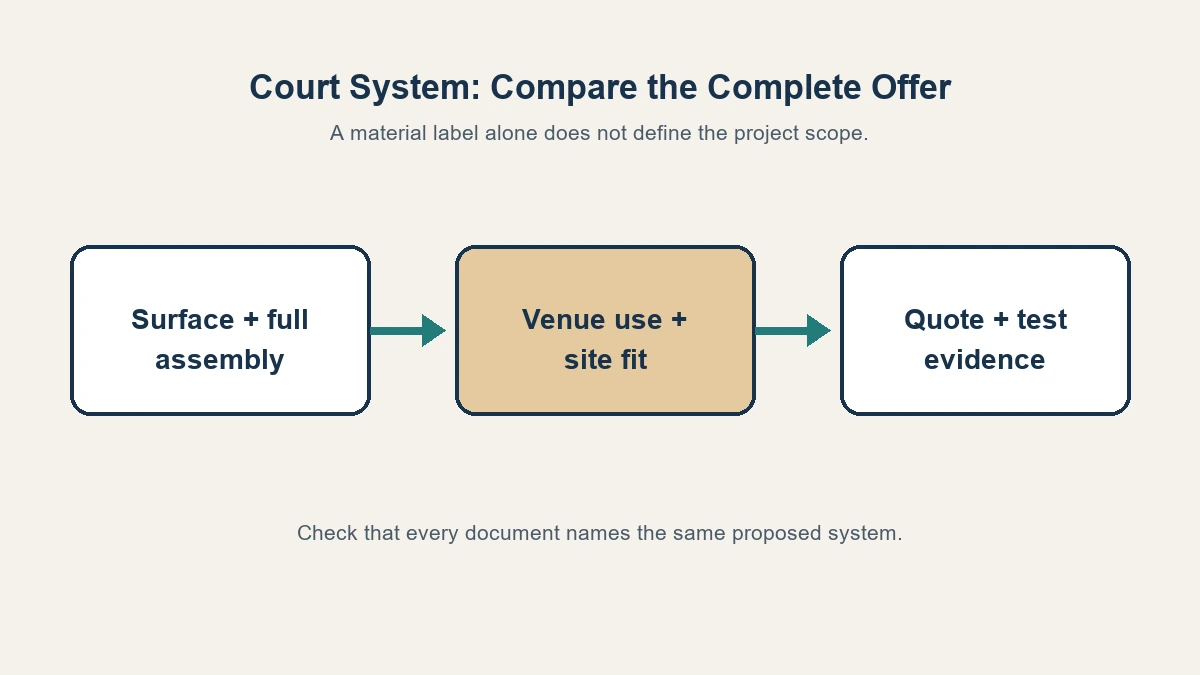
Compare systems by application, format, project coordination, maintenance scope, and the evidence a supplier can provide. A material label alone is not a specification. The FIBA Venue Guide discusses solid hardwood species and engineered wood as court-flooring options, and identifies durability, temperature, and humidity as selection factors. Use those factors to compare the proposed surface and full assembly against the venue’s operating conditions; a species name by itself does not specify the court.
| Decision factor | Hardwood sports-floor system | Modular or synthetic system | What to verify in the quote |
|---|---|---|---|
| Intended use | Confirm the proposed wood surface and complete assembly match the venue brief | Confirm the product is designed for the sports and events in the brief | Named system, intended use, and applicable documents |
| Format | May be specified for a permanent venue or supplied in a portable configuration | Product format and event use vary by system | Fixed or portable scope, assembly method, and storage plan |
| Site work | Review substrate, moisture, transitions, and installation sequence | Review substrate, transitions, and any required preparation | Inclusions, exclusions, drawings, and responsible trade |
| Operating ownership | Confirm cleaning, inspection, finish work, and service responsibilities | Confirm cleaning, inspection, replacement, and service responsibilities | Written maintenance documents and owner responsibilities |
| Evidence | Request system-specific test reports and technical documents | Request system-specific test reports and technical documents | Test method, tested assembly, date, and applicability to the project |
Supplier pages often describe their own products. Treat comparative statements as supplier claims until the quote identifies the system, the test basis, and the conditions. Ask each bidder the same questions rather than treating a broad product category as proof of performance. For an overview of LDK’s sports wood flooring systems, see LDK sports wood flooring systems.
Ask for a section drawing that names the proposed surface and each system layer. Check that the drawing, product data, test report, and installation scope refer to the same configuration. If a proposal offers an alternate, ask for a separate document set and price line; otherwise the team may compare a complete system with an incomplete scope. Record what the supplier assumes about the substrate and what work belongs to another trade.
3. Choose permanent or portable construction
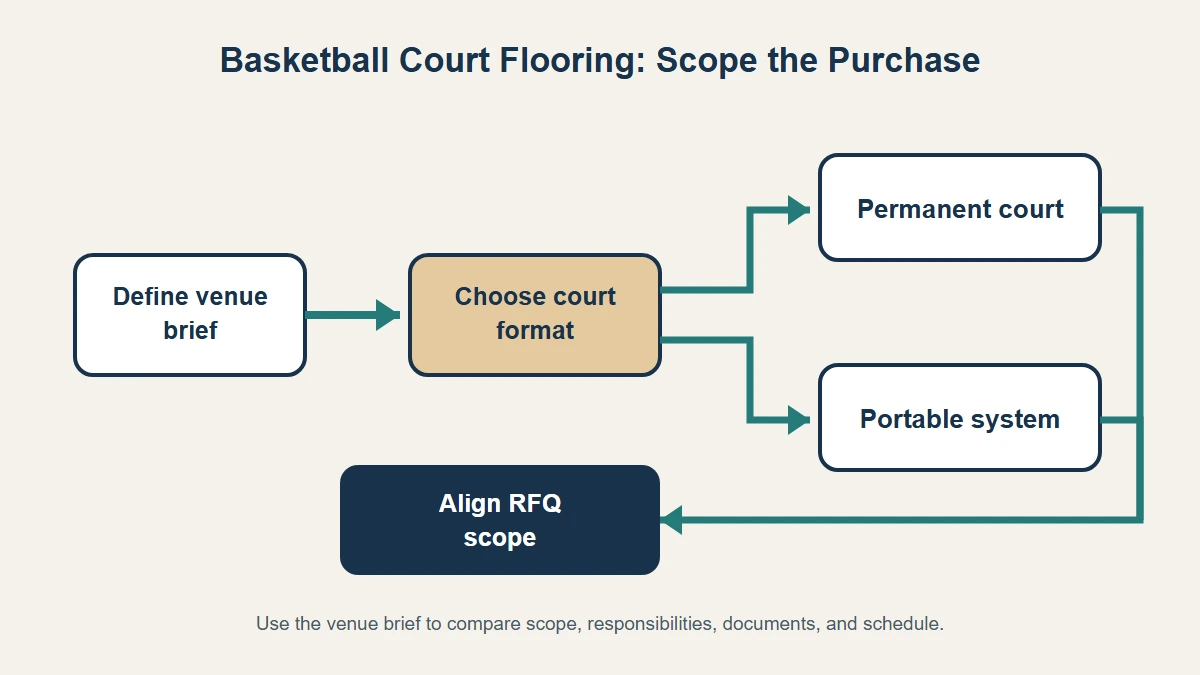
The operating calendar is the first filter. A permanent court is built around a dedicated venue. A portable system may fit a facility that changes its floor layout or hosts events requiring a temporary playing surface. Neither label answers who assembles the system, where it is stored, or what the slab must provide.
| If the venue… | Evaluate… | Put these questions in the supplier meeting |
|---|---|---|
| Keeps one court layout year-round | Permanent construction | What substrate preparation and installation work are included? |
| Converts the hall for other events | Portable construction | Who assembles, disassembles, labels, and stores the components? |
| Has a narrow event changeover | The full work sequence and labor scope | What access window and staging area are required? |
| Is renovating an existing facility | Site access and interface details | Who checks the slab, thresholds, transitions, and adjacent finishes? |
Request a drawing or system build-up for the proposed configuration. Confirm the shipping, unloading, staging, and storage plan before comparing totals. For portable systems, ask how parts are identified and what the venue must provide for assembly. For permanent systems, confirm how the installer coordinates with the slab and adjacent construction. These are scope questions; the design team should resolve project-specific structural and code requirements.
Also assign the event-day tasks. Identify who moves stored components, who inspects the surface after assembly, and who signs off that the hall is ready for use. A venue may have a supplier provide the system while its own team controls the changeover; the quote should state those boundaries. Ask the bidder to list any venue equipment, staging area, or access support the installation plan assumes.
4. Check the facility before specifying the floor
Make site readiness a line item in the project plan. The FIBA Venue Guide recommends a stable, level concrete base and a moisture membrane under wood to limit moisture rise. It also identifies firmness and levelness, consistent performance, resilience, and shock absorption as court-floor evaluation criteria. Put these criteria in the submittal review and ask each bidder for test documentation for the quoted system.
| Check | Primary owner to assign | Record before installation |
|---|---|---|
| Slab condition and levelness | Engineer and installer | Survey, project acceptance tolerance, corrective scope |
| Moisture and environment | Engineer, installer, and owner | Specified test method, readings, dates, ambient conditions, moisture-control detail |
| Floor build-up and transitions | Architect and installer | Section drawing, thresholds, doors, adjacent surfaces |
| Access and sequencing | General contractor and installer | Delivery route, staging, work window, trade handoffs |
| Acceptance documents | Owner and project team | Required test reports, product data, installation records |
If the slab review flags moisture, an uneven area, or a transition conflict, stop the flooring handoff until the engineer and installer record the test method, acceptance criteria, corrective scope, and approved detail in the submittal. That gives the owner a clear item to resolve before delivery.
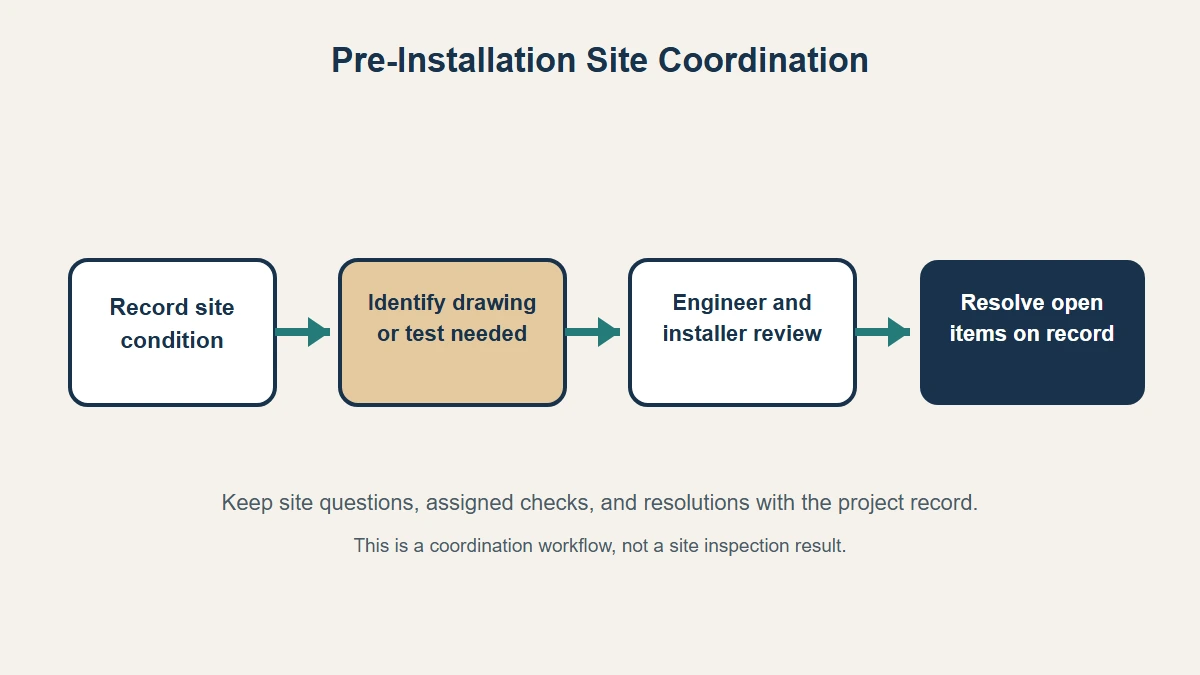
Before installation, require the project team to record the selected moisture test, slab acceptance range, environmental conditions, and approved floor detail. The FIBA guide supplies venue-design criteria; the project documents set the acceptance values for this site.
Use a hold-point sequence: the engineer or installer records the slab survey and moisture results; the project team reviews them against the accepted system detail; the responsible parties close any corrective work; and the owner releases the flooring delivery only after the submittal is complete. Put each record in the project file with the test date, area covered, method, reviewer, and decision. This gives the installer and owner one shared basis for the handoff without importing a generic tolerance into a site specification.
5. Build an RFQ suppliers can answer
Give every bidder the same project information and request the same breakdown. A useful quote describes the proposed system and scope clearly enough that the owner can compare inclusions, exclusions, documents, schedule, and maintenance responsibilities—not just a headline total.
| RFQ field | Information to provide or request |
|---|---|
| Court and use | Dimensions, drawings, sports, competition level, secondary uses |
| Format | Permanent or portable preference; storage and event-change requirements |
| Site | Slab records, moisture information, access, staging, adjacent transitions |
| System | Complete layer/build-up description and identified components |
| Installation | Preparation, installation, line work if applicable, cleanup, exclusions |
| Documents | System-specific technical data, test reports, installation instructions |
| Schedule | Lead-time assumptions, site readiness date, installation window, handoffs |
| Operations | Cleaning and maintenance documents, owner responsibilities, service scope |
| Commercial terms | Itemized inclusions, exclusions, payment milestones, warranty terms |
Ask suppliers to identify assumptions instead of filling gaps with estimates. If dimensions, slab records, or event dates are not final, label them as open items in the quote. Request alternates separately so a change in surface or format does not obscure a change in installation scope.
Do not use one online listing as a market price benchmark. Compare proposals only after aligning court area, system layers, preparation, line work, logistics, installation labor, documents, schedule, and exclusions. The project team can then decide whether a lower total reflects a different system, a narrower scope, or a different commercial assumption.
When bids arrive, move each response into the same comparison sheet. Mark each item as included, excluded, allowance, or owner-supplied; note the document that supports the quoted assembly; and list assumptions that need an answer. Keep alternates beside the base proposal instead of merging them into the headline total. This creates a useful sales discussion: suppliers can clarify scope differences, and the owner can make a decision with fewer hidden variables.
6. Plan maintenance and operating ownership
Name the person or team responsible for routine cleaning, event turnover, inspections, consumables, finish work, and maintenance records before the court opens. Request the floor and finish maker’s written instructions for the specified system. A school-floor user asked what supplies to use on a dusty wooden basketball floor. Put the answer in the operating handoff: name the approved products, equipment, cleaning owner, and source of the system instructions.
| Operating task | Assign an owner | Confirm in writing |
|---|---|---|
| Routine cleaning | Facility or custodial lead | Approved products, equipment, frequency, and training source |
| Event turnover | Event and facility teams | Access window, surface inspection, and handoff checklist |
| Periodic inspection | Owner or maintenance lead | Inspection points, record format, escalation contact |
| Finish or repair work | Qualified service provider identified by owner | Scope, compatible materials, schedule, and closeout records |
| Document control | Facility manager | Current system data, test reports, maintenance instructions, warranty terms |
Create the operating handoff before opening day. Give the maintenance lead the current product documents, approved equipment list, inspection contact, and process for recording service work. Put a review date on the calendar so the facility can confirm that the instructions still match the installed system after staff or operating schedules change.
Frequently asked questions
How much would it cost to build an indoor basketball court in my backyard?
Budget the building shell and sports-floor package as separate scopes. For the floor, compare the same court area, system build-up, slab preparation, playing surface, line work, delivery and staging, installation, documents, and maintenance handoff in every quote. Send each flooring supplier the same drawings and slab records; have a local building contractor price the shell separately.
Indoor Sport Court Tips/Regrets
Start with the activities, facility conditions, and operating calendar. Put them in a short use brief, then compare the proposed system and installation format against it. Confirm the system build-up, slab preparation, event-change plan, and maintenance handoff in the supplier quote.
Basement Sport Court! What would you do?
For a below-grade project, check moisture conditions, slab levelness, delivery access, and floor transitions before selecting the surface. Give the project engineer and installer the site records and proposed floor detail so they can resolve those items in the project documents.
Hardwood or laminate for indoor full basketball court?
A residential laminate label does not specify a basketball sports-floor system. Ask whether the proposed product is a complete assembly intended for court use, and require the supplier to identify its system build-up, applicable test documentation, installation scope, and maintenance instructions.
Has anyone built a home basketball court?
Define indoor or outdoor use and the activities first. Then prepare the court dimensions, site conditions, operating schedule, and permanent-or-portable preference. Use those inputs to request comparable supplier proposals; do not use anonymous crowd estimates as a project quote.
Conclusion
Before requesting proposals, bring together the use and competition requirements, facility drawings, slab and moisture records, operating calendar, installation format, access plan, and maintenance owner. Use that brief to compare hardwood and modular or synthetic systems, assign site checks, and ask each supplier for the same scope and supporting documents.
Prepare the project brief with drawings, court dimensions, intended use, competition level, site records, schedule, and permanent-or-portable preference. Send the same brief to each supplier so proposals cover a comparable scope. LDK is an indoor sports wood flooring system manufacturer.
References
- FIBA, Venue design — FIBA Venue Guide, accessed 2026-11-13. Supports the material-selection discussion, Level 1 and Level 2 playing-surface guidance, substrate and moisture notes, and general court-floor evaluation criteria. This source does not establish LDK-specific system performance or approval.