

Sports Equipment Manufacturer

Compare exact gym-floor finish systems by their manufacturer wording, color, schedule, and compatibility. Learn what to check in current TDS/SDS documents before a facility approves a product.
Choose the gym-floor finish whose current product documents specify the appearance, compatibility, and reopening schedule the facility needs. When comparing water based vs oil based gym floor finish options, read the formulation, resin, and system instructions for the exact product.
AI-generated concept illustration of a generic indoor hardwood gym; not an LDK project or finish sample.
“Waterborne” and “oil-modified” can describe different parts of one finish. Hillyard describes its 1907 Gym Finish as an oil-modified urethane in a waterborne formulation, so the same product carries both descriptions.
That distinction matters when you compare gym floor finishes. A broad label does not tell you the exact color, odor, recoat interval, return-to-play date, or full-cure schedule. Those details belong to the named product and its complete application system.
| Wording in a product description | Hillyard 1907 example |
|---|---|
| Formulation | Waterborne formulation |
| Resin | Oil-modified urethane |
Hillyard’s sports-floor finish guide also separates its solvent-based and water-based product lines and gives product-specific descriptions.
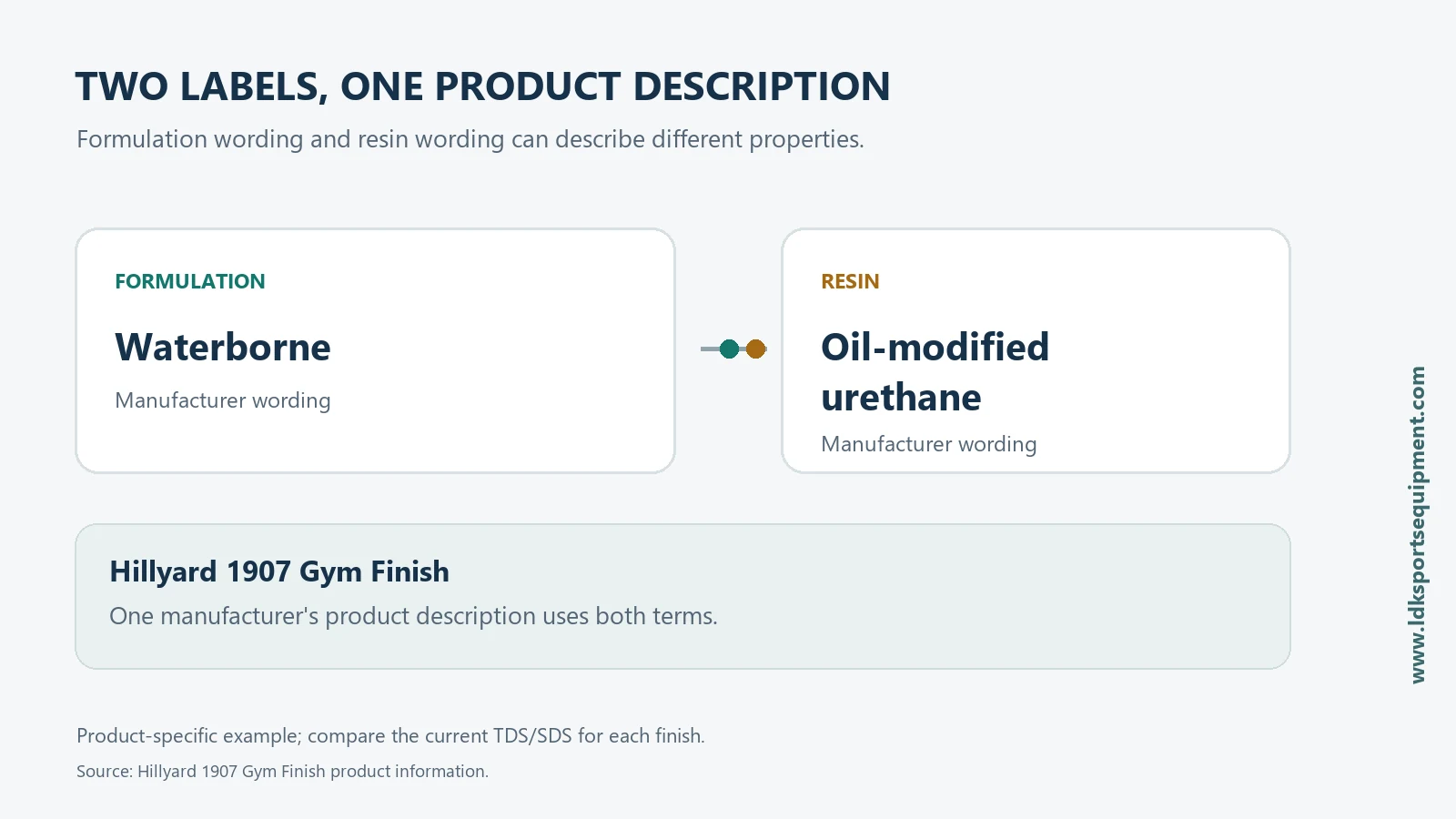
Product-specific label example from Hillyard 1907; not a performance comparison.
Two manufacturer examples show why product documents are more useful than a simple water-versus-oil ranking.
| Product example | Manufacturer’s chemistry wording | Listed color | Product-specific facts in the cited document |
|---|---|---|---|
| Bona Sport® Poly | Oil-modified polyurethane resin; ingredients include mineral spirits and driers | Light amber and clear | US regulatory VOC under 450 g/L; solvent odor; drying time 12–16 hours under recommended coverage and ideal conditions; approximate cure time 14 days |
| Hillyard 1907® Gym Finish | Oil-modified urethane in a waterborne formulation | Light amber | VOC under 190 g/L; low odor; recoat in 4–6 hours without abrasion between coats |
These are manufacturer-specific examples, not a controlled head-to-head test. Bona’s 2026 Sport Poly technical data sheet and Hillyard’s 1907 product information do not report every property under the same conditions. Hillyard’s cited product page reports a recoat interval; it gives no return-to-play or full-cure time.
Bona describes Sport Poly as a four-coat system: one or two Bona Sport sealer coats, game-line paint as applicable, and two Sport Poly coats. This is that product system’s stated sequence, not a coat-count rule for oil-modified finishes generally.
The VOC and odor entries are manufacturer statements for those products, not measurements of a facility’s air. Read them with the current technical data sheet (TDS), safety data sheet (SDS), application conditions, and venue requirements. Compare the current TDS and SDS for the exact coating before choosing between water-based and oil-based finishes in the sports flooring technical resourcessports flooring technical resources.
A recoat interval tells you when the next coat may be applied under the product’s instructions; it does not tell you when athletes can return or when equipment can go back on the floor.
For Bona Sport Poly, the 2026 TDS lists 12–16 hours drying under recommended coverage and ideal conditions and an approximate 14-day cure. It recommends application at 65–80°F and 40–60% relative humidity, and says high humidity or low temperature extends dry time. The document says the floor may be walked on after 48 hours while remaining susceptible to scuffing or marring, and its application instructions call for the final coat to dry at least 72 hours before use. It also says not to wet-clean during the first week and not to replace athletic mats or area rugs until the finish has fully cured. Confirm which milestone governs athletic play, equipment, and floor coverings in the project schedule. The reopening schedule and cleaning restrictions should be recorded with the court care plan in the gym floor maintenance checklistgym floor maintenance checklist.
Hillyard lists a 4–6 hour recoat interval for 1907 Gym Finish, without abrasion between coats. That is a recoat instruction, not a published reopening or full-cure date in the cited product page. If the stated interval is missed, use the manufacturer’s current surface-preparation instructions instead of extending the no-abrasion note beyond its stated window. Put each milestone in the written project schedule instead of comparing unlike numbers.
| Schedule item | What to confirm in the product documents |
|---|---|
| Recoat | Minimum interval and whether abrasion is required between coats |
| Light foot access | Earliest permitted access and any restrictions |
| Return to athletic use | The manufacturer’s stated conditions for play, not just a dry-to-touch or recoat time |
| Mats, goals, and equipment | When each may be returned without harming the finish |
| Full cure and cleaning | Cure period, cleaning restrictions, and the point when normal maintenance may resume |
The cited Bona and Hillyard examples both list a light-amber appearance, so those products do not support the shortcut that every waterborne finish stays clear or every oil-modified finish looks darker.
If wood tone or painted game lines matter, compare the finish over the proposed sealer and line paint. Bona’s TDS says to prepare a sample or test area to determine compatibility, appearance, and the desired result. It also gives separate instructions for line paint and calls for a compatibility and adhesion sample when a different manufacturer’s paint is used. For proper adhesion, the same TDS directs abrasion between all finish coats.
Before approving a system, confirm the named sealer, court-line paint, topcoat, intercoat preparation, and recoat windows together as one sequence.
Use a representative sample to check four things:
Select the product whose written instructions match the facility’s documented appearance, compatibility, schedule, and use requirements.
| Facility priority | Compare in the current product documents | Ask before approval |
|---|---|---|
| Wood tone and line visibility | Listed color and a sample over the actual sealer and game-line paint | Can the full proposed system be tested on a representative area? |
| Tight reopening window | Recoat, light foot access, return-to-play, equipment, and cure milestones | Which date permits athletic use, and what restrictions apply before then? |
| Odor or indoor-product requirements | Product-specific VOC, odor, SDS, and application conditions | What ventilation, occupancy, and protective measures do the product instructions require? |
| Traction or performance specification | The exact listed test, value, and finished-floor test method | Does the evidence address the installed finish system and the facility’s required test? |
| Budget | A written quote with product, preparation, coats, labor, and schedule shown separately | Are both proposals priced for the same floor condition and system scope? |
For a fixed reopening date, first match the written return-to-play and equipment milestones to that date; a short recoat interval alone is not enough. When the shutdown window is flexible, compare the full system, sample appearance, documented cure restrictions, and itemized quote together.
The Bona TDS, for example, lists a coefficient of friction of 0.5–0.7 and says the product meets MFMA standards. That is a statement about this product document; it is not a direct comparison with Hillyard 1907 or a category-wide traction result. Match any performance claim to the test and finished-floor specification required for the venue.
Ask for the exact product names and current TDS/SDS, plus one written schedule that identifies preparation, sealer, court-line paint, each finish coat, recoat windows, permitted athletic use, equipment return, and full cure. A comparable quote should show product and labor assumptions separately and use the same floor condition and scope for every bidder. Compatibility depends on the existing coating and preparation; the gym floor refinishinggym floor refinishing scope should name the exact finish system.
LDK uses professionally imported sports-floor coating from the United States. For an inquiry about a complete wood sports-floor system, send the venue use, project schedule, and finish documentation under consideration through the LDK contact page.
Neither label identifies a universal winner. Choose the exact product whose documented appearance, compatibility, application schedule, and facility requirements fit the project.
Gym-floor products use different documented formulations and resin descriptions. Compare the exact sports-floor finish and its complete system instructions rather than assuming all gym floors use one chemistry.
Waterborne products can have different colors, application conditions, recoat intervals, odors, and cure schedules. Check the chosen product’s TDS/SDS for those details.
The details depend on the product. Bona Sport Poly’s TDS lists solvent odor and a product-specific cure schedule, but that does not describe every oil-modified finish.
Request written quotes for the same floor condition and work scope. Compare product, preparation, number of coats, labor, schedule, and the time the facility must remain closed; no current comparable price was verified for this article.
Choose the exact finish system by its current manufacturer documents, not by the water-based or oil-based label alone. Compare appearance, layer compatibility, application conditions, recoat and return-to-play milestones, and a written quote for the same floor scope before approving the work.
