

Sports Equipment Manufacturer

Choose an indoor basketball floor by competition rules, venue use, substrate, and system evidence. Use this checklist to compare complete proposals.
Choose indoor basketball court flooring as a complete sports system: wood for a dedicated court, glass where the event brief requires it, or a permitted synthetic sports system for a shared gym. Match the assembly to daily use and site conditions. School and university buyers need this before requesting prices.
A home recreation kit and an institutional competition floor can answer different needs even when both are sold as indoor basketball court flooring.
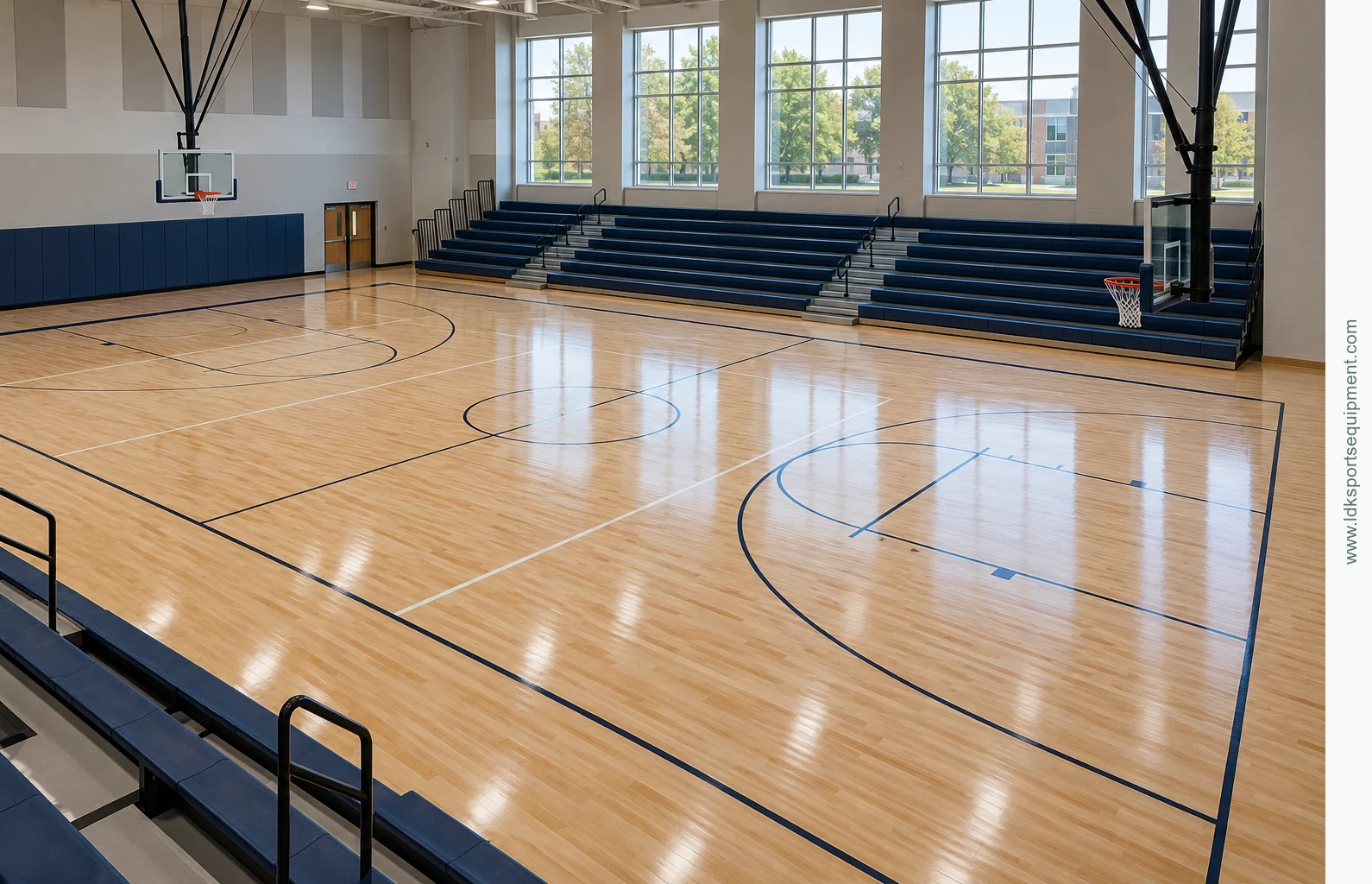
AI-generated concept illustration; not a specific venue or LDK product model. Court lines are illustrative.
The governing competition determines which surfaces and approvals belong in the brief. Under the 2026 FIBA equipment rules, Level 1 covers FIBA national-team and club competitions plus other elite competitions; Level 2 covers competitions outside Level 1.
| FIBA competition | Permitted floor categories | Approval position |
|---|---|---|
| Level 1 | Permanent or mobile wood or glass | FIBA-approved equipment is required; national competitions may have additional rules |
| Level 2 | Permanent or mobile wood, glass or synthetic | Technical specifications must be respected; FIBA approval is strongly recommended |
For FIBA events, the minimum entire playing-floor footprint is 32,000 × 19,000 mm, with an antiglare surface. This includes space around the 28 × 15 m marked court; it is not the marked court’s size. The FIBA Venue Guide explains the surrounding boundary area. Record the actual event rules and local building requirements for a school or community venue rather than assuming its label defines a FIBA level.
Three operating decisions narrow the shortlist:
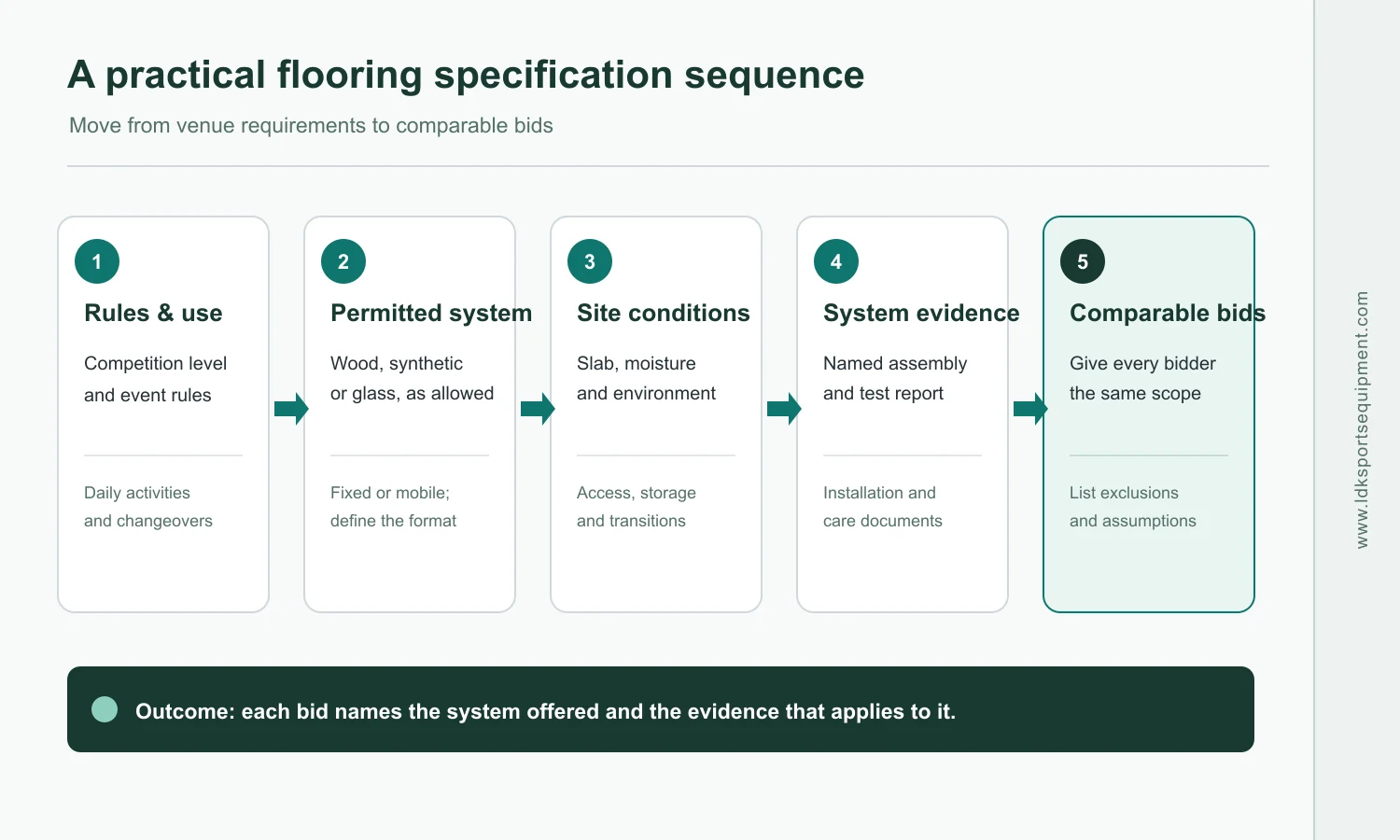
A decision sequence for defining a complete floor system before requesting bids.
This shortlist separates wood from the synthetic sports formats described in FIBA’s venue guidance. Compare each complete system, including the layers beneath its finish.
| Flooring category | Useful selection question | Specify in the proposal |
|---|---|---|
| Wood sports floor | Is the venue prioritising a wood playing surface for dedicated basketball or a competition requirement? | Wood species and grade, solid or engineered format, support construction, fixed or mobile layout, finish and markings |
| Sports PVC or PU system | Does a shared-use gym need a purpose-built synthetic playing surface permitted by its governing event? | PVC roll or PU construction, resilient support, joints, finish, tested assembly and cleaning procedure |
| Modular PP sports tiles | Is a modular synthetic sports surface suitable for the planned use and event rules? | Tile design, underlay, perimeter transitions, expansion detail and evidence for the whole sports-floor assembly |
| Glass sports floor | Does the competition or event brief call for a glass system? | Applicable approval, complete construction, operating requirements and installation scope |
PVC rolls, PU systems and polypropylene tiles are distinct products, not interchangeable versions of one specification. A wood-grain appearance also says nothing by itself about sports performance. Compare a named athletic system instead of decorative flooring chosen only for its appearance.
For indoor basketball court wood flooring, hard maple is a useful starting point. The Maple Flooring Manufacturers Association identifies northern hard maple as a predominant indoor athletic surface and also recognises beech and yellow birch. FIBA’s venue guide discusses maple, beech, oak and ash, as well as engineered wood. State the species and grade; a common choice is not a rule for every venue.
Two wood floors can have similar faces but different support layers, fixing methods and total heights. A basketball court flooring system specification identifies the construction above the slab.
The assembly drawing and proposal should identify:
Request the system-specific expansion, acclimation and fixing details with the assembly drawing. A report for a different support construction does not become equivalent simply because the surface species matches. For the material-format distinction, see solid versus engineered sports flooring.
Site readiness is a release decision before flooring delivery and installation. Keep a dated record of the following items against the selected manufacturer’s instructions:
| Site item | Record before release |
|---|---|
| Slab and available height | Survey of levels, cracks and surface condition; build-up allowance at doors and transitions |
| Moisture | Test method, test locations and results, plus the selected system’s acceptance criteria and moisture-control detail |
| Indoor environment | Operating ventilation or environmental controls and the conditions required for material storage and installation |
| Building enclosure | Weather-tight roof and openings; completed wet or overhead work that could affect the floor |
| Access and storage | Delivery route, unloading and storage space; conversion and load-distribution plan for a mobile floor |
LDK’s wood-floor site-entry instructions call for doors, windows and glass to be installed before work, with closures that keep rain out. The same LDK instructions require a clear handling route and space to store flooring and tools. Record enclosure sign-off before booking delivery so rain protection is in place when the boards arrive.
The hold point is a documented site release to the installer. Unresolved leaks, incomplete overhead work or an unavailable storage route need a named owner and a resolution date before delivery is scheduled.
A performance submission identifies the tested assembly, method, edition, results and offered system. FIBA’s equipment rules require the manufacturer and installation company to provide customer documentation covering prototype testing, installation, maintenance and inspection or approval results. Use it to organise the submission, not an unlabelled certificate image.
| Document | Acceptance question |
|---|---|
| Assembly drawing and product schedule | Do the surface, support layers, finish and fixed/mobile configuration match the proposal? |
| Performance report | Are the sample, test method, edition, report date and relevant results identified? |
| Installation instructions | Do they apply to this construction and the recorded substrate and environmental conditions? |
| Competition approval, when applicable | Does its product and configuration scope match the offered assembly and event requirement? |
| Handover records | Are installation inspection, maintenance instructions and responsibilities included? |
The FIBA performance tables address properties including force reduction, vertical deformation, ball rebound and slip resistance. Compare results against the applicable table and system type; do not substitute a value copied from a different construction. The FIBA-certified flooring guide explains approval-scope checks in more detail.
ASTM F2772-24 is listed as an active specification for athletic performance properties of multipurpose indoor sports-floor systems. Its public listing provides the scope, not the complete requirements. A project naming that standard needs the applicable edition and report for the proposed system.
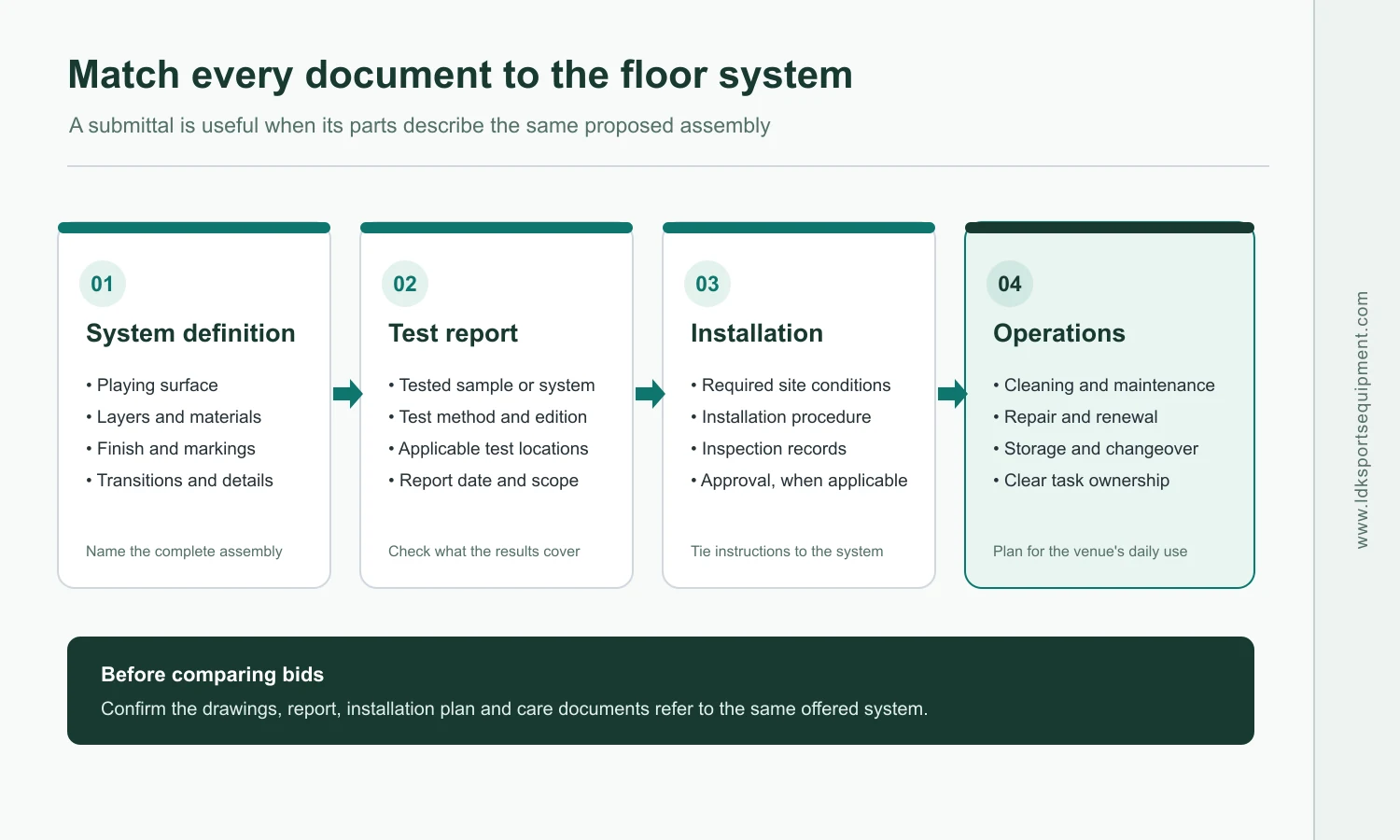
The drawing, test report, installation plan and care documents should identify the same proposed system.
A maintenance handover names the tasks, products, equipment, intervals and responsible person. FIBA’s venue-operations guidance discusses preventive maintenance, prompt removal of spills and renewal work on wood floors. Its guidance recommends annual screening/seal renewal and gives approximate re-sanding/recoating intervals of ten years for permanent wood floors or four to five years for portable floors, depending on use and manufacturer recommendations.
Tarkett’s basketball guide notes that maple needs refinishing, while resilient surfaces such as vinyl do not typically need it. Both still need compatible cleaning and protection; use the supplied system’s care schedule.
Put every bid against the same scope before comparing the total. Use these fields on the comparison sheet:
| Comparison field | What the bidder must identify |
|---|---|
| Competition fit | Permitted surface category and applicable approval or event requirements |
| Complete assembly | Surface, support layers, finish, markings, interfaces and accessories |
| Site readiness | Slab, moisture, environment, access and storage prerequisites; responsibility for remedial work |
| Evidence | Matching report, assembly description, installation instructions and approval scope |
| Programme and handover | Installation sequence, inspections, care plan, training and venue downtime |
| Commercial scope | Included work, allowances, warranty coverage, exclusions and claim conditions |
For replacement work, separate the floor assembly from old-floor removal, slab repairs, installation, markings and protection. A material-only rate and a complete replacement quotation describe different scopes. The basketball flooring cost guide covers budget planning; this checklist keeps the priced work consistent. For an outdoor project, use the outdoor basketball surface material guide.
Wood is a strong starting point for a dedicated basketball gym; a shared-use venue can also evaluate purpose-built synthetic sports systems allowed by its event rules. For FIBA Level 1, wood or glass and the required approval apply. Level 2 also permits synthetic flooring; technical specifications must be respected and FIBA approval is strongly recommended.
Hard maple is a common indoor athletic-floor choice, particularly in North America. FIBA also discusses beech, oak and ash. The specification still needs the actual species, grade, surface format and support assembly, so a timber name alone is not a complete sports-floor description.
A replacement budget includes the floor system, removal, slab correction, installation, markings and protection where required. A material-only price omits that work. Use the basketball flooring cost guide for scope and budget factors.
Share the venue type, competition level, floor dimensions, substrate information and fixed or mobile requirement with LDK. Include planned non-sport activities and any available assembly or test documents so the discussion can focus on a complete wood sports floor for basketball and its installation scope.
Sources reviewed 22 October 2026. LDK site-entry details were checked against its wood-floor installation instructions. Confirm requirements for the named event and supplied system.
