Sports Equipment Manufacturer

Padel Court for Pickleball Sport Club combines the characteristics of tennis and squash and is played on Panoramic Padel Courts.
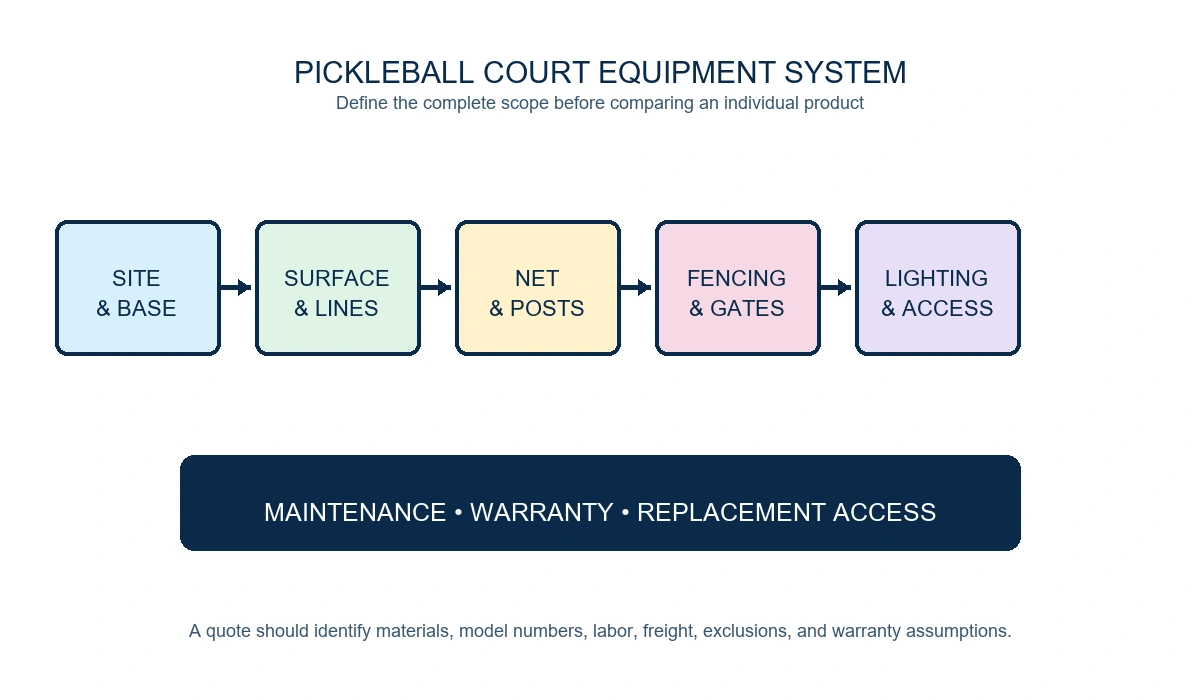
Pickleball court projects are not defined by one net, one paddle, or one type of sports flooring. A usable facility is a coordinated system that includes the site, base, playing surface, lines, net, fencing, lighting, access route, and maintenance plan.
That distinction matters to clubs, schools, parks, developers, contractors, and equipment buyers. A product may look attractive on its own but still be the wrong fit if the slab, drainage, clearances, access, or replacement plan has not been resolved. This guide explains what belongs in a pickleball court equipment package, how to compare products, and how to prepare a more useful request for quotation.
A permanent or semi-permanent court normally involves more than the playing surface. Start with these groups:
| Equipment or scope group | What it affects | What to specify in a quote |
|---|---|---|
| Site preparation and base | Level, drainage, stability, and surface life | Existing condition, excavation, grading, sub-base, compaction, drainage work |
| Court surface and lines | Traction, appearance, maintenance, and play consistency | Surface system, substrate, coating, colors, line method, repair process |
| Net and posts | Play setup and daily durability | Permanent or portable use, post anchoring, net material, replacement parts |
| Fencing and gates | Ball containment, security, and access | Height, mesh, posts, gate width, locks, court separation |
| Lighting | Evening visibility and player comfort | Fixture layout, controls, glare/shadow approach, electrical scope |
| Accessibility and amenities | Usability for players and spectators | Accessible route, gates, seating, shade, signage, maintenance access |
This system view is consistent with the way public projects are written. For example, an Ephraim City request for bids lists site preparation, grading, a cement surface, fencing and gates, line painting, slip-resistant coating, and ADA considerations within the project scope. It also asks bidders to identify materials, model numbers, warranties, labor, and freight rather than hiding all of those details inside a single product name. See the Ephraim City request for bids.
LDK Sports Equipment can be included in a supplier conversation when buyers need to compare court-related equipment and flooring options against a defined site scope.
One of the most common planning mistakes is treating the painted lines as the whole site. USA Pickleball documents a standard court as 20 feet wide by 44 feet long. The same construction guidance recommends a total playing surface of at least 30 by 60 feet and prefers 34 by 64 feet where space allows. Review the USA Pickleball construction guidance and the Official USA Pickleball Rulebook.
These numbers answer different questions:
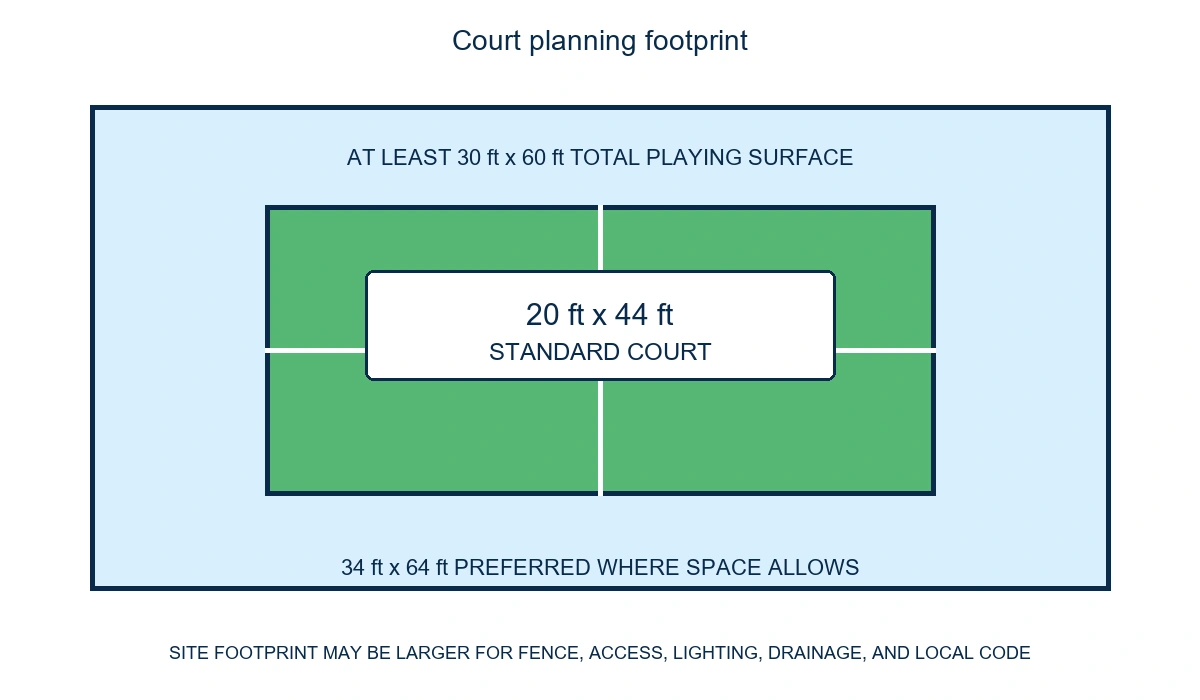
The construction footprint can be larger again. Fences, gates, lighting poles, electrical runs, accessible routes, spectator space, setbacks, drainage, landscaping, and local code all influence the plan. Before ordering products, draw the court, the recommended clearance, and the service/access areas as separate layers.
For a multi-court venue, also decide whether courts share fencing, whether internal dividers are needed, and how players move from parking or a building to the court. Those decisions affect the quantity and placement of products more than a catalog comparison does.
Flooring is often the most visible product decision, but it should be evaluated after the base and water-management conditions are understood. USA Pickleball’s construction guidance describes a hard, debris-free surface as suitable for outdoor gameplay and discusses surface planning together with lighting and the surrounding playing area. It does not certify every commercial flooring product or guarantee a particular performance result.
Use the following questions when comparing pickleball court flooring:
The old article associated a TPE flooring idea with FIBA approval, shock absorption above 35 percent, a temperature range, and comparative softness. Those statements are not carried into this upgrade because the current evidence package does not verify a pickleball-specific certification, independent performance test, or LDK product specification for them. A responsible supplier comparison should attach the actual technical sheet and test conditions to each claim.
LDK’s existing badminton-floor reference can be used as a starting point for a cross-sport flooring discussion, but buyers should request product-specific documentation for the intended pickleball court.
The net is a small line item compared with site work, but it determines whether the court can be set up and maintained as intended. Decide early whether the venue needs a permanently anchored system or a portable court kit. A portable net may suit temporary programming or shared spaces; a permanent venue normally needs a clear anchoring, storage, and replacement plan.
Specify the net and post package by function rather than by a generic “pickleball set” label:
Fencing also needs a site-specific brief. Ask whether it is intended for ball containment, security, wind control, or court separation. Identify fence height, mesh, corner posts, gates, locksets, maintenance access, and any conflict with lighting or accessible routes. If several courts share a venue, ask for a drawing that distinguishes perimeter fencing from internal separation fencing.
The Official Rulebook is the right place to check playing specifications. A construction quote should then explain how its proposed hardware will be installed, accessed, maintained, and replaced. A rulebook dimension is not automatically a complete fence or foundation specification.
Lighting should be considered with the court orientation, poles, neighboring properties, and player sightlines. USA Pickleball’s construction guidance emphasizes solutions that reduce shadows and glare. Use that guidance as the starting reference for lighting questions; ask a qualified designer or contractor to confirm the electrical and local-code requirements for the actual site.
The same principle applies to drainage and accessibility. A surface can be specified correctly and still perform poorly if the base moves or water remains on the court. Include these questions in the project brief:
These are planning questions, not promises that a particular product will solve every site condition. Local permitting, accessibility rules, electrical work, and structural or civil design should be confirmed for the project location.
There is no responsible universal price for “a pickleball court” without knowing the site, court count, base, drainage, amenities, labor market, design, permits, and contingency. Public project documents are more useful as bounded examples than as a price list.
A City of Gilroy staff report for the Las Animas Veterans Park project shows how wide the scope can be. Its estimate table lists approximately $795,329 before contingency for one four-court concept and approximately $1,087,546 before contingency for one six-court concept. The concepts include more than painted lines: the report discusses concrete or asphaltic-concrete options, fencing, lighting, accessibility, landscaping, seating or cabana elements, and related improvements. Read the City of Gilroy staff report.
Those figures are a project-specific planning example, not a universal market rate. A practical budget worksheet should separate:
| Budget bucket | Questions to answer |
|---|---|
| Investigation and design | Survey, geotechnical work, civil design, permits, and approvals |
| Site and base | Demolition, excavation, grading, drainage, sub-base, and compaction |
| Court system | Slab or surface, coating, colors, lines, nets, and posts |
| Perimeter and access | Fencing, gates, locks, accessible paths, and court dividers |
| Electrical and lighting | Poles, fixtures, controls, trenching, connection, and inspection |
| Amenities and closeout | Seating, shade, landscaping, signage, cleaning, testing, and contingency |
When comparing quotes, ask each supplier or contractor to use the same buckets. That makes it easier to see whether a lower price excludes drainage, lighting, freight, installation, warranty service, or site repair.
Before contacting a pickleball court equipment supplier, prepare a one-page project brief with:
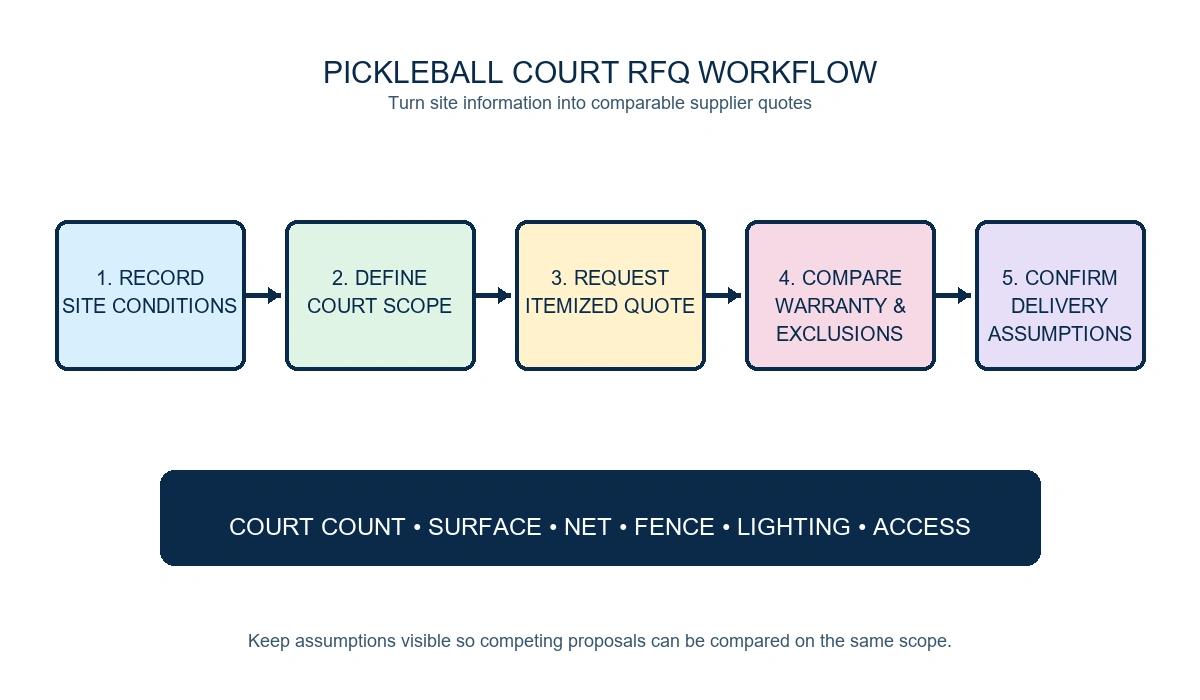
Ask for a line-by-line quote rather than a single “court package” total. The Ephraim bid example is useful here because it shows how a public buyer can request component information, warranties, and separate equipment/material/labor/freight details. The exact scope will vary, but the discipline makes competing proposals easier to compare.
LDK Sports Equipment may be contacted for a product and flooring discussion after the project details, required documents, and quote scope are prepared.
The opportunity in pickleball court products is real at the project level, but the buying decision should begin with the complete court system. Confirm the playing dimensions and planning footprint, then resolve the base, drainage, surfacing, net, fencing, lighting, access, maintenance, and quote exclusions.
Use official playing and construction guidance for dimensions and planning principles. Use public bid and staff-report documents as examples of scope and budgeting, not as universal specifications or prices. Finally, ask every supplier to support product claims with current technical documents that match the intended court.
USA Pickleball documents a standard playing court as 20 feet by 44 feet. That is different from the larger surrounding playing surface and the complete construction footprint. USA Pickleball construction guidance.
USA Pickleball recommends at least a 30-by-60-foot total playing surface and prefers 34 by 64 feet where space allows. Add room for fencing, gates, access, lighting, drainage, setbacks, and local requirements.
Plan for site preparation and base work, surfacing and lines, net and posts, fencing and gates, lighting, access and amenities, and a maintenance plan. The exact package depends on the site and local approvals.
It depends on site conditions, court count, surfacing, drainage, lighting, fencing, amenities, design, labor, and contingency. A Gilroy public-project report provides bounded four- and six-court planning examples, but its figures should not be reused as a universal price.
Ask for product/model details, technical documents, installation and freight scope, warranty, lead time, exclusions, maintenance requirements, and the assumptions behind every performance or cost statement.
Treat LDK product pages as first-party product references and confirm the current model, technical sheet, warranty, and intended use before making a purchasing decision.
A useful inquiry should include the court count, site conditions, surface preference, required accessories, and delivery assumptions so the conversation can stay within a defined scope.