

Sports Equipment Manufacturer

Specify squash court wood flooring as a complete assembly. Learn how to compare system evidence, verify grip and finish, and prepare a like-for-like supplier request.
Squash court wood flooring should be specified and reviewed as a complete, tested assembly—not by wood species or a label such as “anti-slip” alone. The bid package should include current World Squash Federation (WSF) approval and test documents identifying the exact floor construction, surface finish, and sub-layers being quoted; those records should match both the sample and the delivered system.
The playing surface is only one part of a squash floor. The system may also include its coating or finish, support construction, resilient components, joints, fixings, and the interface with the prepared subfloor. These parts affect how the finished court behaves together, so a product name or timber sample cannot describe the whole assembly.
A comparable bid package starts with a section drawing and bill of materials for the proposed system. The drawing should name the surface construction, support or subfloor components, finish, and any underlayers. Each bidder should identify which components are included in its quotation and which are supplied or prepared by others. The package should also state total finished-floor height and transitions at doors or adjoining surfaces; the sample and performance documents should describe that same configuration.
Before comparing offers, require three matching submittals:
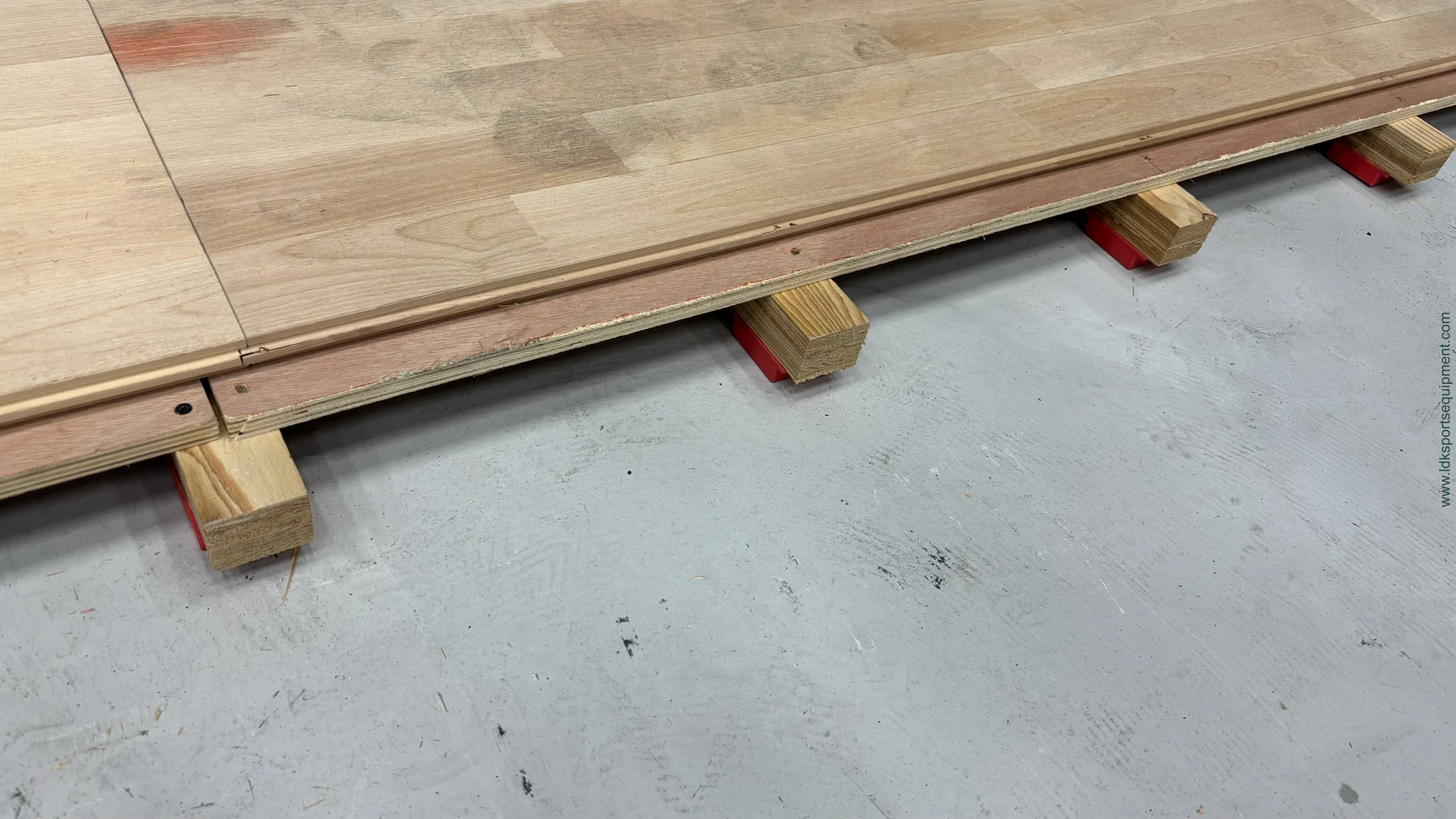
Rendering of a squash-floor assembly. Use the supplier’s drawing and product documents to identify the components in the project-specific system.
This distinction matters when comparing a solid timber system with an engineered construction, or when a supplier proposes a different support arrangement. Neither description by itself establishes WSF approval. The WSF specification treats accreditation as specific to the product configuration tested, including its construction, materials, finish, coatings, surface treatments, and sub-layers. A change to the system can make the original evidence inapplicable.
The WSF Specification and Test Methods for Squash Flooring, Edition 6, references performance tests for force reduction, vertical deformation, friction, gloss, ball rebound, impact resistance, and other floor characteristics. The test-method reference tells you how a property is assessed; it does not by itself prove that a particular floor passed or that a supplier’s proposed model is accredited. The review should include the approval certificate and supporting report. Cross-check the product identity, configuration, issue or validity details, and any stated conditions.
The table below summarizes the Edition 6 criteria in its performance table. Before procurement, the project team should confirm the current edition and applicability with WSF, then decide how test results will enter the contract and site-acceptance process.
| Property | Test method cited by WSF | Edition 6 performance criterion |
|---|---|---|
| Force reduction | EN 14808 | Area 40–75%; point 25–75%; mixed and combined 45–75%; uniformity ±5% of average |
| Vertical deformation | EN 14809 | Area 1.5–5.0 mm; point and mixed ≤3.5 mm; combined 1.5–5.0 mm; uniformity ±0.7 mm |
| Friction | EN 13036-4 | Dry average 80–110; wet average 55–110 (the WSF table does not show a unit beside these averages) |
| Specular gloss | EN ISO 2813 | ≤30 GU |
| Ball rebound | EN 12235 | ≥40%; uniformity ±7.5% |
| Impact resistance | EN 1517 | ≤0.5 mm residual indentation |
| Construction gaps | WSF method | ≤2.5 mm |
“Area-elastic,” “point-elastic,” “combined-elastic,” and “mixed-elastic” describe different ways a floor responds to load. They are not interchangeable marketing adjectives. The WSF document, for example, describes sprung wooden floors as an area-elastic construction. A supplier should state its claimed classification and provide the assessment for the complete submitted assembly.
The current WSF document also specifies what must be included in an accreditation dossier, such as the technical data sheet, installation manual, maintenance guidance, and warranty. Request the documents that apply to the offered product and retain their identifiers with the project specification. See the official WSF specification and test methods, Edition 6.
There is no universal winner between solid and engineered squash flooring. The useful comparison is between complete systems that meet the venue’s requirements and have evidence for the exact construction and finish offered.
Compare proposals against the same questions:
The RFQ should require each bidder to state the timber species and construction in writing instead of relying on a generic “hardwood court” description.
Supplier examples include beech, maple, ash, and oak on Junckers’ squash flooring page; Racquet Sports Institute also lists hevea. These are supplier-listed options, not a performance ranking or proof of WSF approval.
Friction evidence should cover the exact surface and finish proposed. The report should identify the test method and specimen or product configuration, and the review sample should be traceable to the same finish. Use this three-step check:
Words such as “anti-slip,” “matte,” “natural,” or “unsealed” do not demonstrate that a floor meets the WSF friction criteria. A visual inspection can identify obvious finish differences or damage, but it cannot replace the specified test. Include cleaning products, maintenance intervals, and any restrictions on polish or coating in the handover documents, since later treatment can alter the playing surface.
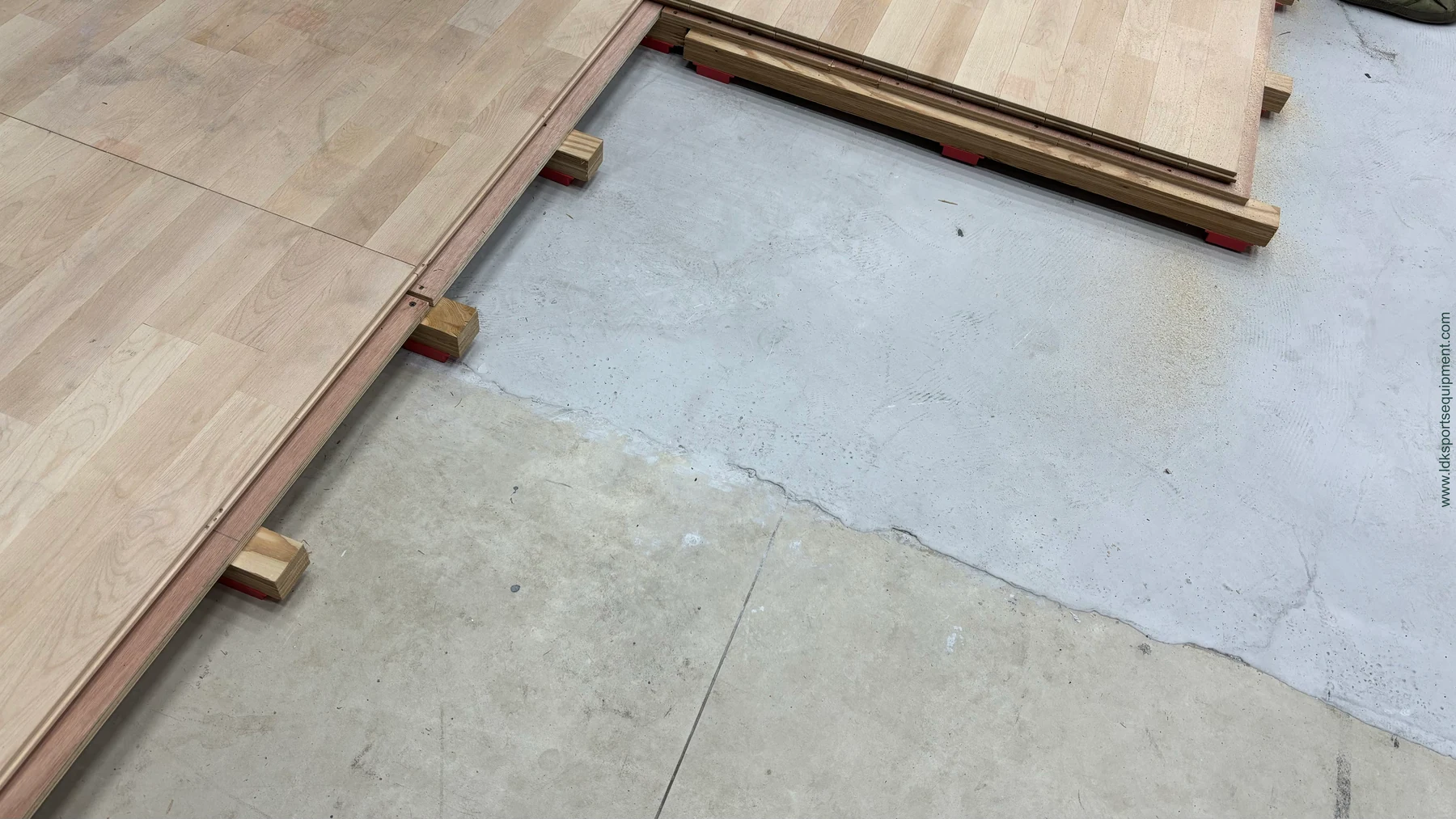
Rendering of floor components at an assembly edge. The proposed layers should be compared with the system drawing, approval documents, and sample.
For a project-specific overview of the product scope, see LDK’s squash court wooden flooring listing. The listing is a product inquiry starting point; it is not evidence that a particular model has WSF accreditation.
Give every bidder the same information and ask for a response in the same format. That makes it possible to compare a test result with the system actually offered instead of with a vaguely similar product.
| RFQ item | What to state or request |
|---|---|
| Venue and use | Court format, intended play and competition use, project location, and any governing-body requirements |
| Proposed system | Section drawing, named components and materials, surface construction, timber species, support arrangement, finish, and included scope |
| Performance evidence | Current certificate and test reports; product identity or unique code; configuration tested; test methods, results, issue/validity details, and limitations |
| Site conditions | Subfloor flatness and moisture checks, environmental requirements, acclimatization, finished floor height and transitions, and readiness criteria before installation |
| Sample | A sample of the exact proposed surface and finish, with product or batch identification and a process for approval |
| Installation | Installation method, tolerances, perimeter movement gaps and wall/tin interfaces, exclusions, inspection points, and responsibility for site preparation |
| Maintenance and warranty | Written cleaning and maintenance instructions, repair/recoating guidance, warranty terms, and the effect of later changes |
| Acceptance record | Agreed document review, visual/workmanship checks, test or inspection responsibility, and records to be handed over |
For background on the wider project scope and cost factors, see the guide to how much it costs to build a squash court and planning a glass squash court. These pages cover court projects more broadly; use the floor-specific checklist above when comparing flooring offers.
Before work starts, align the approved system drawing, quotation, certificate, sample, and installation manual. The project records should name who is responsible for subfloor flatness and moisture checks, environmental conditions, finished floor height, and work due before the flooring contractor arrives. Record product and finish identifiers so substitutions can be reviewed before installation.
LDK’s installation note for its described cushioned maple squash-floor system specifies a minimum 15 mm perimeter expansion gap. Treat the 15 mm value as a detail from that note, not a WSF requirement or universal specification; check it against the exact offered assembly and approved project drawings.
During installation, follow the supplier’s documented method and agreed inspection points. Compare perimeter movement gaps and interfaces with the project drawings. Record each approved deviation and obtain a decision on whether it affects the tested configuration or accreditation. A visually similar substitute component is not automatically equivalent.
At handover, retain the as-installed system description, product or batch identifiers, approval and test documents, warranty, maintenance guidance, and records of agreed inspections. Provide the venue operator with cleaning and maintenance requirements. The project team should confirm any applicable court-format and building requirements.
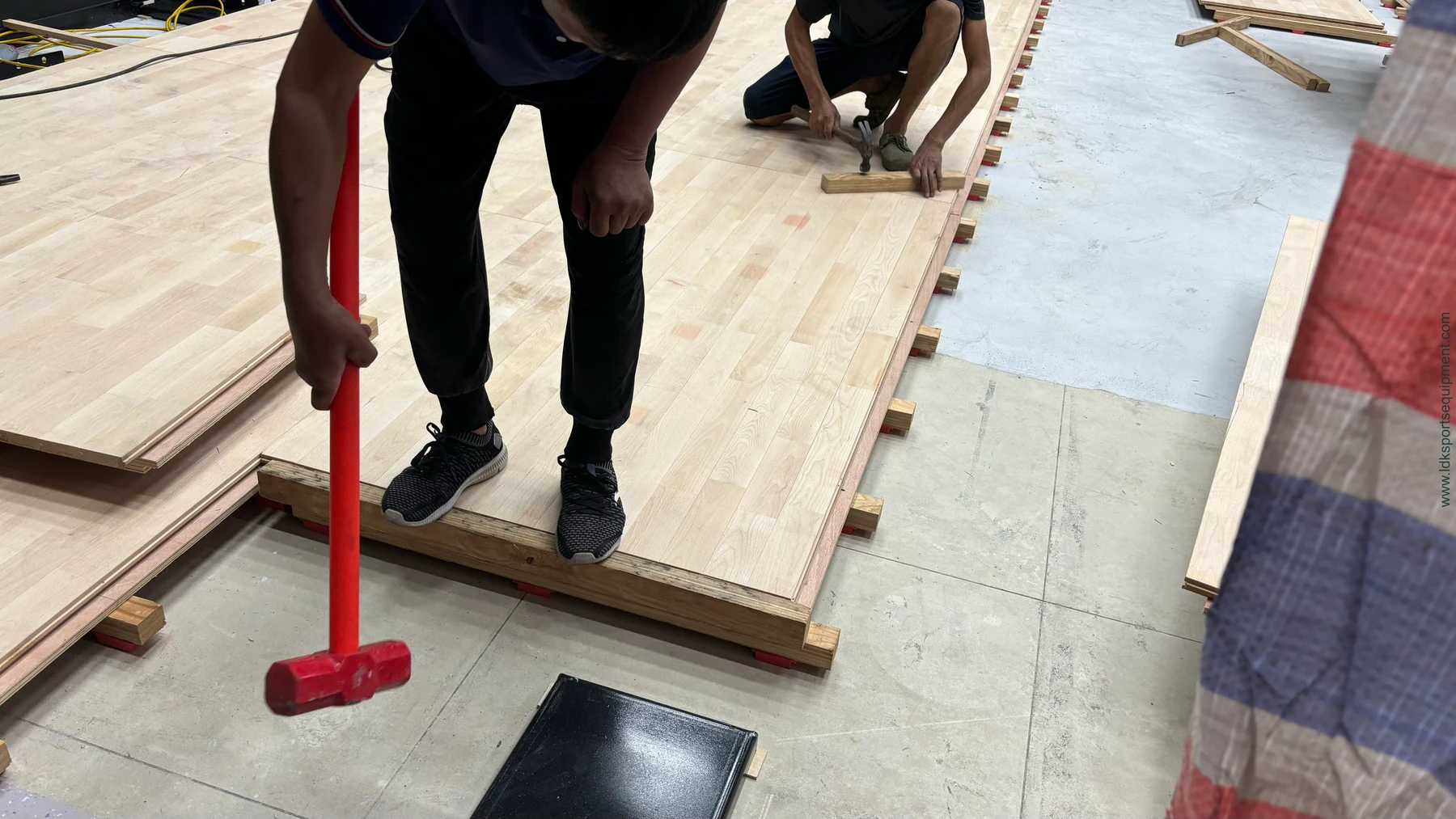
Rendering of panels being fitted; it illustrates an installation scene, not a specific project or product approval.
A useful flooring proposal starts with the venue and the exact system being considered. The inquiry should include court format, location, intended use, drawings or site details, and any competition or governing-body requirements. The supplier response should identify the proposed assembly, finish, relevant performance evidence, installation scope, and maintenance documents.
To discuss a project, use the LDK squash flooring product page or contact LDK. Request project-specific documentation before treating any product as suitable for a regulated or competition use.
No. The material label alone does not establish performance or approval. Compare the complete construction, finish, support layers, installation requirements, maintenance plan, and current test and accreditation documents for the exact system being offered.
No. Appearance and labels such as “anti-slip” do not replace friction-test evidence. Match the applicable test report to the quoted surface finish and the labeled sample.
No. A test method explains how a property is assessed. Ask for the current approval record and supporting report, then confirm that the product identity and tested configuration match the quotation, sample, and installed system.
This guide describes criteria in the cited WSF edition. The current WSF requirements and the applicability of submitted documents should be confirmed before procurement or publication.
