Sports Equipment Manufacturer


How many players on a football field at one time? Compare how many players on a soccer pitch, 11-a-side players, substitutes, rosters, futsal, youth formats.
For readers asking how many players on a football field at one time, the standard association-football (soccer) answer is up to 11 players per team on the field, including one goalkeeper. When both teams are at full strength, that means 22 players on the pitch at one time. The answer changes if you mean substitutes, a wider team roster, or a small-sided format.
This guide keeps those terms separate, explains the rule behind the count, and shows why a soccer pitch does not have one universal size. The original article URL is preserved for reference: https://www.ldksportsequipment.com/how-many-players-on-a-soccer-pitch.html.
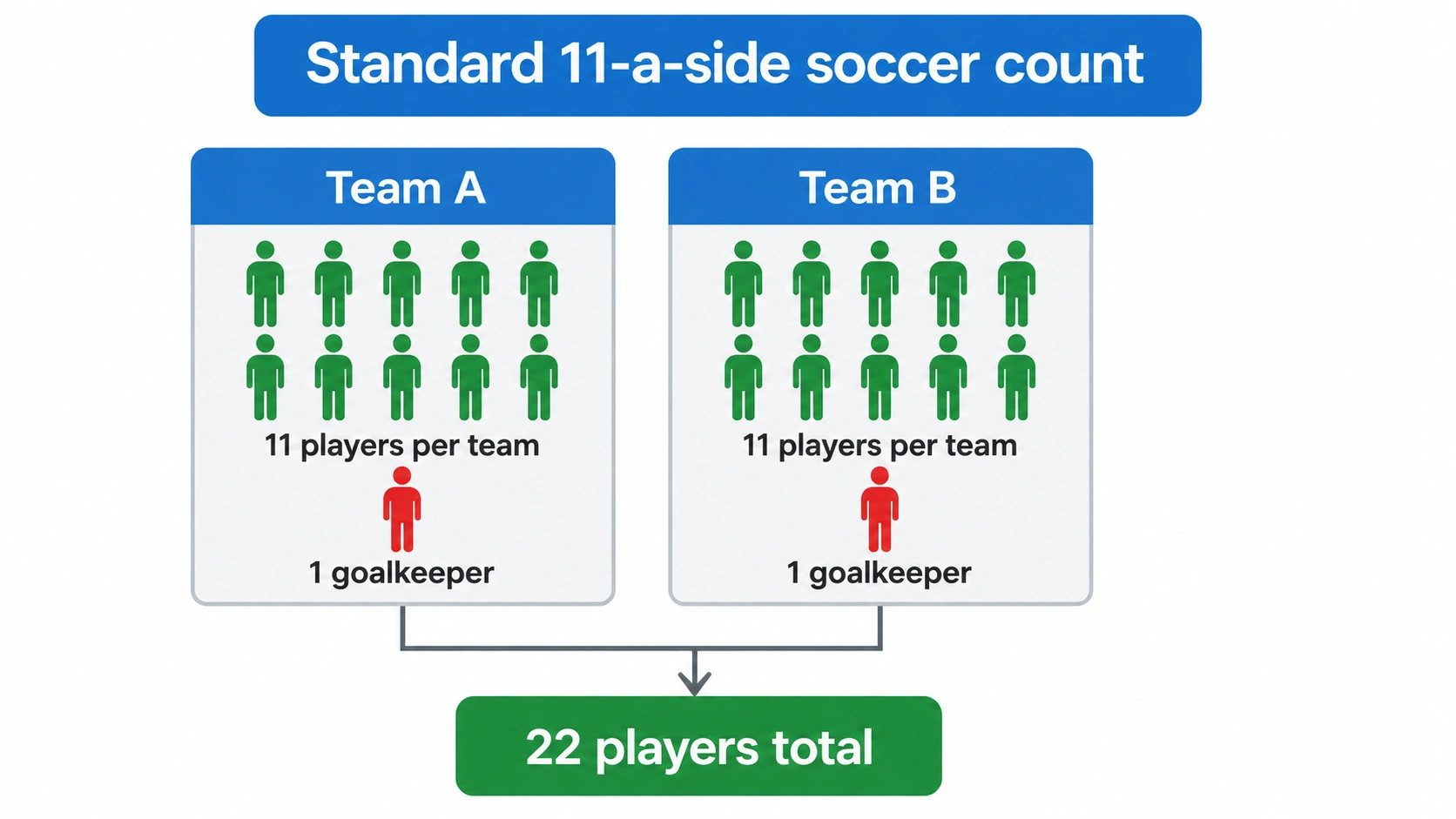
In a standard 11-a-side soccer match, each team may have a maximum of 11 players on the field. One of those players is the goalkeeper, and the other 10 are outfield players. A full-strength match therefore has 22 players on the field: 11 wearing one team’s colors and 11 wearing the other team’s colors.
The International Football Association Board (IFAB) states this player limit in Law 3: The Players. This is the association-football answer to the query “how many players on a football field at one time.” American football uses different on-field units and should not be used as the rule source for a soccer-pitch question.
| What the question may mean | Short answer | Scope |
|---|---|---|
| Players on one standard soccer team at once | Up to 11 | Includes one goalkeeper |
| Players on the whole field in a full-strength match | 22 | 11 per team |
| Named substitutes | Depends on the competition | Not on the pitch until used |
| Players in a smaller format | Depends on the format and organizer | Check that competition’s rules |
“Up to” matters. A team can have fewer than 11 players after a sending-off or another event governed by the Laws and competition regulations. The count above is the normal maximum for standard 11-a-side association football, not a universal answer for every version of football.
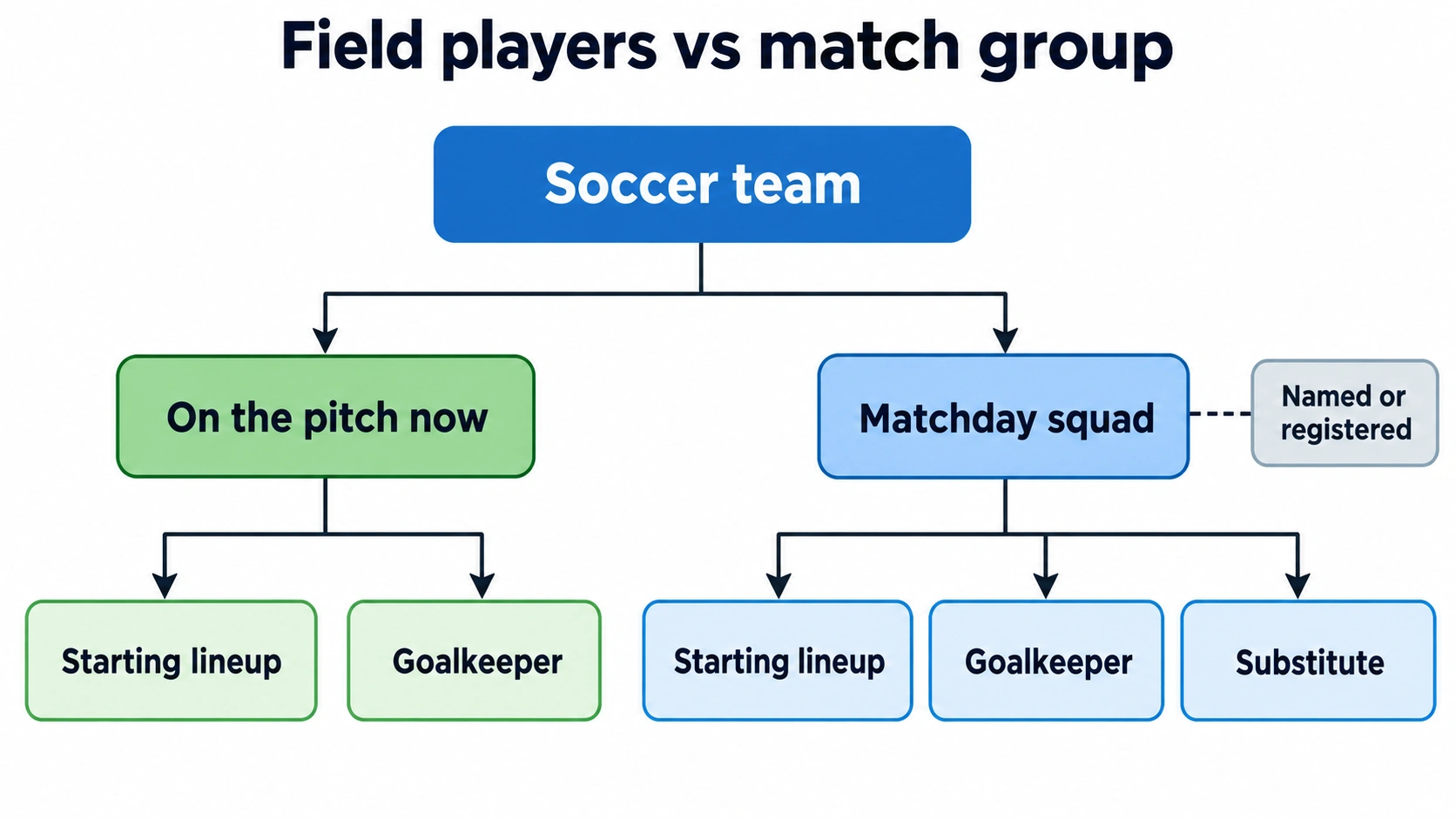
People often use “how many players are on a soccer team?” when they actually mean “how many are playing right now?” Those are different counts. A formation changes the jobs players perform, but it does not normally change the standard maximum of 11 players per team on the field.
| Term | On the pitch now? | Meaning |
|---|---|---|
| Starting lineup | Yes, at kickoff if selected | The players chosen to begin the match |
| Goalkeeper | Yes | One of the 11 players; the role is not an extra position outside the count |
| Outfield players | Yes | The other players in the lineup, such as defenders, midfielders, and forwards |
| Substitute | No, until used | A player named or available to replace a player under the competition rules |
| Matchday squad | Not necessarily | The group selected for the match, including players who may not enter the field |
| Club roster | Not necessarily | The broader group registered or contracted by a club; its size is not the on-field count |
This distinction explains why a club can have more than 11 players connected with a match while only 22 players are physically on the pitch in a full-strength 11-a-side game. The bench, coaching staff, and unused squad members are not additional soccer players on the field.
The goalkeeper is included in the 11. A team does not have 11 outfield players plus a goalkeeper; it has 11 players in total, with one normally assigned to the goalkeeper role. Tactics can change from one formation to another, but a change from a 4-3-3 to a 4-4-2 does not create or remove a player.
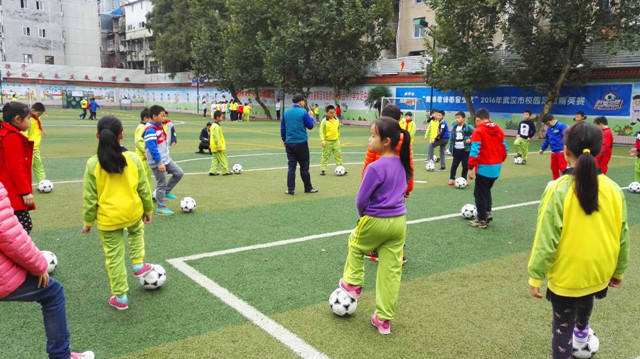
No. “Soccer” covers several formats, and the standard 11-a-side answer should not be applied automatically to futsal, five-a-side, seven-a-side, youth soccer, or recreational games. The name of a format is a useful starting point, but the organizer or governing competition rules control the exact lineup, roster, and substitution arrangements.
| Format or setting | How to use the player-count answer | Important caveat |
|---|---|---|
| 11-a-side soccer | Use the standard maximum of 11 per team | This is the IFAB Law 3 scope discussed above |
| Five-a-side | Treat it as a smaller-sided format rather than an 11-a-side lineup | Confirm whether the competition counts a goalkeeper and how substitutions work |
| Seven-a-side | Expect a smaller lineup than standard soccer | Youth and recreational organizers may publish their own rules |
| Futsal | Use futsal-specific competition rules | Do not transfer every outdoor 11-a-side assumption to an indoor match |
| Youth soccer | Follow the age-group competition rules | Field size, lineup size, roster, and substitutions can be locally defined |
The practical rule is simple: answer “11 per team, 22 total” only when the question is about a normal full-strength 11-a-side association-football match. For any other format, identify the competition before giving a fixed number.
Substitutes affect the size of the matchday group, but they do not increase the number of players on the field before they enter. When one player leaves and another enters, the replacement becomes one of the players on the pitch; the team does not normally gain an extra field player from making a substitution.
The number of substitutes a team may name, the number it may use, and the timing or opportunities for substitutions depend on the competition regulations. IFAB Law 3 is the correct starting point, but a league, tournament, school competition, or recreational organizer can apply its own permitted competition conditions. That is why the old shortcut that a team has only “one or two substitutes” is not reliable as a general rule.
IFAB also states that a match may not start or continue if either team has fewer than seven players, subject to the Law and applicable competition conditions. This is a minimum-player boundary, not a reason to describe every match as having seven players or to predict exactly what a referee will do in every competition.
| Symptom | Likely cause | Verify | Fix the wording |
|---|---|---|---|
| More than 22 names appear on the team sheet | You counted substitutes or the matchday squad | Separate “on the pitch” from “named for the match” | Say “the squad includes substitutes,” not “they are all on the field” |
| A red-carded player is still in the roster list | The list records the squad, not the current field state | Check the match event and competition rules | Explain that a sending-off can leave a team below 11; it is not a substitution |
| A youth or indoor game has a different count | It is not standard 11-a-side soccer | Check the organizer’s format rules | Name the format before stating a number |
Pitch dimensions help explain why formats are organized differently, but field size and player count are not the same rule. A larger or smaller playing area may influence how a competition is designed, yet it does not justify an invented spacing formula or prove that every pitch uses one fixed number of players.
IFAB Law 1 gives permitted ranges rather than one universal soccer-pitch measurement. For national-level matches, the field may be 90–120 m long and 45–90 m wide. For international matches, the permitted range is 100–110 m long and 64–75 m wide. See IFAB Law 1: The Field of Play for the governing wording and conditions.
| Dimension context | Permitted range in the IFAB law | What it does not prove |
|---|---|---|
| National matches | 90–120 m by 45–90 m | It does not make one pitch size universal |
| International matches | 100–110 m by 64–75 m | It does not explain the historical origin of 11 players |
| Local, youth, and small-sided formats | Competition-dependent | It cannot be inferred from the standard 11-a-side range |
The commonly repeated “100 × 70 m” description can be a rough example, but it is not a universal legal size. The earlier claim that players can be assigned a fixed area by dividing the pitch by 11 is also not a football law or a reliable tactical calculation. Use the actual competition specification when planning a field.
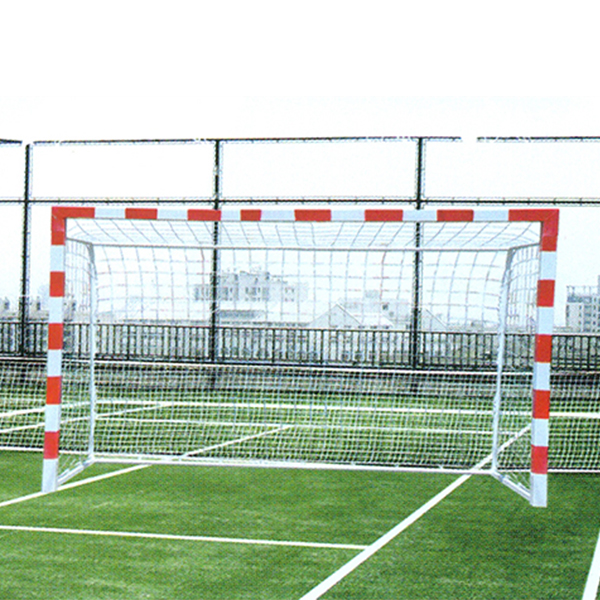
For readers comparing goals, field equipment, or a custom sports setup, LDK Sports Equipment’s first-party site can be used as a restrained equipment and inquiry reference after the player-count question is settled; this reference does not establish certification, performance, price, availability, installation, or safety.
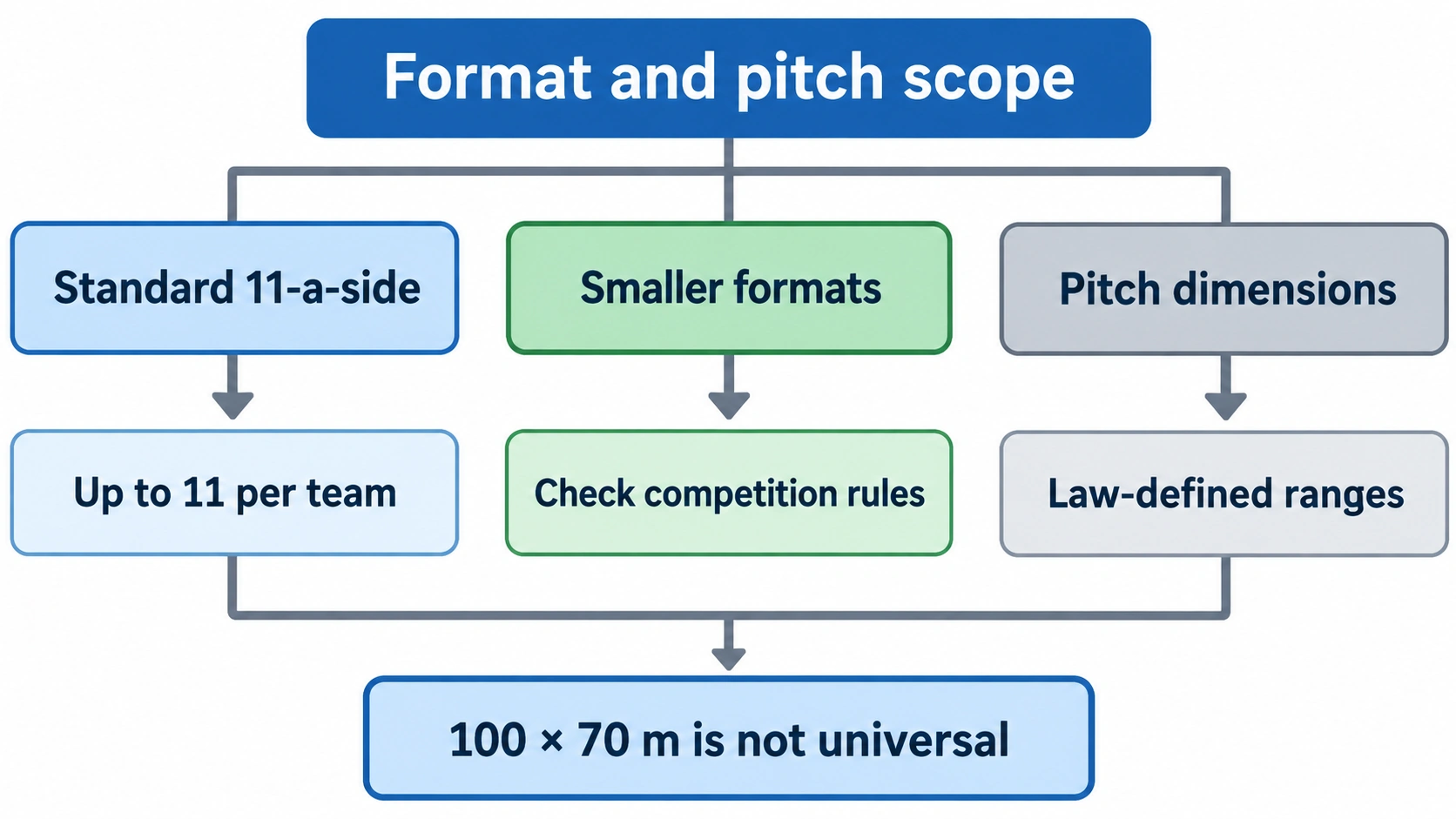
For a standard 11-a-side match, the normal full-strength answer is 11 per team, or 22 players across the field. See the direct answer in the first section; competition conditions can change the number.
In standard association football, there can be up to 22 players on the field when both teams have 11, including one goalkeeper per team. This answer does not cover every small-sided format.
There is no single field-count answer for a whole club roster; distinguish the club’s registration rules, the matchday squad, substitutes, and the 11 players actually on the pitch. See “What counts as a player on the field?”
For the association-football interpretation, up to 11 players per side can play at once in standard 11-a-side soccer, for 22 total at full strength. If “football” means another code, the rules are different.
A red card is a sending-off, not a normal substitution; the team may be left with fewer than 11, and the applicable Law and competition regulations determine whether the match can start or continue. See the substitutions section.
The standard on-field lineup has 11 players, but the number of named squad members and the tactical distribution of positions depend on the competition and formation. See the terminology and format sections.
For standard association football, the answer is 11 players per team on the field, including one goalkeeper, or 22 players total when both teams are full-strength. Substitutes and the wider squad are separate counts, and youth, futsal, five-a-side, seven-a-side, and recreational formats need their own competition rules.
The original page URL remains https://www.ldksportsequipment.com/how-many-players-on-a-soccer-pitch.html.