Sports Equipment Manufacturer

Difference between rugby and soccer pitch~Hello everyone, today the editor is paying attention to an interesting topic, which is the difference between football fields. So the editor has compiled 3 answers related to the differences between football fields. Let's take a look.
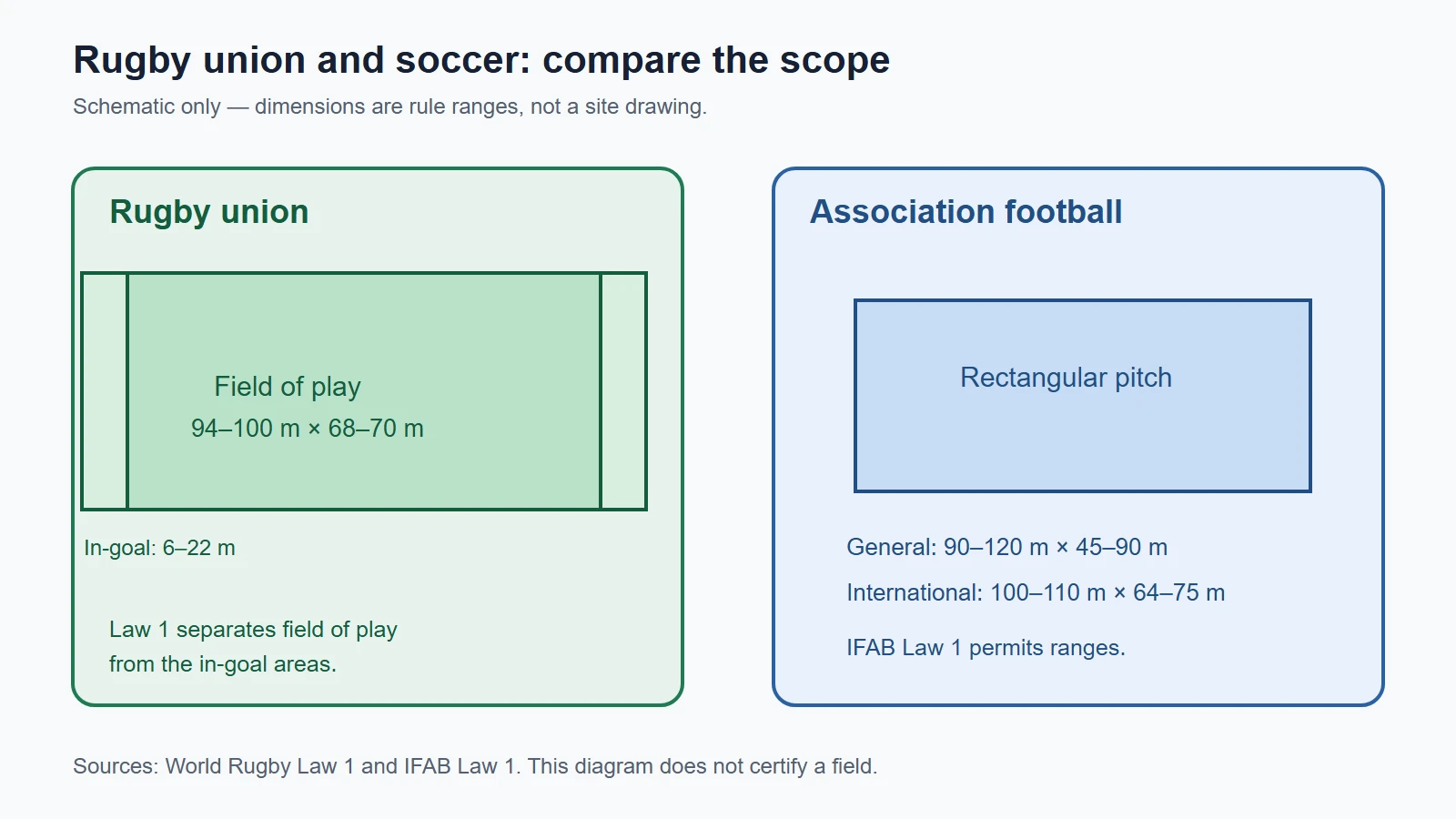
If you are comparing the difference between a rugby and soccer pitch, the short answer is that neither sport has one footprint that makes every field automatically larger. A rugby union ground is described through a field of play plus an in-goal area, while association football (soccer) uses a rectangular pitch with permitted ranges that vary by competition. The comparison only becomes meaningful when you state the sport code, competition level, and zones included in the measurement.
This guide keeps those scopes separate. It uses World Rugby Law 1 for rugby union and The International Football Association Board (IFAB) Laws 1 and 2 for association football. The aim is to answer the size question first, then explain markings, shared-field planning, and the ball rules without repeating the unsupported figures found in many informal comparisons.
At a high level, a rugby union pitch includes a field of play and two in-goal areas. A soccer pitch is the rectangular field of play marked for association football. That means a comparison can change depending on whether someone is comparing only the main playing rectangle or the full rugby playing area, including in-goal.
| Comparison point | Rugby union | Association football (soccer) | Authority link | Scope note |
|---|---|---|---|---|
| Governing source used here | World Rugby Law 1 | IFAB Law 1 | World Rugby Law 1 · IFAB Law 1 | These are different rule books. |
| Main length rule | Field of play: 94–100 m | Touchline: 90–120 m | World Rugby Law 1 · IFAB Law 1 | The terms are not identical. |
| Main width rule | 68–70 m | Goal line: 45–90 m | World Rugby Law 1 · IFAB Law 1 | Soccer uses a permitted range. |
| Additional zone | In-goal: 6–22 m | No rugby-style in-goal measurement | World Rugby Law 1 | Do not add the zones silently. |
| International scope | Rugby union rule scope above | Touchline: 100–110 m; goal line: 64–75 m | IFAB Law 1 | The soccer range is narrower for international matches. |
So, which field is bigger? There is no universal winner from the names alone. A soccer pitch can be longer or wider than a particular rugby field, while a rugby union ground can occupy more total length once its in-goal areas are included. Compare the actual rule scope and site dimensions rather than relying on a single “standard” number.
World Rugby Law 1 describes the rugby union playing area as rectangular. Its field of play is 94–100 metres long and 68–70 metres wide. Each in-goal area is 6–22 metres long. The law also distinguishes the field of play from the in-goal areas, so a total site comparison should state whether the in-goal zones are included. Variations require approval from the relevant union or World Rugby. World Rugby Law 1
This distinction matters when a school, club, or facility planner compares a rugby field with a soccer pitch. “Rugby pitch length” may mean the field of play, the full playing area, or an informal local layout. Those are not interchangeable descriptions. A useful specification should record at least:
The markings also serve different game functions. Rugby needs markings that identify the halfway line, touchlines, goal lines, dead-ball lines, and other rugby-specific lines. A soccer pitch uses touchlines, goal lines, the halfway line, penalty areas, goal areas, the centre circle, and other IFAB markings. Even if the same grass or synthetic surface is used, painting one set of lines over another does not by itself make the site ready for both sports.
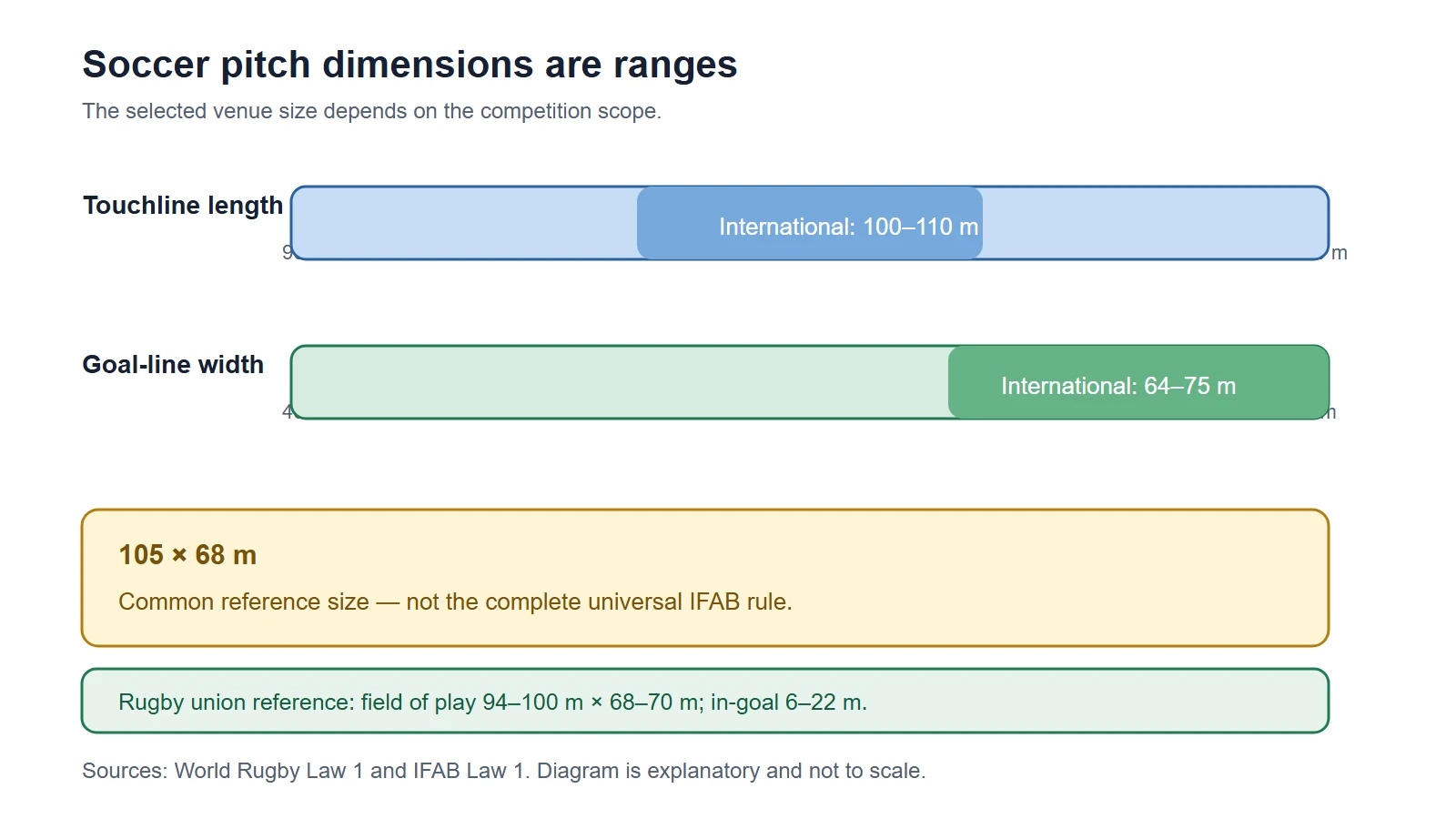
IFAB Law 1 states that an association-football field must be rectangular. For general matches, the touchline may be 90–120 metres long and the goal line may be 45–90 metres long. For international matches, the permitted ranges narrow to 100–110 metres for the touchline and 64–75 metres for the goal line. IFAB Law 1: The Field of Play
This is the key to understanding the dimensions of a FIFA soccer pitch or a professional soccer pitch: the governing rule provides permitted ranges, while a competition or venue may use a selected layout within those ranges. A commonly quoted reference such as 105 × 68 metres can be useful when discussing a particular competition format, but it should not be presented as the complete universal IFAB rule.
| Soccer scope | Touchline | Goal line | Authority link | How to use it |
|---|---|---|---|---|
| General permitted range | 90–120 m | 45–90 m | IFAB Law 1 | Use for a broad rules comparison. |
| International-match range | 100–110 m | 64–75 m | IFAB Law 1 | Use when the competition has that scope. |
| Common reference size | 105 m | 68 m | IFAB Law 1 | Treat as a reference, not a universal range replacement. |
The ranges also explain why two photographs can appear to show very different “full-size” soccer pitches while both are used legitimately. A domestic match may use a layout near one end of the permitted range, while an international venue may have to stay inside the narrower international range. The same reasoning applies to rugby comparisons: a drawing that shows only the field of play will look shorter than one that includes both in-goal areas. When reviewing a supplier quotation or site plan, ask the preparer to label every dimension line and identify the governing competition. This small documentation step prevents a familiar reference size from being mistaken for a universal legal requirement.
The term “professional” also needs care. Professional competitions can have competition-specific requirements, and a project should confirm the applicable competition handbook before ordering materials or setting out lines. The IFAB range tells you what the law permits; it does not select a pitch for your site.
A shared ground may be possible, but the word “possible” is not a site certification. The reviewed community sample includes questions and observations about different field sizes, worn surfaces, and rugby/soccer sharing. Those records are useful for discovering reader concerns, not for proving a dimension or approving an installation.
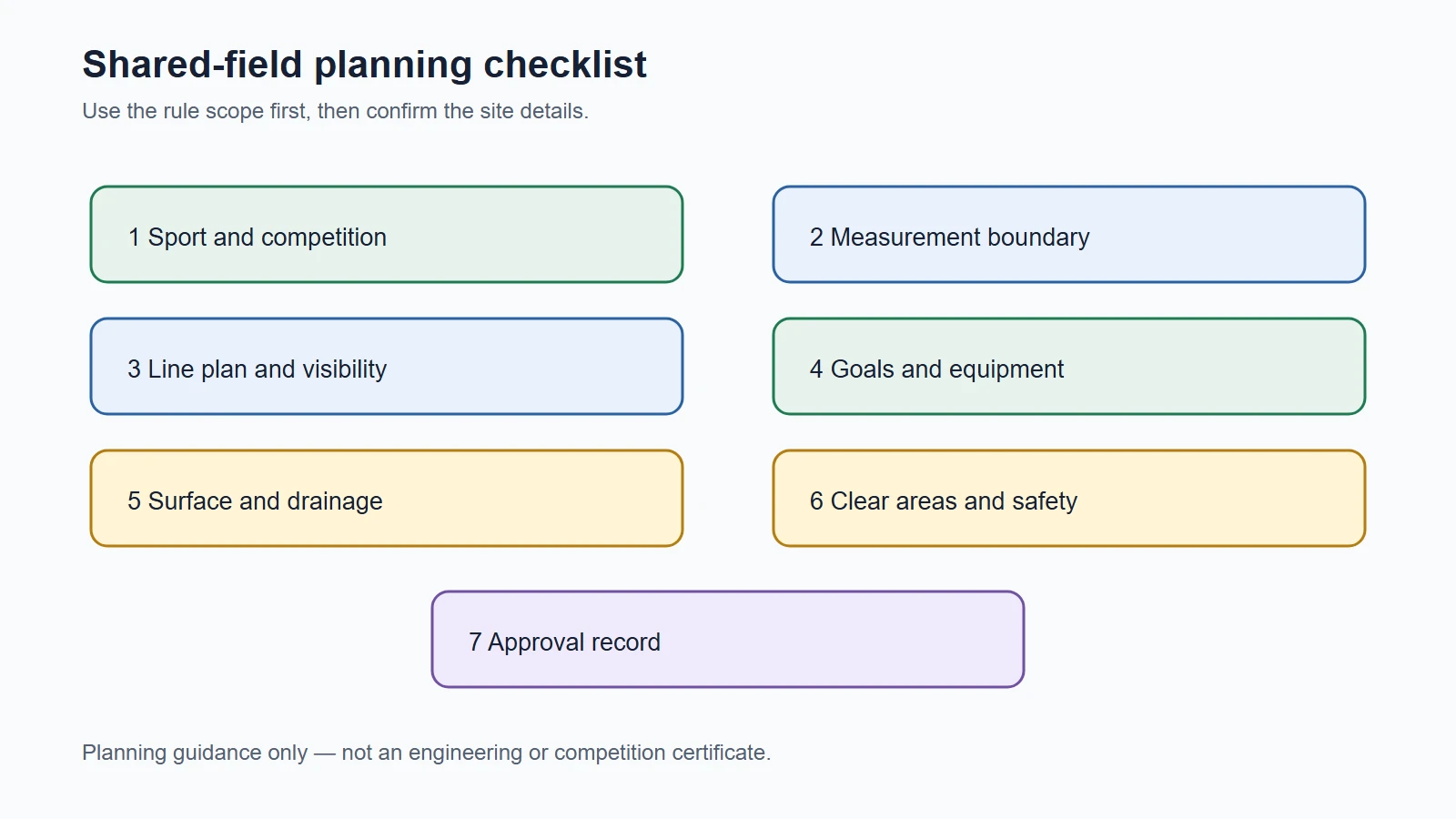
Before treating one location as a multi-use sports field, confirm the following in order:
The practical conclusion is that shared use is a coordination and specification problem, not just a question of whether two rectangles have similar dimensions. LDK Sports Equipment can be included in the supplier brief for football goals, football cages, and related field equipment; ask for current drawings and specifications before comparing quotations.
Pitch dimensions and ball specifications should be treated as separate questions. IFAB Law 2 states that an association-football ball has a circumference of 68–70 centimetres, a mass of 410–450 grams at the start of the match, and a pressure of 0.6–1.1 atmosphere at sea level. IFAB Law 2: The Ball
Those are association-football requirements. They do not prove that Asia and Europe use different mandatory soccer-ball sizes. The governing rule and competition context matter more than a continent-wide assumption. This article does not add rugby-ball measurements because the approved research package for this upgrade did not include a verified rugby-ball source.
The same evidence boundary applies to goal frames, surface performance, and equipment durability. A rules page can tell you what a field or ball law specifies. It cannot certify that a particular product, surface, supplier, or multi-use site will perform as promised. For a purchasing decision, request the exact product drawing, material specification, installation method, warranty boundary, and approval documents from the responsible supplier or authority. If equipment sourcing is part of the project, LDK’s football-equipment categories can be a starting point, but current product details and rule compliance still need to be confirmed with the responsible supplier or authority.
Use this checklist before building, buying equipment, or repainting a shared field:
| Item to confirm | Why it matters | Responsible confirmation | Status/notes |
|---|---|---|---|
| Sport code and competition | Determines which law and range apply | Governing body or competition manager | — |
| Playing-area boundary | Prevents mixing field of play, in-goal, pitch, and runoff | Designer and grounds manager | — |
| Final dimensions | Converts permitted ranges into an approved site layout | Project designer and approving authority | — |
| Marking schedule | Avoids confusing or unsafe overlapping lines | Grounds manager and competition authority | — |
| Goals and anchors | Equipment geometry and safety are sport-specific | Equipment supplier and site engineer | — |
| Surface and drainage | Shared use may change wear, recovery, and maintenance needs | Grounds or engineering team | — |
| Clear zones and access | Protects players, officials, spectators, and emergency routes | Site owner and safety reviewer | — |
| Maintenance and changeover | A layout that works on paper may fail operationally | Facility operator | — |
| Approval record | Confirms the selected rule scope and local requirements | Site owner and relevant authority | — |
This checklist is planning guidance, not a substitute for engineering review or competition approval. It is also the main practical difference between a reliable comparison and a recycled list of dimensions: the numbers only become useful when their scope and implementation are explicit.
Neither is always larger. Compare the rugby field of play and in-goal scope with the soccer competition range, and state which zones are included. See the scope comparison above.
IFAB permits ranges, and the competition or venue selects dimensions within the applicable range. International-match ranges are narrower than the general range. See the association-football ranges.
They may be planned for shared use, but the line layout, surface, clear areas, equipment, scheduling, and approvals must be checked for the specific site. See the shared-use planning section.
Confirm the sport code, competition, measurement boundary, dimensions, markings, goals, surface, drainage, safety zones, maintenance plan, and approval record. Use the pre-construction checklist.
No. It is a common reference size, while IFAB Law 1 defines permitted general and international ranges. See the range table.
The difference between a rugby and soccer pitch is not just a matter of one field being bigger. Rugby union separates a 94–100 metre field of play from 6–22 metre in-goal areas and uses a 68–70 metre width range. Association football uses a rectangular pitch with general and international ranges set by IFAB. The correct comparison therefore depends on the sport code, competition, measurement boundary, markings, and site requirements.
If you are comparing a field for a club, school, or facility project, start with the official rule scope, place the numbers in a drawing, and then confirm the line plan, equipment, surface, clear areas, and approvals. For a quotation brief, LDK Sports Equipment can be one supplier contact for football goals, cages, and related equipment, provided the request includes the approved field layout and current project requirements.