

Sports Equipment Manufacturer

Understand how resilient pads work inside wood sports-floor assemblies and what whole-system documents to compare when specifying a pad-supported court.
Resilient pads in a wood sports floor sit within the subfloor assembly and compress under load. They help the complete sprung floor respond to impact, but a pad by itself does not tell you how the finished court will perform. For a specification, compare the tested floor assembly—surface, subfloor, cushioning, anchoring, and installation—not a pad’s material or thickness in isolation.
That distinction matters because a search for sports floor shock absorbing pads can lead to two different products: loose rubber mats for a home gym, or resilient components designed into a permanent wood athletic floor. This guide covers the second use.
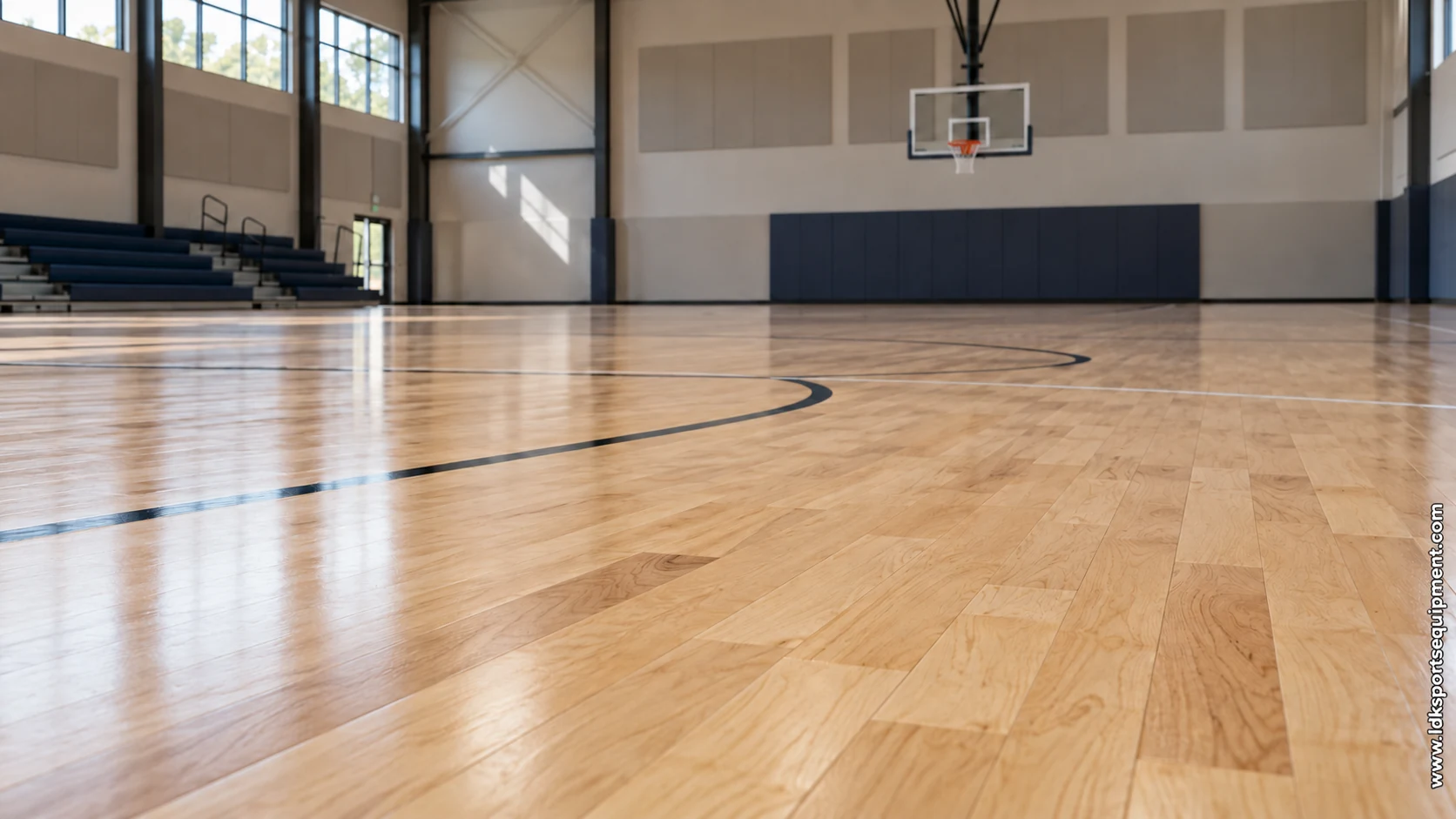
AI-generated concept scene; not a project photograph
A resilient pad is a synthetic or rubber support that compresses under stress. The Maple Flooring Manufacturers Association (MFMA) connects resilient pads with shock absorption, area of deflection, and vertical deflection in a wood sports-floor system.
In a sprung floor, pads support the subfloor above the slab. When a player lands or changes direction, the surface and the layers below it move together. The pad is one part of that response; the battens or other subfloor members, their spacing and anchoring, the wood surface, and the installation all affect how the assembly behaves.
Basketball guidance from FIBA’s Venue Guide describes sprung flooring as a surface supported by a subfloor. It notes traditional arrangements using wooden battens and plywood, as well as modern arrangements using rubber pads or foam layers. The guide also explains that FIBA Approved flooring incorporates the subfloor as part of the approved product. The practical point for a specifier is to evaluate a complete flooring system rather than treat its cushioning as a stand-alone accessory.
For a component-level review, separate these three checks:
A wood gym floor usually has a finished playing surface above one or more supporting layers, with resilient elements positioned according to the system design. The exact arrangement varies by system. A pad may support a batten, a panel, or another designed subfloor element; it should not be assumed that every court uses the same layer order or spacing.
One documented LDK configuration uses two crossed batten layers combined with elastic rubber shock pads. This is an example of a double-keel assembly, not a universal layout. In the drawing below, the layers are simplified to show the relationship between the playing surface, subfloor, resilient support, and slab; it is not a construction detail or installation plan.
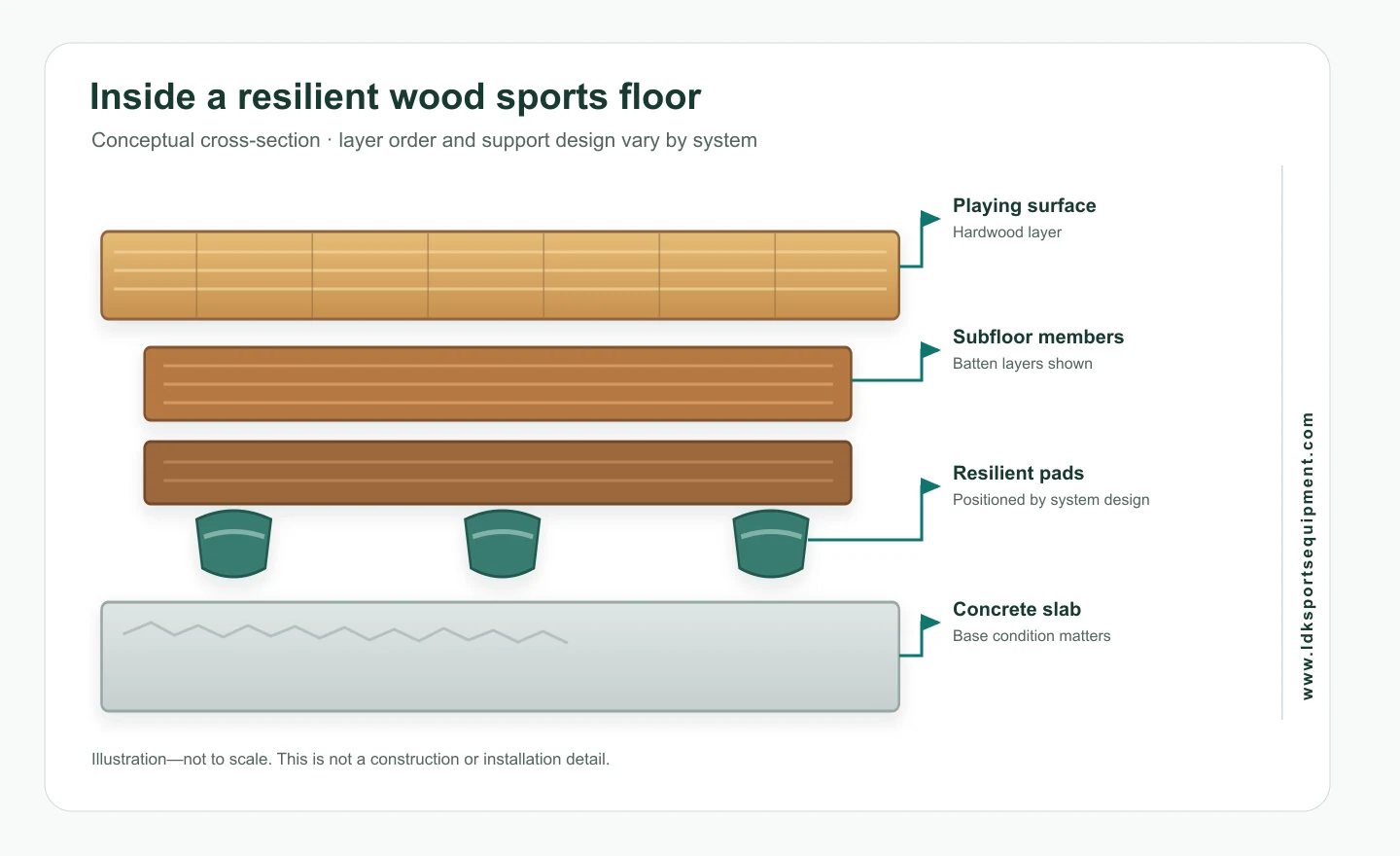
Conceptual floor assembly illustration—not to scale
The project drawings and the system manufacturer’s instructions determine the actual pad type, support pattern, fastening, perimeter treatment, and slab requirements. MFMA’s pad-supported basket-weave guide specification directs that resilient pads be supplied and installed according to the manufacturer’s instructions. Its performance-based guide specification similarly assigns cushioning and subfloor anchoring to the flooring manufacturer’s design and evaluates the complete floor system.
If you are comparing assembly options, see this guide to fixed-resilient and floating wood sports-floor systems. It explains the broader subfloor choice; this page focuses on the resilient support within that assembly.
Before comparing layouts, match these items across the drawing, specification and instructions:
“Shock absorption” is one characteristic used to describe an athletic floor, but it is not a score that can be assigned to a loose pad and then transferred to any court. MFMA lists shock absorption, vertical deflection, area of deflection, basketball rebound, and surface friction as separate sports-floor performance characteristics. The organization describes shock absorption and vertical deflection at the flooring-system level; area deflection considers how movement extends beyond the impact point.
Those measures describe different parts of play. Shock absorption concerns how the system reduces impact force; vertical deflection describes movement under impact; area deflection considers movement around that point; ball rebound and surface friction relate to ball response and player-surface interaction. No single pad specification gives you all of these results.
The MFMA performance-characteristics reference is useful when reading test information. Look for the floor assembly identified in the report and the stated test method, then check that the installed floor matches that assembly. A test result for one construction should not be treated as a rating for a different combination of surface, pads, battens, and anchoring.
When comparing systems, “more cushioning” is not automatically a better specification. The target is a floor response suited to the sport and facility, supported by test documentation for the actual system. For a broader discussion of court surfaces, see basketball court surface options.
MFMA separates five useful performance categories for an athletic wood floor:
Compare the applicable results with the test method and assembly identified in the report.
Use this checklist during design review or supplier discussions:
| Ask for | What to check | Why it matters |
|---|---|---|
| A section drawing of the proposed assembly | Surface, subfloor members, pads, anchoring, and slab are shown together | Confirms how the components work as one floor |
| Test documentation for the complete floor | The report identifies the tested construction and the relevant test methods | Keeps system results tied to the assembly that was evaluated |
| The pad and subfloor schedule | Pad locations, supporting members, and connection details match the proposed system | Prevents a component from being specified outside its designed role |
| Installation instructions | The supplied cushioning and anchoring follow the system manufacturer’s design | Installation changes can alter how the assembly performs |
| Slab and moisture requirements | The project team knows what condition the base must meet before installation | The supporting surface is part of the floor system’s installation conditions |
| Compliance or system documents | The named system in the documents matches the product and drawings being procured | Avoids relying on a document for a different construction |
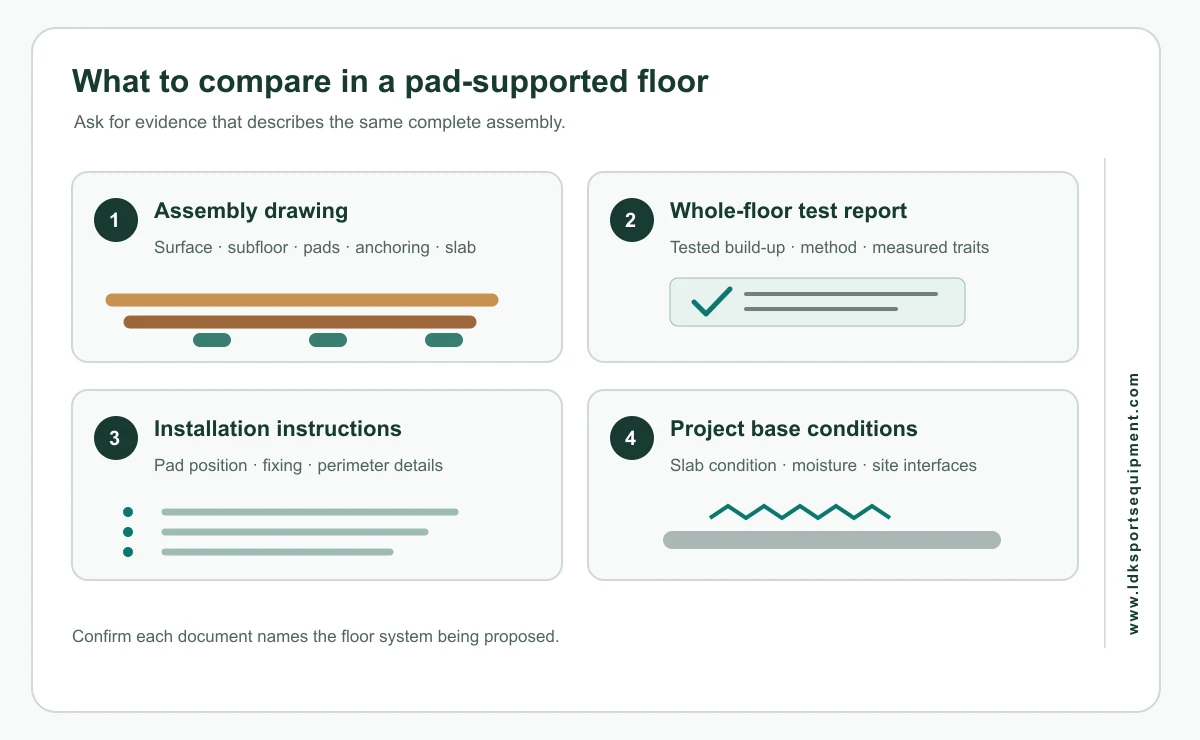
Compare documents for the same complete floor assembly
MFMA’s floor specification guidance is intended to help architects prepare project specifications for athletic wood floors. Use the same system-level approach in procurement: identify the design, match the supporting documents to it, and coordinate the installation requirements with the project team.
Choosing by pad material alone. “Rubber” or “foam” describes a material family, not the complete court response. Ask what assembly the component belongs to and what system evidence is available.
Comparing thickness as if it were a performance rating. Thickness alone does not establish shock absorption, ball rebound, or stability for the finished floor. Compare complete assemblies and their documentation.
Mixing a gym mat with a subfloor pad. Loose rubber tiles or rolls sold for exercise areas sit on top of an existing floor. Resilient pads in a wood athletic floor are installed within the designed subfloor. The terms may overlap in search results, but the products have different functions.
Using a generic spacing pattern. Pad placement and subfloor anchoring should follow the proposed flooring system’s drawings and installation instructions. A spacing detail copied from another system may not match the assembly being purchased.
Treating a single test number as the full decision. Shock absorption is only one performance characteristic. Review the system identification and other measures relevant to the sport and project requirements.
A quick specification review should rule out these five mismatches:
Before approving a proposal, ask the designer or flooring supplier to identify the floor assembly and provide its section drawing, system-specific installation instructions, and test documents. Confirm which pads and subfloor members are included, how they are positioned and anchored, and what base-slab conditions the installation requires.
Then check that the test documentation refers to the same assembly named in the proposal. If a document shows a different surface, pad arrangement, or subfloor, ask the supplier to explain the difference before comparing results.
For a project-specific discussion, share the sport, venue use, proposed floor assembly, and available slab information with LDK’s flooring team. The team can help identify which system details and documents are relevant to the project.
A loose rubber mat does not automatically need an underlay; follow the mat maker’s instructions for the product and floor beneath it. That is separate from a resilient pad designed into a sprung wood sports floor, where the pad belongs to the specified subfloor assembly and should be installed to the system manufacturer’s instructions.
