

Sports Equipment Manufacturer

A practical guide to portable hardwood basketball courts: system layers, venue readiness, storage and changeover planning, competition documentation, and a comparable RFQ checklist.
A portable basketball wood floor is a hardwood playing surface built in connected sections over a supporting structure, so a venue can install it for court use and remove it when the arena needs another layout. It suits operators who need a hardwood court and have a workable plan for the base floor, handling, storage, and the required competition specifications.
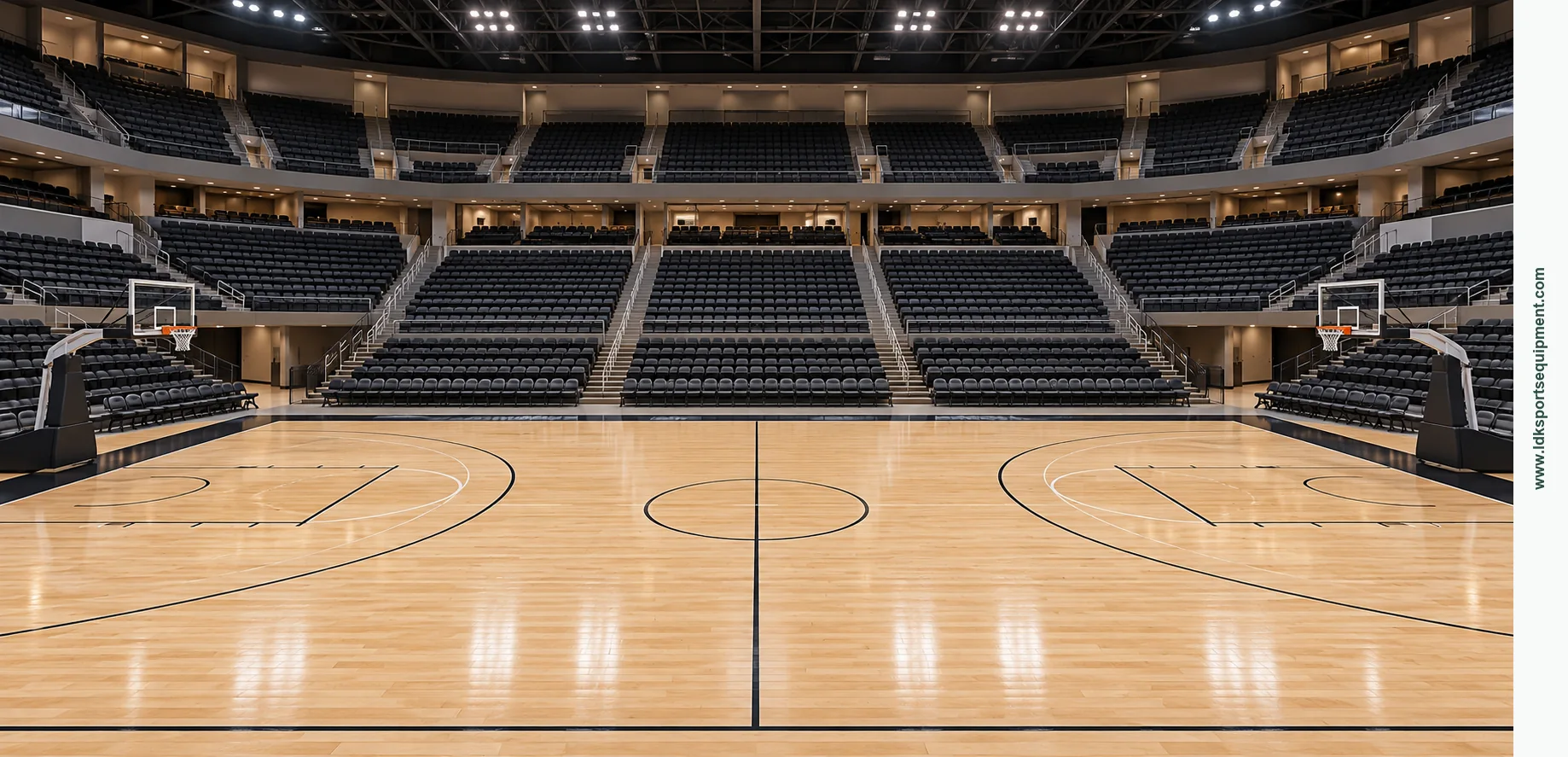
Concept illustration of a multi-use arena with a portable hardwood basketball court
The term usually describes a court assembled from modules or panels that join to form a continuous hardwood playing surface. A supporting substructure sits below the surface, and the complete system is designed to be assembled and dismantled when the venue changes use. The exact panel size, connection, substructure, and handling method depend on the system offered.
That is different from two products sometimes described as “portable basketball flooring.” Interlocking polypropylene (PP) tiles are separate plastic modules, while wood-look vinyl planks use a synthetic surface. The FIBA Venue Guide describes these flooring categories separately, alongside wooden court flooring. A buyer comparing bids should therefore ask for the material and system drawing, not rely on “portable” or “wood look” in a product title.
A modular hardwood court combines a playing surface with support and cushioning layers. The documented LDK25W05 configuration uses 22 mm sports flooring panels, 30 mm main LVL joists, a 12 mm composite middle layer, interlocking grooves with pull tabs on metal parts, and 20 mm resilient pads.
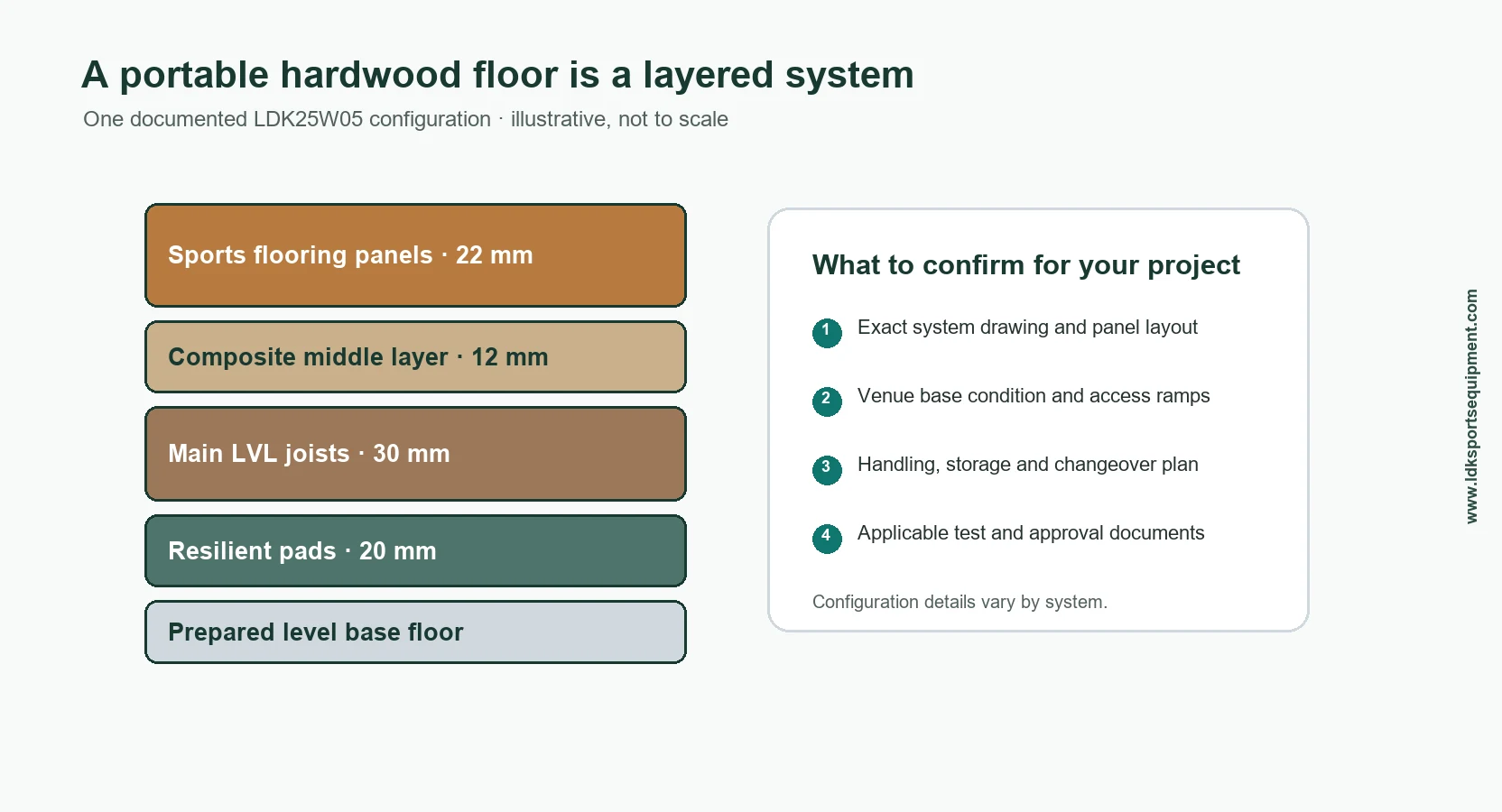
Illustrative system layout, not to scale; configuration shown is one documented LDK25W05 option
The module connection and the supporting layers work as one system. When comparing proposals, request a drawing that identifies each layer, panel arrangement, connection method, court markings, and the equipment needed to handle the modules. That gives the venue team something specific to compare and helps prevent a test report or sample description from being mistaken for the system actually offered.
The right choice depends on the venue schedule and operating plan. A portable wood system keeps a hardwood playing surface available for basketball while allowing the court area to be changed; permanent wood avoids recurring assembly and storage; PP tiles offer a different material and surface system.
| Choice | When it can fit | Main planning question |
|---|---|---|
| Portable modular hardwood | A multi-use arena needs a hardwood court and can manage installation, removal, and storage | Where will components be handled and stored, and who owns each changeover task? |
| Permanent hardwood | Basketball is the venue’s regular use and the floor can remain in place | Does the fixed court layout serve the event calendar and other users? |
| Interlocking PP tiles | A venue needs a modular plastic surface rather than a hardwood system | Does the tile system’s material and performance suit the sport and competition level? |
These are operating distinctions, not a performance ranking. A venue should compare the exact system against its playing requirements, event calendar, base-floor conditions, labor plan, and available storage. The basketball stadium wooden floor product page and the sports flooring category can help buyers identify the LDK product scope before requesting a project-specific proposal.
FIBA notes that court flooring can be permanent or moveable, and that a moveable surface may suit arenas with substantial non-court sports or entertainment use, such as concerts. That makes a portable hardwood system worth evaluating when basketball shares the floor area with events that require a different layout.
The operational case depends on more than the court itself. A venue needs a level, stable base; clear access for the installation and removal route; a defined storage location; and a schedule that allows the floor changeover to be completed by the responsible team. If the system is elevated above the base floor, FIBA says appropriate non-slip ramps should be provided at access points. Build these items into the venue plan and quote request rather than treating them as afterthoughts.
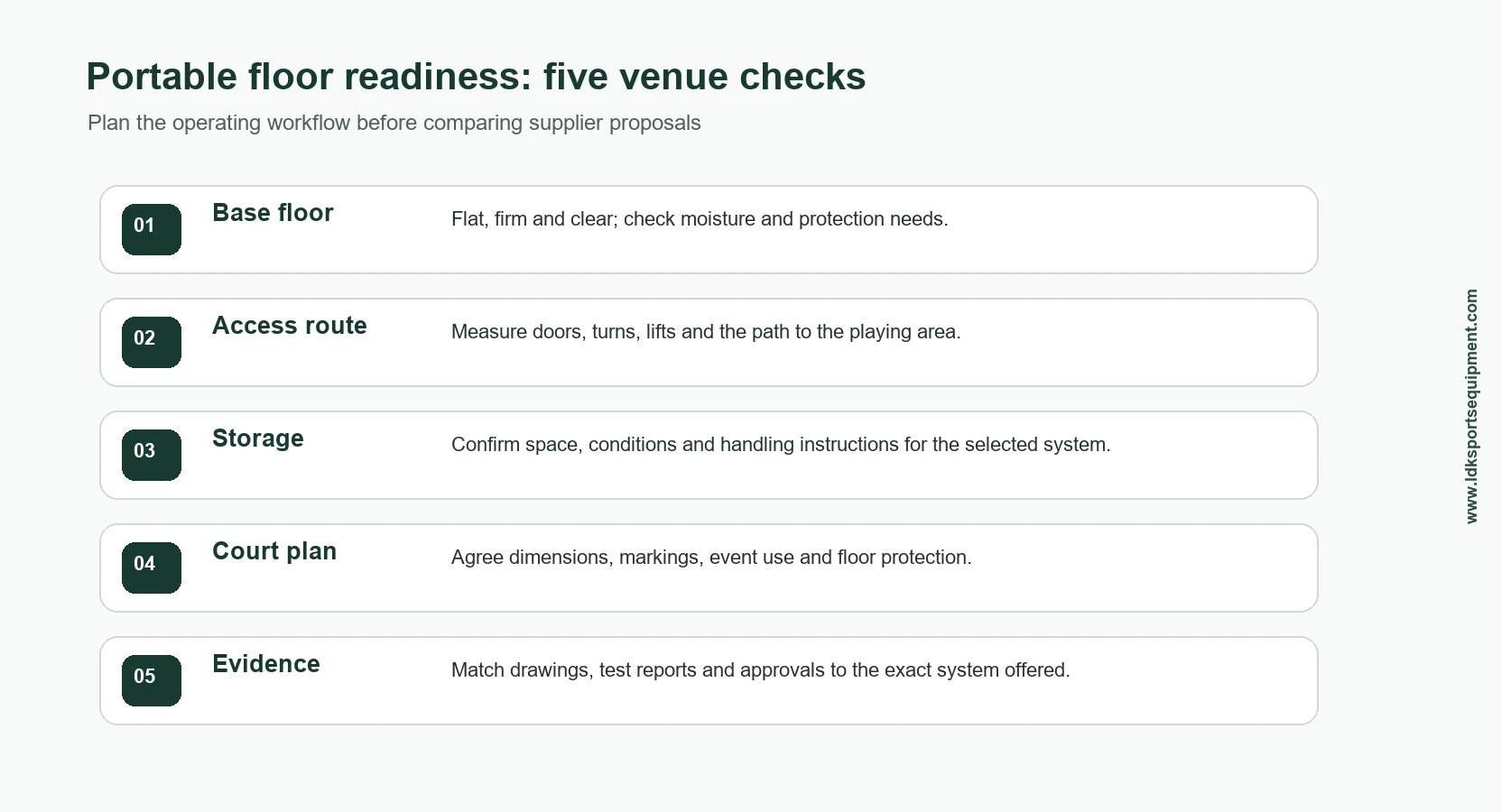
Use these venue checks to prepare a comparable portable-floor request
If the court will remain in one configuration for most of the year, compare the recurring handling and storage work with a permanent floor. For frequent event changes, map the sequence and storage route first, then ask bidders to state the time, labor, and space their proposed system requires.
Use a written checklist so suppliers answer the same scope:
This checklist turns a broad request for “portable wood flooring” into a defined venue project. It also makes it easier to compare a hardwood system with permanent wood or a synthetic modular surface without mixing unlike products.
The 2024 FIBA Official Basketball Rules and Basketball Equipment document states that the floor surface for Levels 1 and 2 shall be permanent or mobile wooden flooring. The rules identify an allowed floor type; they do not mean that every mobile wood floor is approved for every competition.
For a venue that hosts a regulated event, check the applicable competition rules and the approval record for the exact product or complete floor system being proposed. The LDK indoor wooden basketball floor product page is a separate product listing; its wording should not be extended to another model or configuration. Where requirements are unclear, ask the competition organizer which documentation it accepts before the purchase specification is finalized.
Ask each bidder to answer these points against the same venue information:
The response should name the system and tie every drawing and test result to the configuration in the proposal. That creates a like-for-like review and gives the venue a clear basis for checking that the delivered floor matches the system it selected.
FIBA’s venue guidance lists solid hardwoods such as maple, beech, oak, and ash, and also notes that engineered wood is used. The right choice depends on the system, venue conditions, and applicable competition requirements.
There is no single best material for every venue. Hardwood, synthetic systems, and PP tiles serve different operating and competition needs, so compare the specific floor system with the venue schedule, base, and required performance documentation.
The 2024 FIBA equipment rules list permanent or mobile wooden flooring for Levels 1 and 2. The venue still needs to verify that the exact floor system and its approval documentation meet the requirements for the event it plans to host.
An NBA hardwood floor price depends on the project’s court, system, installation, and transport scope. Define those requirements and request a current, itemized quote. See the separate basketball court wood flooring cost guide for cost-planning factors.
Share the venue layout, event schedule, floor-base information, storage plan, and competition requirements when requesting a proposal. Contact LDK Sports Equipment to discuss a portable or permanent sports flooring system for your project.
