

Sports Equipment Manufacturer

A sprung wood base and a roll-out PVC badminton mat often work as layers in one system. Compare tournament requirements, daily handling and what to put in a flooring bid.
For a badminton court, a sprung wood floor and a roll-out PVC court mat are often layers in one system, not competing choices. For specified high-level BWF events, the facility rules require a sprung wooden floor or an approved equivalent subfloor beneath the court mats; the mats also have their own approval requirement. For a club or multipurpose hall, choose the setup around the event level, daily use, storage and maintenance plan.
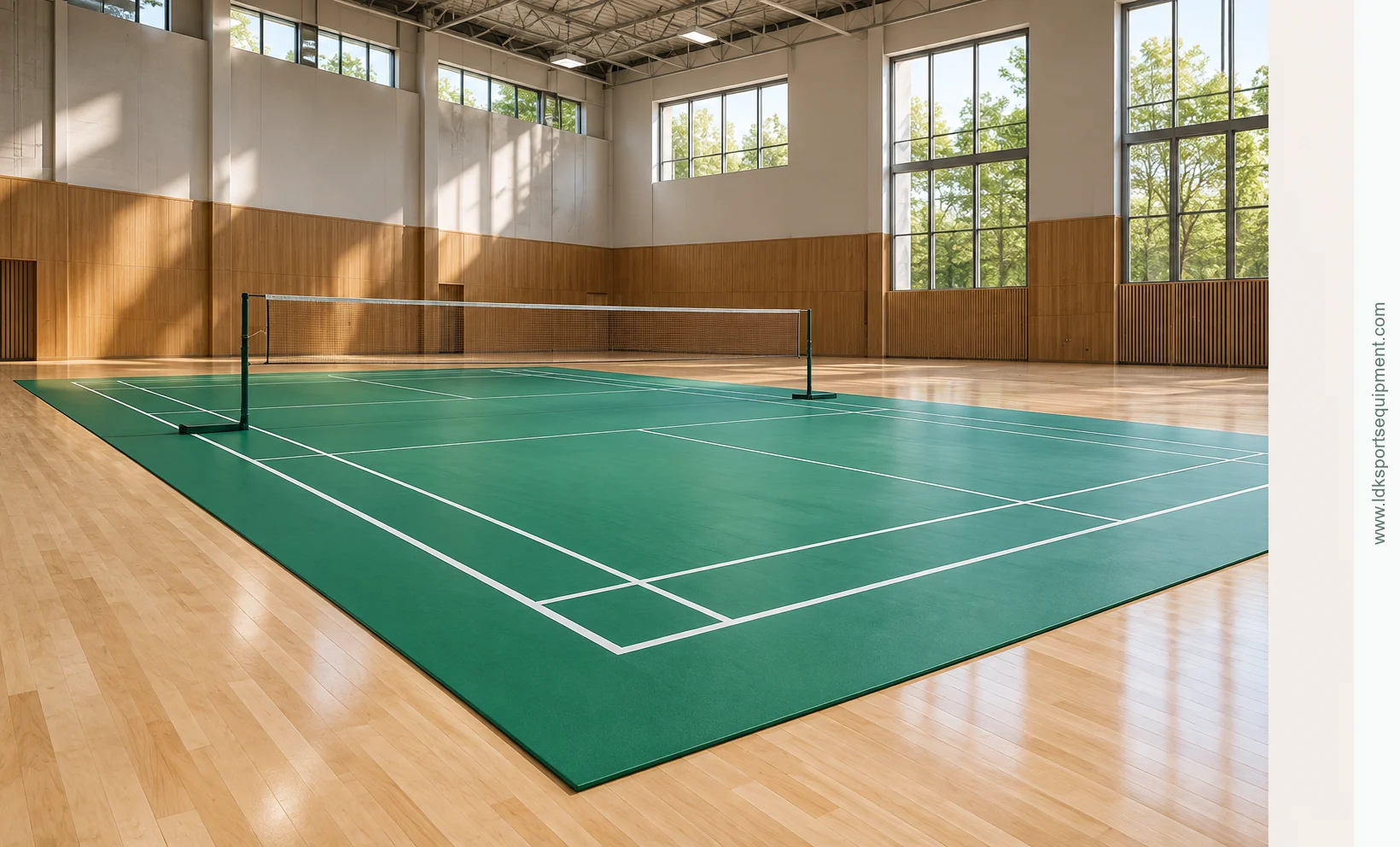
Think in layers. The visible playing surface may be a roll-out PVC badminton mat. Beneath it sits a supporting sports floor: often a sprung wood system, or another surface accepted for the event. The sports floor itself rests on the building’s structural slab. A permanent wood sports floor can also serve as the playing surface in facilities whose use and governing requirements allow it.
The distinction matters when a specification says only “PVC floor” or “wood floor.” Those labels do not tell a bidder whether PVC is the playing mat or the permanent sports surface, what supports it, or which parts of the proposed assembly have been tested or approved.
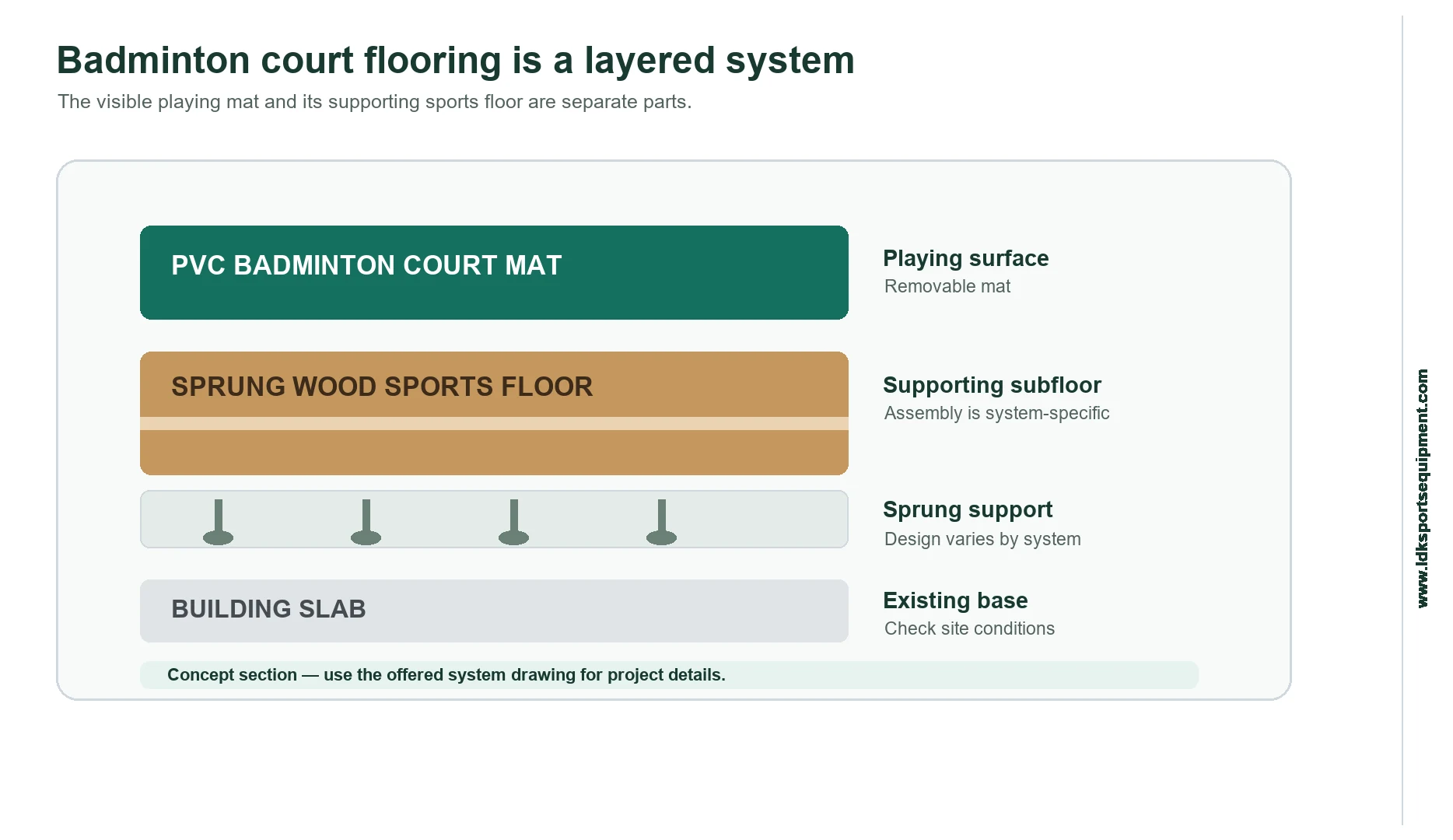
| Decision point | Sprung wood base + roll-out PVC mat | Permanent wood sports surface |
|---|---|---|
| What players stand on | The removable badminton mat | The finished wood sports-floor surface |
| What supports the surface | A sprung wood floor or an approved equivalent subfloor, as required for the event | The specified sports-floor structure and supporting slab |
| When it fits | A venue that needs removable court mats or follows an event format that specifies mats over a subfloor | A club or shared-use hall choosing a permanent surface that matches its sport and event requirements |
| Daily operations | Staff need a plan to move, lay out, inspect and store mats; seams and markings need routine checks | Staff maintain the permanent surface under the floor maker’s instructions; no mat handling is needed when the surface is used directly |
| Main procurement check | Approval for the exact mat and compatibility with the proposed supporting floor | Test evidence and approval for the exact floor system and the intended use |
The removable mat changes the playing surface without changing the underlying floor, but it adds handling and storage work. A permanent wood surface removes that setup step; the facility then relies on the finish and upkeep of the installed floor. Neither option is automatically right for every badminton venue.
Sports-floor suppliers commonly offer beech, ash, maple and oak. List the exact species, board construction, subfloor system and test documents in the quotation, then compare the complete assemblies against the venue brief.
The retrieved BWF Section 5.3.4 document says Olympic Games, Youth Olympic Games, Grade 1 and specified Grade 2 tournament levels require a wooden sprung floor—or an equivalent subfloor—for badminton court mats. It also requires approved court mats at minimum approval level 1B. For other BWF-sanctioned tournament levels, the document recommends a sprung wood or equivalent surface and approved non-slip mats, with mat approval recommendations varying by the supporting floor arrangement. See BWF Section 5.3.4: Specifications for International Standard Facilities.
That is why “wood versus PVC” can be the wrong comparison for tournament planning: the event may call for both a supporting floor and a separate court mat. The BWF flooring programme also treats a wooden floor used as the badminton playing surface differently from a wooden floor used only as a subfloor for a court mat. Approval applies to a named product and grade; it is not established by the material label alone. See the BWF Equipment Certification Programme overview for flooring.
The Section 5.3.4 PDF identifies itself as in force from 1 January 2018. Tournament organizers should check the current event regulations and host contract before writing a compliance requirement into a tender.
Choose the sprung wood base with a roll-out PVC mat when the facility needs a removable playing surface or its event requirements call for a mat over a supporting floor. Before choosing, confirm that the proposed mat is approved for the relevant event, that the base is accepted for the same arrangement, and that the club can handle setup and storage.
Choose a permanent wood playing surface when the hall intends to use the installed sports floor directly and the governing requirements allow that configuration. Beech, ash, maple and oak are common options in sports-floor catalogues, but the species name alone does not show how the complete floor performs. Match the floor system and finish to the use, and ask the supplier to provide test documentation for the exact assembly.
For either option, check four site conditions before comparing bids:
Ask every bidder to price the same scope. Include the exact mat and supporting-floor product names, the complete layer drawing, total finished height, site-preparation assumptions and installation scope. For each performance or certification claim, request the report or current approval listing for the exact model and grade being offered.
Also ask how the mat is installed, inspected, cleaned and stored; which party supplies line markings; what maintenance is required for the wood surface; and how a worn mat or floor finish is replaced. If two bids use different assemblies, their quoted price and test documents are not an apples-to-apples comparison until the differences are written down.
LDK’s internal product records include a PVC flooring product named Badminton PVC floor for Training. Its public catalog page presents PVC sports flooring for indoor badminton and other sports. Ask the bid to name the exact mat and supporting floor, then attach the documents for that combination.
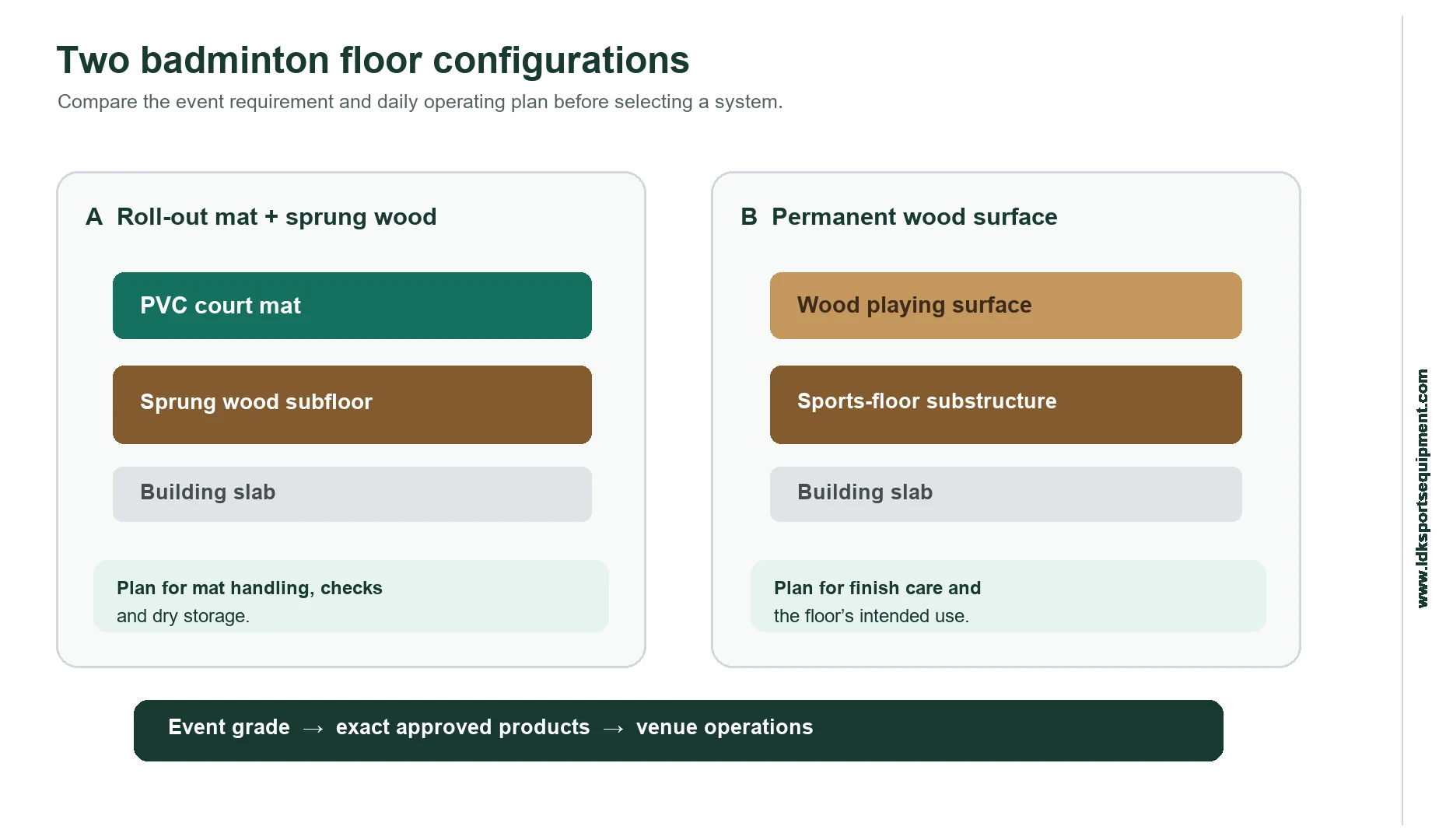
For BWF events whose facility rules specify mats, the required comparison is a court mat plus its supporting floor, not PVC or wood in isolation. For everyday club use, choose a permanent surface or removable mat system according to the event rules, schedule, storage capacity and maintenance plan.
There is no single wood species that the cited BWF facility rule names as best. Sports-floor suppliers commonly offer beech, ash, maple and oak; compare the complete tested system and the requirements for the venue.
A badminton floor may be a permanent sports surface, or it may use a removable PVC court mat over a supporting floor. In specified BWF competition arrangements, the mat and its sprung wood or approved equivalent subfloor are separate parts of the system.
A wood sports floor can be part of a badminton system, but the required configuration depends on the event. For specified high-level BWF events, Section 5.3.4 calls for court mats over a sprung wood floor or equivalent subfloor.
Send the venue’s event level, floor plan, existing base information, daily schedule and mat-storage constraints when requesting a proposal. Contact LDK about the project requirements.
