

Sports Equipment Manufacturer

What are soccer goal posts made of? Compare aluminum vs steel soccer goals and learn what are the measurements of a football goal, plus buyer safety checks.
Soccer goal posts can be made from different approved materials; IFAB does not prescribe one universal metal. In manufactured goals, buyers will encounter specifications built around materials such as aluminum or steel, but the material name alone does not establish safety, suitability, or compliance. The complete goal design—including its frame profile, supports, joints, finish, anchoring, net, intended use, and applicable requirements—must be assessed as one system.
| Question | Short answer | What to verify |
|---|---|---|
| Does IFAB require aluminum or steel? | No. Law 1 requires approved, non-dangerous material rather than one named metal. | The governing competition’s rules and the supplier’s documented frame specification. |
| Is the net made from the same material as the posts? | Usually it is a separate component with its own specification. | Net material, mesh, dimensions, support method, and compatibility with the frame. |
| Does a material label prove a goal is safe? | No. | Complete design, condition, firm securing, instructions, and any required test evidence. |
| Are all soccer goals 7.32 m by 2.44 m? | No. Those are the full-size Law 1 measurements; other formats may differ. | The playing format and competition requirements. |
The most accurate rules-based answer is that the posts and crossbar must be made from an approved material and must not be dangerous. That wording matters. It means the Laws of the Game do not turn “aluminum,” “steel,” “wood,” or any other material name into automatic approval.
For a buyer, aluminum and steel are useful starting categories, not final decisions. Two goals described with the same metal can still differ in frame section, joint design, net supports, finish, mobility hardware, anchoring arrangement, instructions, and intended setting. Conversely, two different materials may both be offered for legitimate use cases when the complete products meet the relevant requirements.
Begin with the use case: match or training, adult or youth format, indoor or outdoor, permanent or movable, and the competition or facility rules that apply. Then compare product documentation—not just the material label.
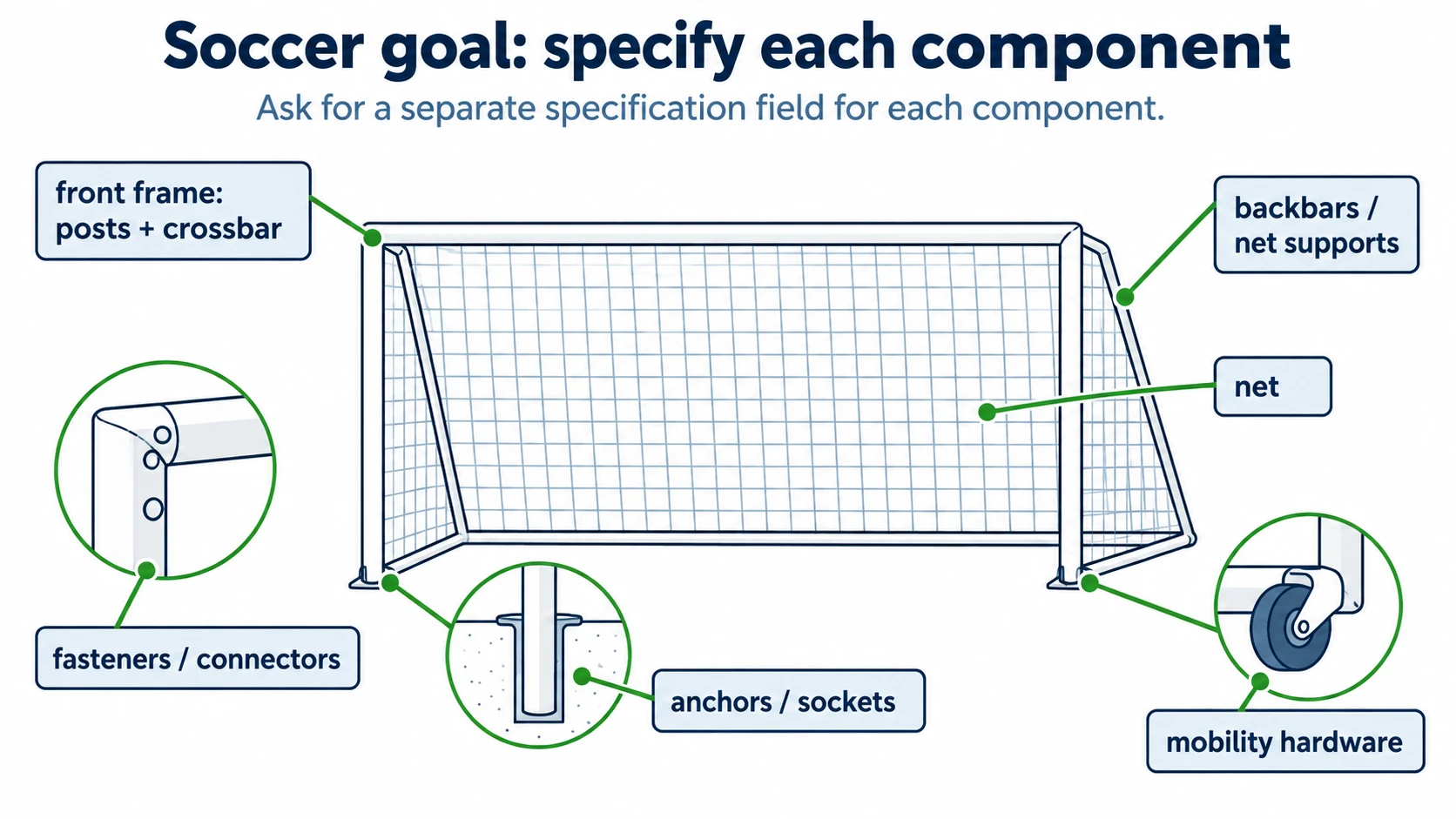
The visible front frame consists of two upright posts joined by a crossbar. A complete goal assembly may also include backbars or net supports, fasteners and connectors, ground sockets or anchors, wheels or hinges, and a net. The actual components vary by design, so the supplier’s drawing and instructions should define what is included.
These components should not be collapsed into one “goalpost material” field. The front frame might have one specification, while supports, connectors, ground interfaces, and mobility parts have others. The net is a separate item again. Ask for each field explicitly, especially when comparing quotes from different suppliers.
IFAB Law 1 treats the net separately from the frame. Nets may be attached to the goal and the ground behind it, provided they are properly supported and do not interfere with the goalkeeper. That rule does not tell a buyer the net material, mesh, cord size, depth, support layout, or replacement method. Those belong in the product and project specification.
Compare aluminum and steel as complete product configurations, not as abstract materials. Universal shortcuts such as “aluminum is always lighter” or “steel is always stronger” ignore the profile, joints, supports, finish, and hardware that define the offered goal.
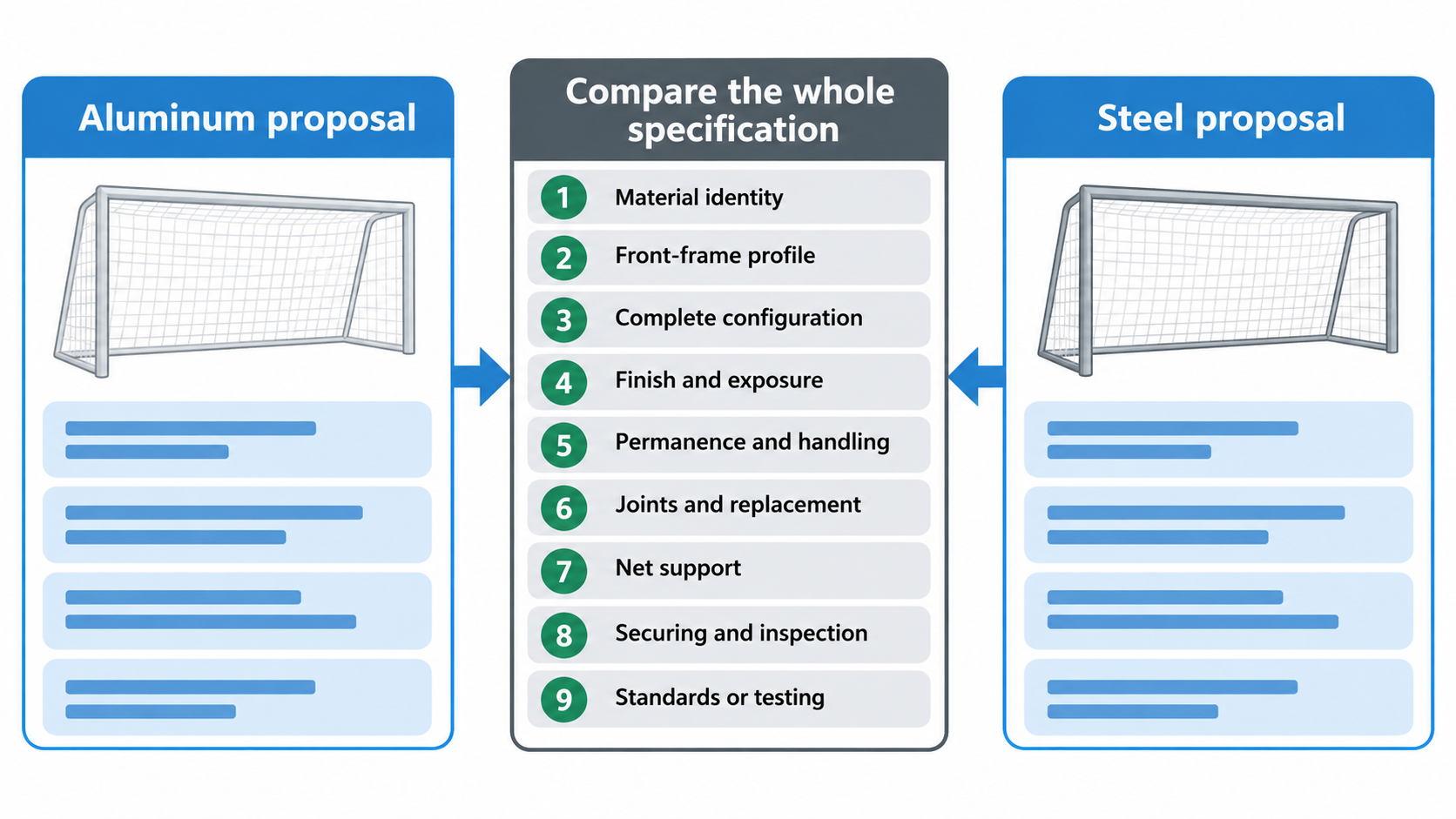
| Specification field | For an aluminum proposal | For a steel proposal | Decision evidence |
|---|---|---|---|
| Material identity | Ask for the stated alloy or product material designation, if relevant. | Ask for the stated grade or product material designation, if relevant. | Supplier data sheet or drawing. |
| Front-frame profile | Request the section shape and documented dimensions. | Request the section shape and documented dimensions. | Dimensioned product specification. |
| Complete configuration | Confirm which supports, connectors, sockets, anchors, wheels, and net are included. | Confirm the same scope. | Bill of materials, drawing, or quotation schedule. |
| Finish and exposure | Ask what finish is supplied and what exposure and maintenance instructions apply. | Ask the same questions. | Finish specification and maintenance instructions. |
| Permanence and handling | Confirm whether the product is permanent, socketed, movable, folding, or another defined type—and how it is intended to be handled. | Confirm the same classification and method. | Product instructions; documented complete assembly information. |
| Joints and replacement | Ask how joints are formed and which parts are replaceable. | Ask the same questions. | Assembly and spare-parts documentation. |
| Net support | Confirm support geometry and compatible net specification. | Confirm the same fields. | Drawing, net schedule, and installation instructions. |
| Securing and inspection | Request the intended securing arrangement and pre-use/maintenance guidance. | Request the same information. | Product-specific instructions and project requirements. |
| Standards or testing | Name the requirement that applies and request evidence for any claimed test or certification. | Apply the same rule. | Current, product-specific documentation with clear scope. |
The table does not declare a winner; it makes quotes comparable. If a material claim does not identify the covered components, the quotation is incomplete.
Compare LDK proposals consistently.
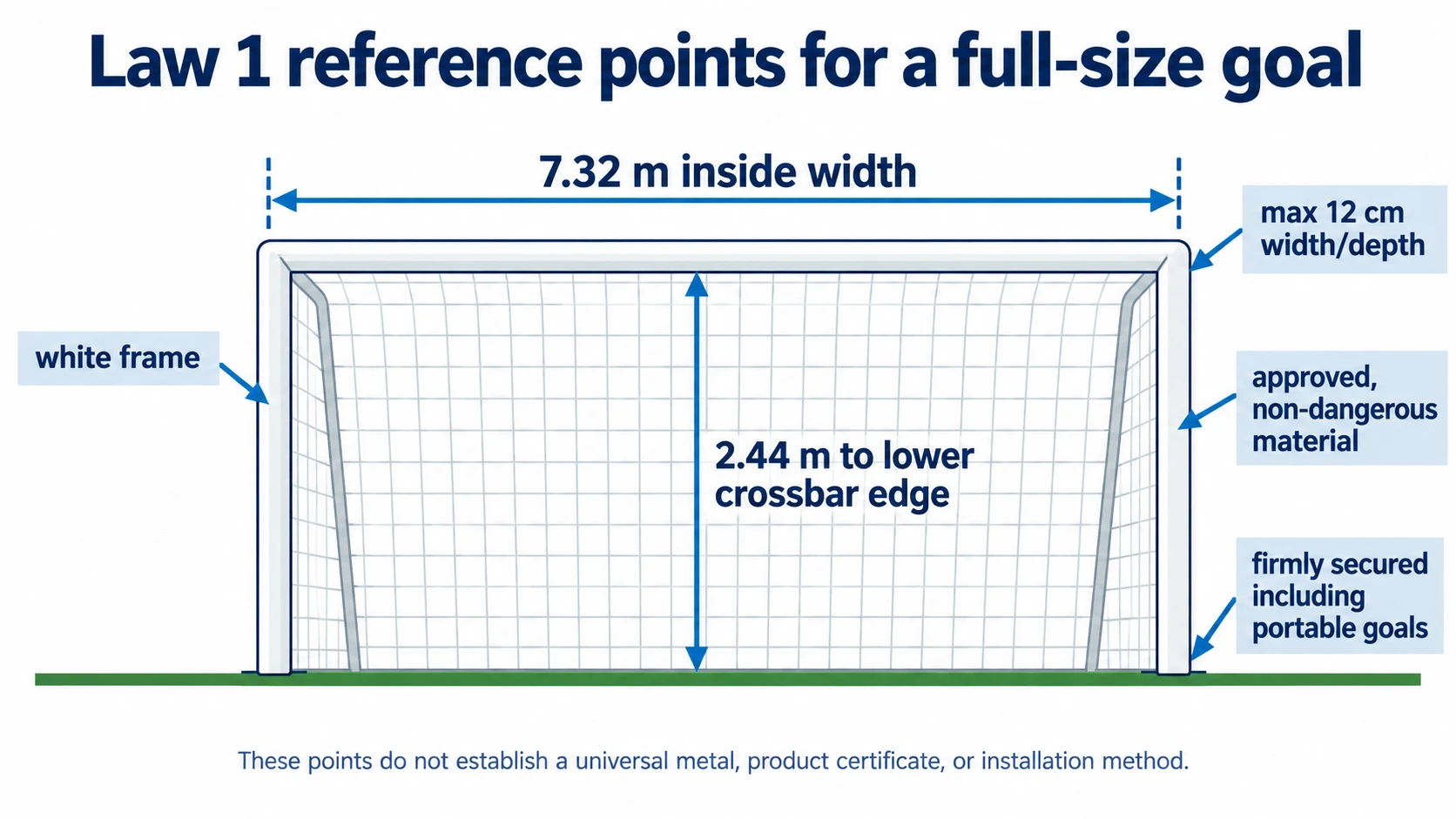
Law 1 sets several match-facing requirements for the goal. Both goals must use the same shape, selected from square, rectangular, round, elliptical, or a hybrid of those options. The posts and crossbar must be white, have equal width and depth, and be no more than 12 cm (5 in) across those dimensions.
| Law 1 requirement | What it answers | What the buyer must still establish |
|---|---|---|
| Approved, non-dangerous material | The rules boundary for frame material. | Actual material designation, profile, construction, and product evidence. |
| Same permitted shape for both goals | Acceptable match-facing cross-sectional categories. | Exact product section and connection details. |
| White posts and crossbar | Required match appearance. | Finish system, repair method, and maintenance guidance. |
| Equal width/depth, maximum 12 cm | A frame-section limit under Law 1. | The exact dimension within the limit and how it relates to the product design. |
| Properly supported, non-interfering net when fitted | A play and goalkeeper-interference boundary. | Net type, depth, mesh, attachment, and support specification. |
| Firmly secured goal | The required safety outcome, including for portable goals. | A product- and site-compatible securing method and responsible installation process. |
These are not a complete manufacturing standard, engineering design, installation instruction, or product certificate. They also do not prove that a particular supplier’s goal meets a competition’s requirements. Use Law 1 as one layer of the specification, then identify any additional competition, facility, jurisdictional, and product-testing obligations.
For the full-size association-football goal described in Law 1, the distance between the inside of the posts is 7.32 m (8 yd). The distance from the ground to the lower edge of the crossbar is 2.44 m (8 ft). Those measurement points are as important as the numbers.
The dimensions do not answer what the goal is made from. Nor should they be applied automatically to youth, futsal, mini, backyard, or training goals. A buyer should name the format and governing competition before requesting dimensions. A product labeled “full size” should still be checked against the required measurement points and the rest of the specification.
Keep the 12 cm limit in the correct category as well: it controls the maximum width and depth of the posts and crossbar under Law 1. It is not a generic wall thickness, alloy, steel grade, or structural-performance value.
IFAB states that goals, including portable goals, must be firmly secured to the ground. The rule defines the required outcome; it does not provide one universal anchor for every goal, surface, or site. Follow the product-specific instructions and the responsible facility or project requirements.
A visual pre-use check should never become an improvised load test. If firm securing cannot be confirmed, or damage creates uncertainty, do not place the goal in use until the instructions or a competent responsible assessment resolves the issue.
| Symptom | Possible issue to check | Verify without unsafe testing | Action |
|---|---|---|---|
| The goal visibly moves or its position changes | Securing may be absent, incomplete, incompatible, or damaged. | Keep users away; compare the visible configuration with the product instructions and site plan. | Stop use until firm securing is confirmed and any defect is resolved. |
| A connector or fastener is loose or missing | The assembly may not match its documented configuration. | Perform a visual inventory against the supplier’s drawing; do not improvise a substitute. | Stop use and follow the specified replacement/assembly process. |
| A post, crossbar, support, or edge appears bent, cracked, sharp, or otherwise damaged | The component’s condition is uncertain. | Record the location and consult the product’s inspection guidance or a competent responsible party. | Isolate the goal until assessed and repaired or replaced as required. |
| A net or support intrudes into the goalkeeper’s space | The net may be incorrectly fitted, unsupported, damaged, or incompatible. | Compare the setup with the net and goal instructions from outside the playing area. | Correct the documented setup before use; replace incompatible or damaged parts. |
| Coating damage or corrosion is visible | The finish or underlying component may need maintenance or assessment. | Check the documented maintenance limits; do not infer remaining strength from appearance alone. | Follow the manufacturer or facility maintenance decision process. |
Material choice cannot compensate for missing securing, incompatible parts, or unresolved damage. The decision sequence is therefore: confirm the required format, obtain the complete specification, confirm the intended installation and securing method, and maintain the assembly under documented instructions.
A reliable specification separates three layers rather than using the word “standard” as if it meant one thing.
First, IFAB Law 1 defines the goal requirements relevant to the match. Second, the governing competition, facility owner, and local jurisdiction may add format, installation, operational, or procurement requirements. Third, the supplier’s documentation should identify the actual product and the evidence behind any test, certification, or performance statement.
IFAB recommends that goals used in official competitions organized under FIFA or confederations meet the FIFA Quality Programme for Football Goals. Keep that statement within its recorded scope. It is not evidence that every goal requires that programme, and it is not proof that a specific product has passed it.
Before issuing a request for quotation, write down the competition and location, identify the requirement by its current name, and ask the supplier to map its evidence to the exact product configuration being offered. Do not accept an organization logo, a generic certificate, or the phrase “FIFA standard” as a substitute for scoped documentation.
A consistent request-for-quotation schedule exposes hidden differences. Adapt these fields with the competition, facility, and project professionals.
| RFQ field | Information to request |
|---|---|
| Use case | Match, training, school, club, municipal, indoor, outdoor, backyard, or another defined setting. |
| Playing format | Full-size, youth, futsal, mini, or other competition-defined format; include required measurement points. |
| Front frame | Material designation, section shape, documented dimensions, finish, joint construction, and color. |
| Backbars and net supports | Materials, geometry, connections, and replacement parts, listed separately from the front frame. |
| Goal type | Permanent, socketed, freestanding, movable, folding, ceiling-suspended, or another documented design. |
| Ground interface and securing | Product-specific sockets, anchors, foundations, counterweight provisions, or other designed system; installation responsibility and site compatibility. |
| Mobility and storage | Complete assembly information, approved handling method, wheel or hinge details, storage position, and staffing/equipment requirements. |
| Net | Material, mesh, cord, dimensions, depth, attachment method, support compatibility, and replacement reference. |
| Inspection and maintenance | Pre-use checks, inspection schedule if documented, maintenance limits, repair process, and stop-use criteria. |
| Governing requirements | Competition rules, facility requirements, jurisdiction, and any required product-testing or certification evidence. |
| Delivery and installation | Included components, site readiness, assembly, installation, handover documents, and responsible parties. |
| Evidence schedule | Drawings, data sheets, instructions, test reports, certificates, and their exact product/configuration scope. |
Have every bidder complete the same schedule and explain any non-applicable field. The quotation should identify options that affect a claim. This avoids comparing an installed system with a frame-only price or assuming one material label covers the entire goal.
Send specifications through LDK’s inquiry channel.
Choose only after confirming that the 8 × 24 ft measurement is the required full-size format and that the complete goal can be handled, stored, inspected, and firmly secured as documented. Use the material-comparison and buyer-checklist sections to compare products rather than relying on “portable” in the name.
Start with the available space, intended users, supervision, exposure, storage, and a product-specific method for firm securing. The buyer checklist shows which frame, support, net, maintenance, and site fields to confirm; a backyard label does not remove the need for safe use.
There is no evidence-backed universal winner, so define “best” through the documented folding method, complete configuration, handling, storage, net support, securing, replacement parts, and applicable requirements. Apply the aluminum-versus-steel specification table and avoid rankings based only on material or price.
A portable goal should not be used in an indoor setting if the product’s required securing method cannot be followed there. Refer to the safety section: confirm the exact product instructions and facility constraints, and do not improvise an anchor or assume that a small goal is exempt.
Select the net as a separate, compatible component rather than treating “goalpost material” as a net specification. Use the component section to confirm net dimensions, depth, mesh, cord, attachment, support, and goalkeeper clearance for the particular frame and format.
So, what are soccer goal posts made of? There is no single material mandated by IFAB. The rules require approved, non-dangerous material and define important properties such as shape, color, full-size dimensions, net conditions, and firm securing. A buyer should then compare the complete documented configuration—whether a proposal uses aluminum, steel, or another material—against the intended format, site, handling plan, product instructions, and applicable requirements.