Sports Equipment Manufacturer

See indoor basketball court cost ranges for hardwood floor packages, existing buildings and new construction. Compare what each quote includes.
For an indoor basketball court construction cost estimate, first clarify what “court” means: a floor package in an existing gym differs from converting a garage or constructing a new building. If you are asking how much it costs to build an indoor basketball court, one manufacturer’s October 2026 guide reports $10,000–$45,000 for small residential or training half-courts inside existing structures, $46,000–$198,000 for full-size competition courts, and $12–$26 per square foot for an installed hardwood floor package.
Those figures are Junckers’ published planning benchmarks, not universal prices: its installed floor-package scope includes the subfloor, hardwood sports flooring, line marking and finishing, while a building shell, site services and local approvals need separate project pricing. Define the scope before comparing ranges.
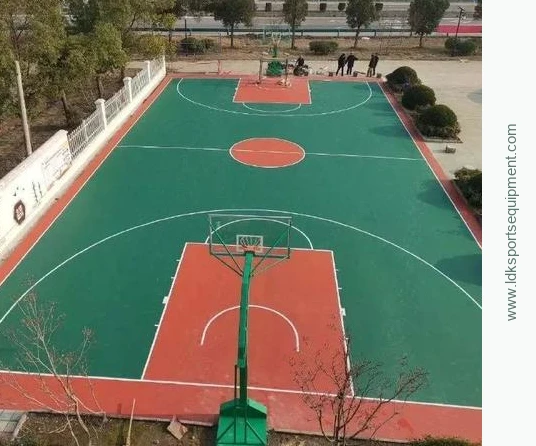
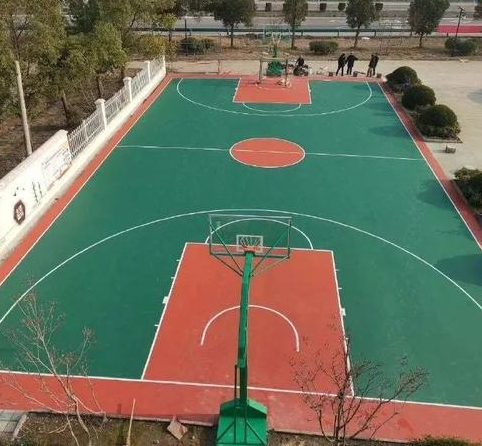
Basketball court project example.
Ask whether the quote is for flooring only, work inside an existing building, or a complete new facility. Then check the following items separately:
| Budget area | Questions for the supplier or project team |
|---|---|
| Building or room | Is the space already available? Are structural alterations, roof, walls or access included? |
| Base and subfloor | What existing slab or substrate is assumed? Is inspection, preparation or a new subfloor included? |
| Playing floor | Which exact flooring system and construction are quoted? Is it fixed or portable? |
| Lines and finish | Are the court markings, colors, logos and finishing included? |
| Equipment | Are hoops, backstops, padding, scoreboards and installation included? |
| Building services | Are lighting, heating, ventilation, electrical work and fire systems included? |
| Delivery and site work | Are freight, unloading, access equipment, disposal and site cleanup included? |
| Design, permits and contingency | Who handles drawings, engineering, permits, inspections and change orders? |
When comparing bids, align the court size, floor system, installation scope, project location, currency and included work.
Junckers’ published guide gives three useful reference points for indoor flooring projects:
The same guide says system choice, court size, substructure, site conditions, installation requirements and custom features affect the quote. These numbers are from a flooring manufacturer’s current planning guide, not an independent survey. They can help frame a first discussion about a floor package, but they do not price every building component or replace a project quote.
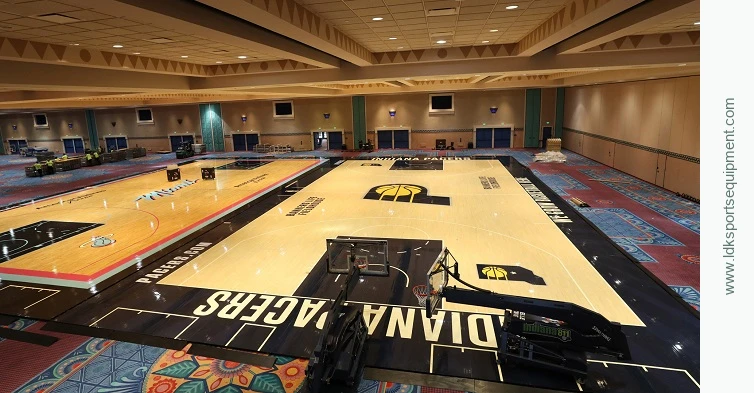
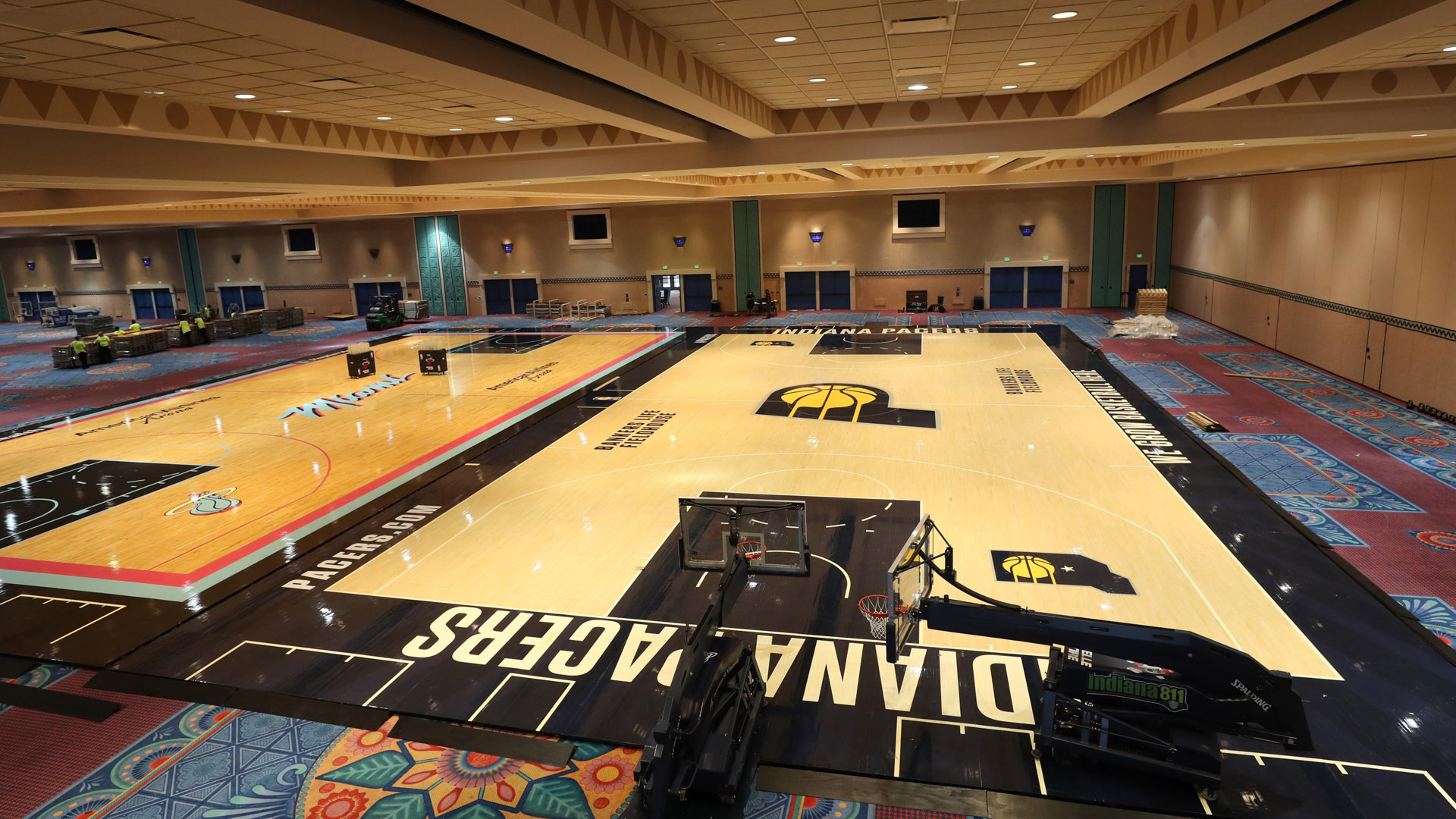
Indoor wooden basketball floor example.
For an indoor floor option, review the LDK wooden basketball flooring page. Confirm the exact construction and supporting documents for the intended project.
An existing hall, garage or warehouse may reduce the amount of new building work, but it does not mean the floor can be installed without checking the base and room. Ask the project team to verify slab condition, moisture, levelness, loads, access and building services against the selected flooring system’s instructions and local requirements.
A new standalone facility adds scope beyond flooring: site work, foundations, structure, roof, enclosure, utilities, code compliance and approvals. The published flooring benchmark above does not include enough information to price those items. Request separate line items and have the building work estimated by qualified local professionals.
For context, FIBA’s venue guide specifies a 28 m × 15 m inner playing area and a further boundary area around it for its full-size court layout. That affects the space available for a competition court, but a project’s required total room envelope must also account for structure, services, circulation and applicable local codes.
Give each bidder the same project brief:
This makes differences in price easier to explain. It also prevents a low floor-only quote from appearing equivalent to a broader construction offer.
The range depends on whether you are buying an installed floor package inside an existing building or constructing a full facility. Junckers’ October 2026 guide reports $10,000–$45,000 for small residential/training half-court projects and $46,000–$198,000 for full-size competition-court projects, with its $12–$26 per-square-foot installed hardwood-floor figure covering subfloor, flooring, lines and finishing. Treat these as one manufacturer’s planning references and confirm exact scope.
The slab price depends on site conditions, design loads, local labor and materials, reinforcement, drainage, access and the project’s engineering requirements. The floor-package ranges above do not price a new slab. Ask a qualified local designer or contractor for a site-specific slab scope and quote.
If a suitable building and base already exist, retaining them may reduce the amount of new construction. Compare the base preparation and flooring system as one installed scope, and include required services, markings and equipment. A surface-only quote does not represent the total project cost.
For a FIBA full-size court layout, the inner playing area is 28 m × 15 m, with at least 2 m of boundary area around it. The FIBA Venue Guide therefore gives minimum overall court-area dimensions of 32 m × 19 m and at least 7 m of clear height above the playing area. That is a competition-layout reference, not a universal building footprint: circulation, access, equipment, structure, services and local requirements can add space. A private half-court has different needs; confirm its layout with the project designer.
There is no single value increase that applies to every home. Resale impact depends on the local market, buyer demand, the court’s condition and whether the space can serve other uses. Treat resale value as a question for a local real-estate appraiser, not as a guaranteed return in a construction budget.
Permit requirements depend on the location and the work involved. A flooring replacement may be treated differently from a building conversion or new structure. Check with the local authority and project professionals before construction begins.
For project details or a flooring discussion, contact LDK.