Sports Equipment Manufacturer

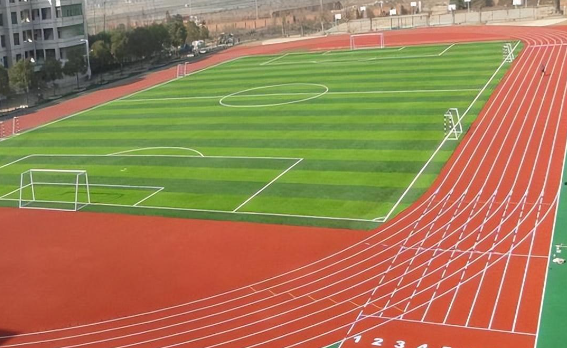
How long is a track around a football field? Learn Lane 1 nominal 400m dimensions, outer lane distances, lap-to-mile conversions, and infield geometry fit.
A standard regulation running track built around a football field has a nominal length of 400 meters (437.45 yards / 1,312.34 feet / 0.2485 miles) in Lane 1 (the innermost lane). Four complete laps around Lane 1 equal 1,600 meters, which is just 9.34 meters (30.64 feet) short of a full international statute mile (1,609.344 meters / 5,280 feet). Under official regulatory specifications established by World Athletics, the National Federation of State High School Associations (NFHS), and the NCAA, a standard 400m outdoor running track consists of two straightaways measuring 84.39 meters and two semicircular curves with an inner curb radius of 36.50 meters, measured 30 centimeters outward from the inside curb. Official World Athletics facility rules permit a strict construction tolerance between +0.000m and +0.040m (400.000 m to 400.040 m) for certified competition tracks.
Note on Non-Regulation and Legacy Tracks: While the overwhelming majority of modern high school, collegiate, and professional stadiums feature regulation 400-meter tracks, older facilities (particularly those constructed before metric conversion in the 1970s and 1980s) may feature legacy imperial 440-yard tracks (402.34 meters), or custom non-standard perimeters adapted to tight property boundaries. Athletes and planners should confirm whether a local facility is a standard 400m metric oval or a legacy imperial layout.
While Lane 1 has a nominal length of 400.00 meters, each successive outer lane covers a wider radius and is progressively longer. Running in Lane 2 adds 7.037 meters (approx. 7.04 m) per lap (measuring 407.04 meters), while Lane 8 measures a calculated 453.03 meters (with a total cumulative stagger of 53.030 meters). Understanding these precise geometric dimensions is essential for runners pacing workouts, coaches calculating interval splits, and facility managers planning dual-purpose athletic stadiums. In this guide, we analyze the mathematical geometry of standard 400m tracks, calculate outer lane distances and lap-to-mile conversions, evaluate spatial compatibility for American football and soccer infields, and examine industry engineering standards for track construction and drainage.
To quickly compare track distances, lane measurements, and mile calculations across a standard 8-lane athletic track, review the standardized data summarized below based on official World Athletics Track Facilities Manual Table 1.2.3.2 and ASBA Guidelines:
| Lane Number | Running Line Radius (Meters) | Calculated Lap Distance (Meters) | Lap Distance (Yards / Feet) | Stagger / Distance Added vs. Lane 1 | Laps Required for 1 Mile (1,609.34 m) |
|---|---|---|---|---|---|
| Lane 1 (Inside) | 36.80 m (30cm from curb) | 400.00 m (Nominal) | 437.45 yd / 1,312.34 ft | Baseline (0.000 m) | 4.023 laps (4 laps + 9.34 m) |
| Lane 2 | 37.92 m (20cm from line) | 407.04 m | 445.14 yd / 1,335.43 ft | +7.037 m (+23.09 ft) | 3.954 laps |
| Lane 3 | 39.14 m (20cm from line) | 414.70 m | 453.52 yd / 1,360.56 ft | +14.703 m (+48.24 ft) | 3.881 laps |
| Lane 4 | 40.36 m (20cm from line) | 422.37 m | 461.91 yd / 1,385.73 ft | +22.368 m (+73.39 ft) | 3.810 laps |
| Lane 5 | 41.58 m (20cm from line) | 430.03 m | 470.29 yd / 1,410.86 ft | +30.034 m (+98.54 ft) | 3.742 laps |
| Lane 6 | 42.80 m (20cm from line) | 437.70 m | 478.67 yd / 1,436.02 ft | +37.699 m (+123.68 ft) | 3.677 laps |
| Lane 7 | 44.02 m (20cm from line) | 445.37 m | 487.06 yd / 1,461.19 ft | +45.365 m (+148.84 ft) | 3.614 laps |
| Lane 8 (Outside) | 45.24 m (20cm from line) | 453.03 m | 495.44 yd / 1,486.32 ft | +53.030 m (+173.98 ft) | 3.552 laps |
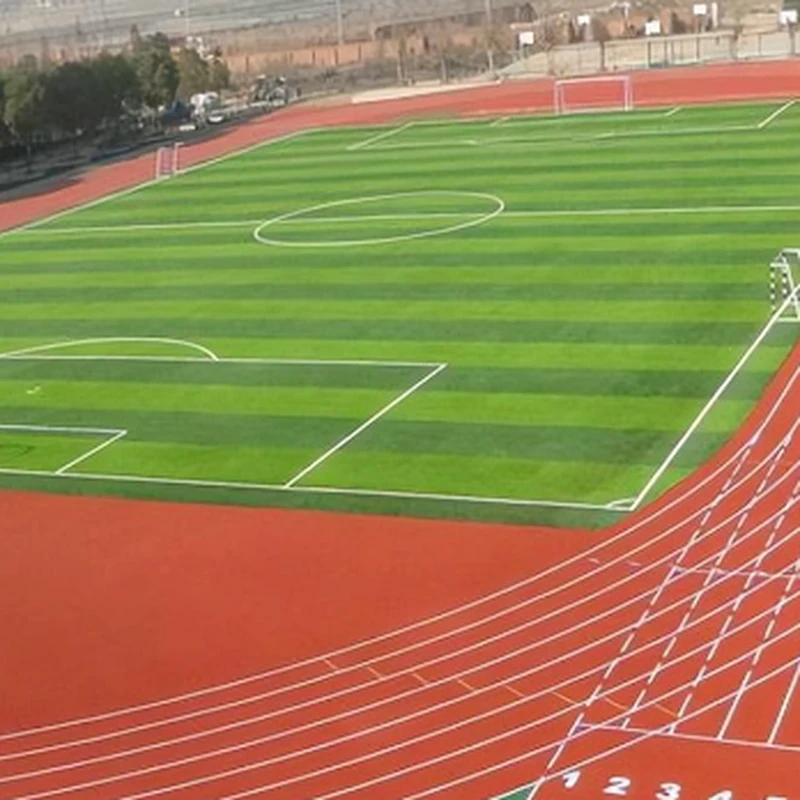
Modern competition running tracks are precision-engineered geometric layouts rather than simple ovals. Their dimensions are designed to ensure fair competition and uniform pacing worldwide.
Under the World Athletics Track and Field Facilities Manual (Chapter 1) and NCAA Rule 1, the standard outdoor track consists of:
Athletics rules mandate that runners cannot run directly on top of the raised inner curb or inside painted chalk line. World Athletics Rule 14.1 specifies that:
Using the standard 30 cm kerb offset, the theoretical calculation for Lane 1 distance is:
This mathematical balance between straights and circular turns is why 400 meters is the universal international standard.
Because each lane increases the turn radius, runners in outer lanes cover a wider path around every curve.
A vital regulatory distinction in World Athletics and NCAA rules is how the running line is measured across different lanes:
With a standard lane width of 1.22 meters (w = 1.22 m), the running line radius for Lane 2 is:
R2 = 36.50 m (curb radius) + 1.22 m (Lane 1 width) + 0.20 m (measurement offset) = 37.92 meters.
The radius increase between Lane 1 and Lane 2 is:
ΔR(1 to 2) = 37.92 m – 36.80 m = 1.12 meters (not 1.22 m).
Therefore, the additional lap distance (stagger) added from Lane 1 to Lane 2 is:
ΔD(1 to 2) = 2 * π * 1.12 m = 2 * 3.14159265 * 1.12 m = 7.037 meters (approx. 7.04 m / 23.09 ft).
For Lanes 3 through 8, each subsequent lane line is spaced by 1.22 meters, and all outer lanes share the uniform 20 cm offset. Thus, from Lane 2 outward, each additional lane adds:
ΔD(outer) = 2 * π * 1.22 m = 2 * 3.14159265 * 1.22 m = 7.6655 meters (approx. 7.67 m / 25.16 ft).
Official World Athletics cumulative stagger distances and calculated lap lengths:
To equalize competitive distances across different events, start lines are staggered based on race format:
A frequent question for fitness enthusiasts, runners, and physical education students is converting track laps to statute miles.
If you jog in outer lanes during public track hours, you cover significantly greater yardage per lap:
Completing 4 laps in Lane 8 equals 1,812.12 meters (1.126 miles), which is more than 202 meters longer than a statute mile.
The central area enclosed by a 400-meter track oval is known as the infield. While athletic facilities routinely use this space for team sports, spatial compatibility differs substantially between American football and association football (soccer).
Architectural & Engineering Notice: Spatial compatibility figures and run-off calculations presented below represent preliminary geometric clearance checks based on idealized mathematical boundaries. They do not constitute formal architectural construction drawings or site-specific design approvals. Dual-use athletic facility projects must engage licensed architects and civil engineers to evaluate local property setbacks, spectator sightlines, and competition sanctioning requirements.
| Field Type | Playing Area Dimensions | Total Playing Field Footprint (Including End Zones / Goal Areas) | Infield Spatial Fit inside Standard 36.5m Radius Track | Sideline Clearance to Inner Track Curb | Safety and Operational Assessment |
|---|---|---|---|---|---|
| American Football (NFL / NCAA) | 100 yd x 53.33 yd (91.44 m x 48.77 m) | 120 yd x 53.33 yd (109.73 m x 48.77 m) [Field Proper with End Zones] | Ample Lateral Fit: 48.77m width fits inside the 73.0m straight width; 109.73m length extends 12.67m past the 84.39m straights into curves where width exceeds 68m. | 12.12 m (39.75 ft) on each straight sideline | Readily accommodates typical high school 3.66m (12 ft) safety borders. Professional NFL configurations requiring 30+ ft bench zones plus auxiliary setback require specialized site layout. |
| High School Soccer (NFHS Multi-Use) | 100 – 110 yd x 65 – 70 yd (91.44 – 100.58 m x 59.44 – 64.01 m) | 100 – 110 yd x 65 – 70 yd (97.4 – 106.6 m x 65.4 – 70.0 m with 3m auxiliary margins) | Recommended Multi-Use Fit: Sizing the soccer pitch at 60 m – 64 m width fits standard tracks comfortably. | 4.50 m – 6.50 m on each touchline | Provides practical unencumbered run-off margins consistent with typical interscholastic multi-sport recommendations (NFHS Rule 1-1). |
| Benchmark International Soccer (FIFA) | 105.00 m x 68.00 m (114.83 yd x 74.37 yd) | 105.00 m x 68.00 m (113.0 – 115.0 m x 74.0 – 76.0 m incorporating auxiliary spaces) | Spatial Restriction at Curves: A 68m pitch inside a 73m straight width leaves 2.5m touchline clearance, narrowing to ~1.0m at corner arcs; goal run-offs intersect track curves. | 2.50 m (8.20 ft) along straight touchlines; ~1.0 m at corner arcs | 2.5m touchline clearance meets the immediate 2.0m level boundary, but falls below recommended 3.0m-5.0m auxiliary space. Goal deceleration zones intersect curves unless track geometry is modified. |
Under the Official NFL Rulebook (Rule 1), an American football field measures 120 yards (109.73 meters) in total length by 53.33 yards (48.77 meters) in width.
A standard 400m track features an infield straight width of approximately 73.00 meters (calculated as 2 * 36.50 m radius). Centering a 48.77-meter-wide gridiron field inside the infield yields:
(73.00 m – 48.77 m) / 2 = 12.115 meters (39.75 feet) of clear sideline buffer on each side along the straightaways.
Because the track straightaways measure 84.39 meters, the 109.73-meter total field (including two 10-yard end zones) extends past the straightaways by (109.73 m – 84.39 m) / 2 = 12.67 meters into each semicircular curve. At 12.67 meters into a 36.50-meter radius curve, circular geometry dictates that available track width remains: 2 * sqrt(36.50^2 – 12.67^2) = 2 * sqrt(1332.25 – 160.53) = 2 * 34.23 = 68.46 meters, which easily clears the 48.77-meter-wide end zones.
In interscholastic dual-use venues, this ~39.7-foot buffer comfortably exceeds typical high school perimeter guidelines (which recommend at least 12 feet / 3.66 m of unobstructed space under NFHS guidelines). However, facility planners should note that professional NFL rules specify team benches positioned at least 30 feet 4 inches (9.25 m) back from the sidelines and rigid fixtures at least 10 yards (9.14 m) away; at the professional level, a 12.12-meter sideline clearance leaves limited auxiliary depth behind benches, requiring specialized stadium boundary layouts.
Under FIFA Football Stadiums Guidelines (Chapter 2), standard professional soccer pitches measure 105 meters long by 68 meters wide. FIFA guidelines differentiate between:
When evaluating this footprint against a standard 36.5-meter radius track (73.00 m straight width), specific geometric constraints arise:
To balance safety and athletic competition, facility planners commonly implement two engineering solutions:
This design compromise provides ample width for international soccer but requires extended sprint chutes for 100m sprint and 110m hurdle events.
Engineering Design Guidance Notice: While track geometric boundaries and lane markings are governing competition rules and technical standards governed by World Athletics Rule 14, NFHS Rule 2, and NCAA Rule 1, foundation depths, drainage gradients, and synthetic polymer formulations represent civil engineering design heuristics. Site planners should adapt construction specifications to local geotechnical, seismic, and climatic conditions in consultation with guidelines published by the American Sports Builders Association (ASBA) and SAPCA. All subbase crossfalls and slot drainage designs must be reviewed and stamped by a qualified professional civil engineer to ensure compliance with regional stormwater regulations.
Modern competition tracks utilize all-weather synthetic surfaces designed to provide uniform traction and shock absorption across varying weather conditions:
Under technical design standards outlined in the ASBA Running Tracks Construction Manual and World Athletics Technical Regulations Rule 14.3:
Observing customary track etiquette promotes safety and orderly training in shared athletic environments:
Lane 1 of a regulation outdoor athletic running track has a nominal length of 400.00 meters (437.45 yards / 1,312.34 feet / 0.2485 miles). World Athletics certified tracks permit a construction tolerance between 400.000m and 400.040m. This standard applies to high school, NCAA collegiate, and international Olympic venues governed by World Athletics, NFHS, and NCAA rules.
Four laps around Lane 1 equal 1,600.00 meters, which is 9.34 meters (30.64 feet) short of a standard statute mile (1,609.34 meters). To run a full statute mile in Lane 1, you must complete 4 full laps plus an additional 9.34 meters (approximately 4.023 laps).
Under official World Athletics specifications (Table 1.2.3.2), one complete lap in Lane 8 measures a calculated 453.03 meters (495.44 yards / 0.2815 miles). That is 53.030 meters (173.98 feet) longer than a lap in Lane 1 due to the cumulative curve radius increase.
Semicircular curves enable runners to maintain centripetal momentum and smooth stride mechanics at high speed without decelerating for sharp turns. Circular geometry also provides uniform mathematical radii, permitting precise lane staggers for multi-lane competition.
A regulation 105m x 68m FIFA soccer pitch faces spatial restrictions inside a standard 36.5m radius track infield (73m width). Mid-pitch touchline clearance is 2.5m (satisfying FIFA’s 2m level grass boundary, but less than the 3-5m recommended auxiliary margin), corner kick arcs leave ~1.0m of clearance, and 4-5m goal deceleration zones physically intersect track curves. High schools resolve this by using 60m to 64m wide pitches, while specialized multi-sport stadiums utilize enlarged 40m-radius tracks with shortened 73.4m straights to widen the infield to 80 meters.
Yes, an American football field fits with generous sideline clearance. Measuring 120 yards (109.73 m) long including end zones and 53.33 yards (48.77 m) wide, the gridiron field leaves over 12.1 meters (39.7 feet) of sideline buffer along the straightaways inside a standard 73-meter track infield, while the end zones extend into the curves where available width remains over 68 meters.
Modern stadium running tracks are surfaced with all-weather synthetic materials, most commonly polyurethane-bound rubber systems (such as spray-applied, sandwich, or full-pour elastomeric systems) installed over an asphalt and crushed aggregate base. These surfaces deliver all-weather traction, spike resistance, and shock absorption.
A regulation running track around a football field is a 400-meter oval governed by international athletics geometry. Whether pacing a 1-mile interval workout or evaluating a multi-use athletic complex, accurate understanding of lane dimensions and infield clearances ensures peak performance and player safety.
Key facility planning takeaways:
Technical Reviewer Profile: Marcus Sterling, Senior Sports Surface & Pitch Construction Specialist (B.Sc. Civil Engineering). Marcus brings over 15 years of practical experience in athletics track geometry, synthetic turf civil works, and stadium drainage compliance. He advises on international facility standards in accordance with World Athletics, NFHS, and ASBA technical guidelines.