Sports Equipment Manufacturer

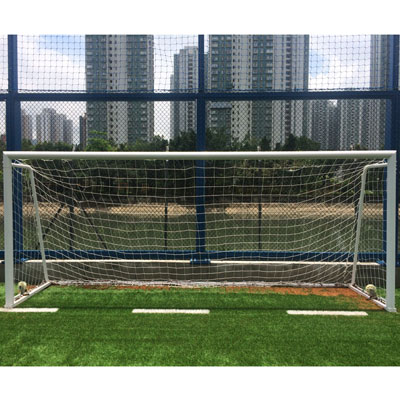
Official 11 a side football goal post size in meters is 7.32m x 2.44m. Explore IFAB rules, standard football goal dimensions in meters, net depth, and safety.
Under official International Football Association Board (IFAB) Laws of the Game (Law 1 – The Field of Play) and FIFA stadium guidelines, the standard size of an adult 11-a-side football goal is exactly 7.32 meters wide by 2.44 meters high. In British imperial measurements, this corresponds to 8 yards (24 feet) in width and 8 feet in height. The width is measured between the inner edges of the two vertical goalposts, while the height is measured from the ground level of the pitch to the lower edge of the horizontal crossbar. Furthermore, the goalposts and crossbar must not exceed 12 centimeters (5 inches) in width and depth, which must exactly match the width of the painted goal line. For official match play, a goal must also provide adequate net runback depth, typically requiring a minimum of 1.50 meters of ground depth and 0.80 meters of top depth to prevent balls from rebounding back into active play.
Whether you are a municipal groundskeeper marking out a regulation pitch, a football club facility manager procuring certified match equipment, a referee carrying out mandatory pre-match safety checks, or a youth coach navigating age-specific step-downs, understanding the exact regulatory and structural dimensions of full-size football goals is fundamental to ensuring fair play and athletic safety.
To answer the core question directly, all senior competitive 11-a-side matches, including the FIFA World Cup, UEFA Champions League, English Premier League, Major League Soccer, and sanctioned adult grassroots leagues, require identical goal dimensions:
A common search query and historical typographical error circulating on legacy sports websites is “7.23 meters” instead of “7.32 meters”. This discrepancy originates from a typographical digit transposition of the imperial conversion. When the Football Association initially codified association football rules in 1863, the goal width was established as 8 yards. Because one international yard equals exactly 0.9144 meters, 8 yards converts mathematically to:
$$8 \times 0.9144\text{ m} = 7.3152\text{ meters}$$
Rounded to two decimal places, international governing bodies standardized this statutory figure as 7.32 meters. Similarly, the crossbar height of 8 feet converts to:
$$8 \times 0.3048\text{ m} = 2.4384\text{ meters}$$
Standardized as 2.44 meters. Any equipment marketed or installed at 7.23 meters is non-compliant and will fail formal pre-match pitch inspection.
The following technical specification table summarizes the regulatory parameters governing official 11-a-side goalposts:
| Parameter | Metric Value (Meters / cm) | Imperial Equivalent (Feet / Inches) | Governing Regulatory Standard |
|---|---|---|---|
| Interior Goal Width | 7.32 m | 24 ft (8 yards) | IFAB Law 1 / FIFA Quality Programme |
| Interior Goal Height | 2.44 m | 8 ft | IFAB Law 1 / FIFA Quality Programme |
| Post / Crossbar Profile Width | Max 12 cm (typically 10-12 cm) | Max 5 in | IFAB Law 1 (Shape: Elliptical / Round) |
| Goal Line Width | 12 cm (identical to post profile) | 5 in | IFAB Law 1 |
| Minimum Net Base Depth | 1.50 m | 4.9 ft | FIFA Stadium Guidelines |
| Minimum Net Top Runback | 0.80 m | 2.6 ft | FIFA Goal Standards / Continental D-bracket |
| Horizontal Pull Stability | 1,100 N applied at crossbar | ~112 kg force | BS EN 748 / ASTM F2056 Safety Standard |
Under IFAB Laws of the Game, Law 1 sets forth unequivocal mandates regarding the construction, color, and positioning of the goal structures. A regulation goal consists of two upright vertical posts equidistant from the corner flagposts and joined across the top by a horizontal crossbar.
IFAB Law 1 explicitly requires that:
“The goalposts and crossbar must be white.”
White provides the highest optical contrast against varied pitch backgrounds, green natural turf, stadium seating, and dim floodlit skies, enabling goalkeepers, outfield players, assistant referees, and video assistant referees (VAR) to clearly discern whether the entire ball has crossed the line. The finish must be non-reflective and weather-resistant, commonly applied through architectural-grade polyester powder coating over primed metal.
Goalposts and crossbars must be identical in cross-sectional shape. Permissible geometries include:
– Elliptical / Oval: Widely favored in professional stadiums because the aerodynamic curve reduces frontal wind resistance and minimizes unpredictable ball rebound deflections while maintaining structural rigidity.
– Round: Traditional profile, common in multi-sport public parks and school facilities (typically 100mm to 120mm outside diameter).
– Square / Rectangular: Permitted under law provided all corners are rounded with an appropriate radius to mitigate player laceration hazards.
The law requires that goal components must be constructed of wood, metal, or other approved materials and must not be hazardous to players. Contemporary competition facilities universally utilize extruded, high-tensile aluminum alloy (an equipment manufacturing category cataloged by sports facility suppliers such as LDK Sports Equipment) or hot-dip galvanized steel, combining lightweight strength with structural longevity.
A critical regulatory detail frequently overlooked during grassroots pitch installation is the alignment between the goalposts and the chalked goal line:
– The goalposts and crossbar must be positioned directly over the goal line.
– The width of the goal line must be exactly equal to the width and depth of the goalposts (up to a maximum of 12 cm).
– If the goalposts are 10 cm in diameter, the goal line must be marked at 10 cm. If the posts are 12 cm, the line must be 12 cm.
– The front edge of the goalposts must be aligned flush with the outer edge of the goal line that faces the field of play. This ensures that a goal is awarded only when the entire sphere of the ball has completely crossed over the rear edge of the goal line into the interior net cavity.
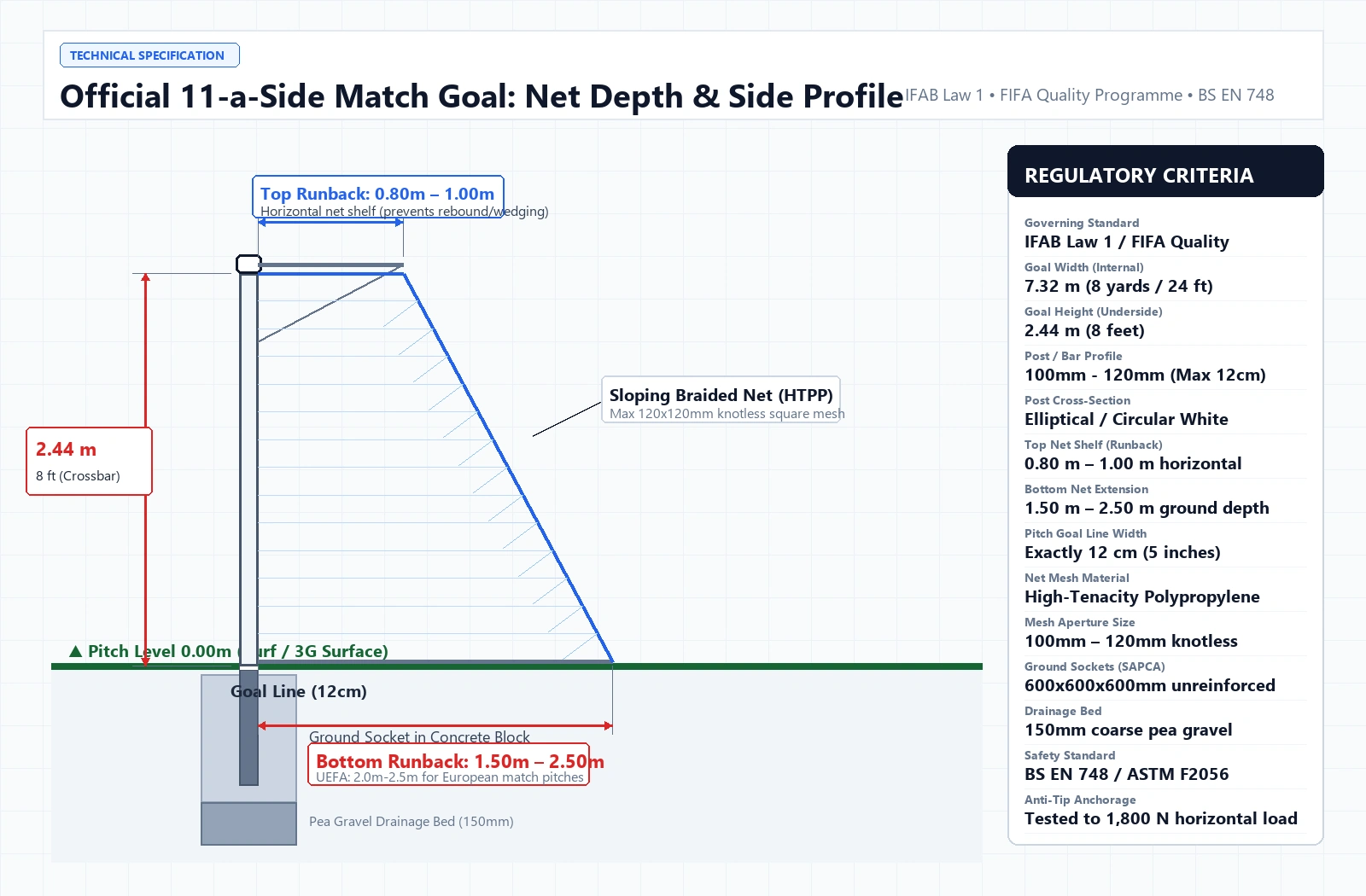
While width and height determine the scoring window, net depth determines how the goal functions during fast-moving match scenarios. A goal without adequate net depth can cause powerful shots to strike the back netting and rebound immediately into the field of play, causing referee confusion and player disputes over whether a goal was scored.
FIFA Quality Programme for Football Goals and UEFA stadium infrastructure regulations dictate the following spatial clearances:
– Ground Runback (Bottom Net Depth): At pitch level, technical stadium guidance and tournament equipment specifications generally call for rear net extension of approximately 1.50 meters (5 feet) from the goal line, with professional stadium setups frequently providing 2.00 to 2.50 meters to ensure adequate catching depth.
– Top Runback (Crossbar Net Spread): At crossbar level, match goals typically incorporate a horizontal net spread of approximately 0.80 meters to 1.00 meter before sloping downward. This horizontal shelf helps prevent the ball from getting wedged atop the crossbar or caroming straight back out.
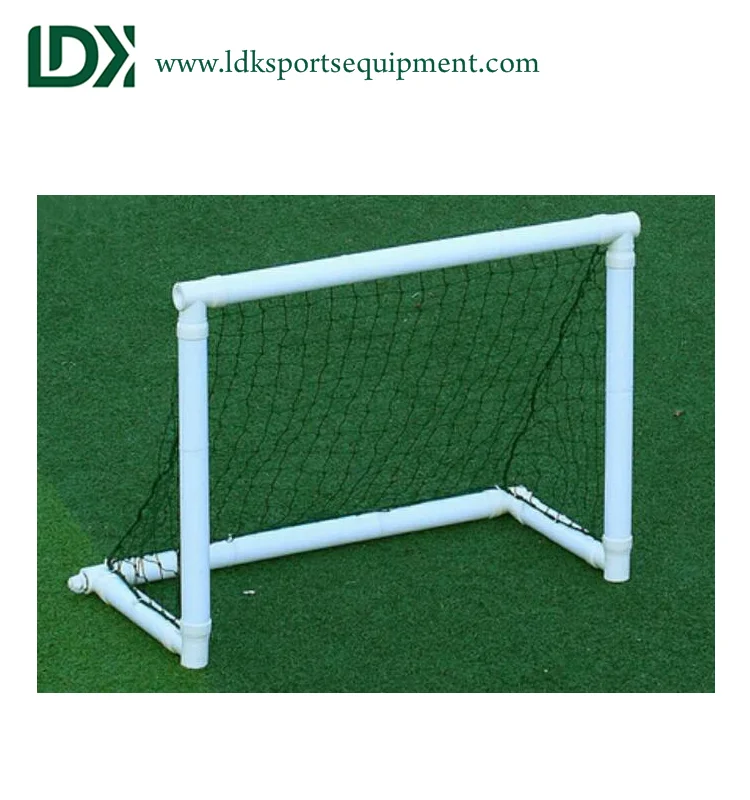
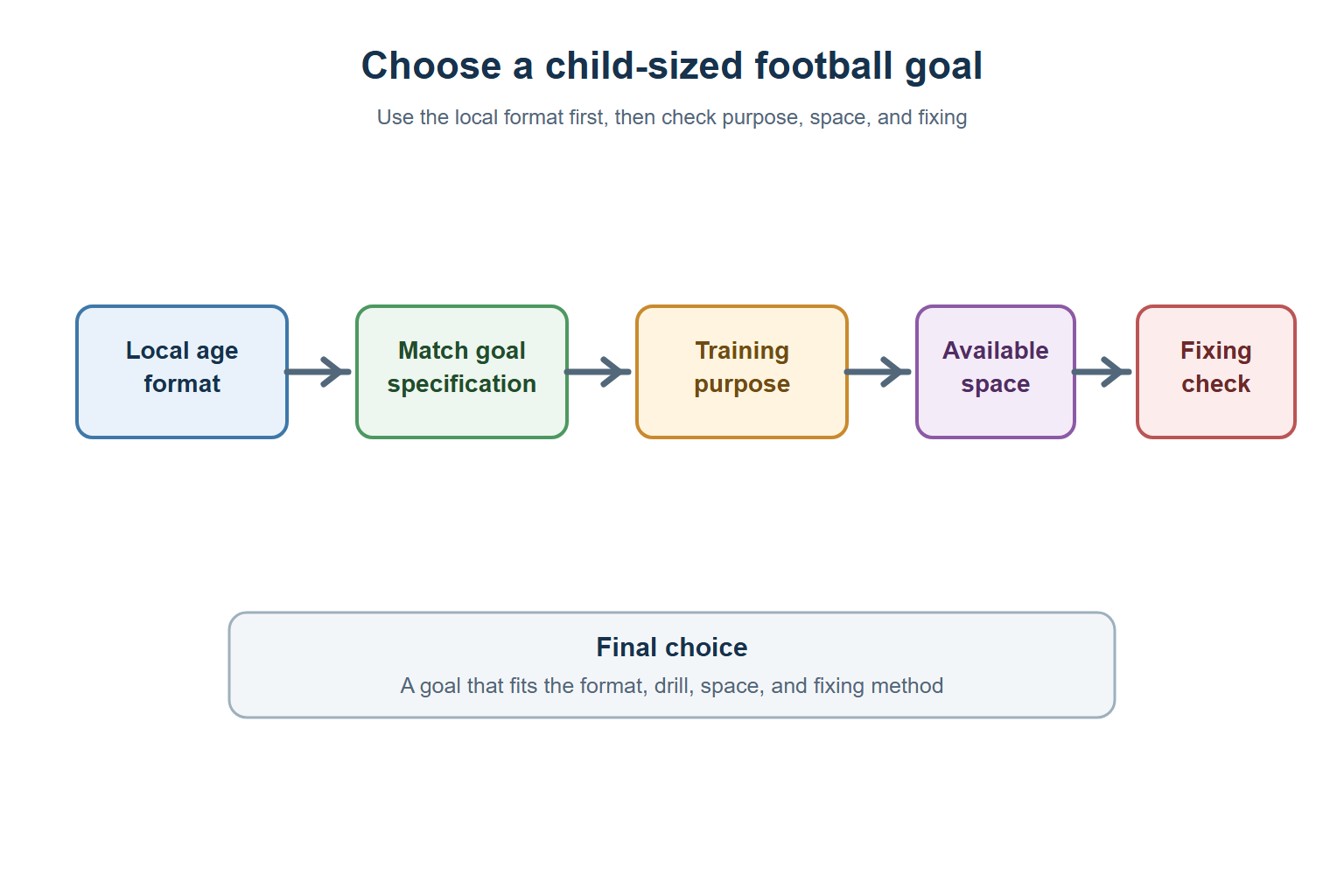
Placing 10-year-old goalkeepers in a full-size 7.32m x 2.44m goal is physically and pedagogically counterproductive. Children do not possess the vertical jumping power or lateral arm span to defend an 8-foot-high, 24-foot-wide aperture, leading to defensive frustration and distorted shooting mechanics.
National associations, led by The Football Association (The FA) and U.S. Soccer, mandate progressive goal scaling aligned with player maturity:
| Age Bracket | Format | Goal Dimensions (Meters) | Goal Dimensions (Feet) | Typical Ball Size | Pitch Size (Meters) |
|---|---|---|---|---|---|
| Under 7 & Under 8 | 5v5 Mini-Soccer | 3.66 m x 1.83 m | 12 ft x 6 ft | Size 3 | 37 m x 27 m |
| Under 9 & Under 10 | 7v7 Youth | 3.66 m x 1.83 m | 12 ft x 6 ft | Size 3 / 4 | 55 m x 37 m |
| Under 11 & Under 12 | 9v9 Intermediate | 4.88 m x 2.13 m | 16 ft x 7 ft | Size 4 | 73 m x 46 m |
| Under 13 & Under 14 | 11v11 Junior | 6.40 m x 2.13 m | 21 ft x 7 ft | Size 4 / 5 | 82 m x 50 m |
| Under 15 to Senior Adult | 11v11 Full Regulation | 7.32 m x 2.44 m | 24 ft x 8 ft | Size 5 | 105 m x 68 m |
The transition from 9v9 to 11v11 represents the biggest spatial leap in youth football. Recognizing that early adolescent goalkeepers cannot effectively defend a senior goal, The FA formalized the 21ft x 7ft (6.40m x 2.13m) format for U13 and U14 matches. Full-size 7.32m x 2.44m (24x8ft) goals are standardly recommended under The FA goalpost guidance notes from the Under-15 age bracket upward, though regional associations and youth leagues may adapt age boundaries according to local developmental policy.
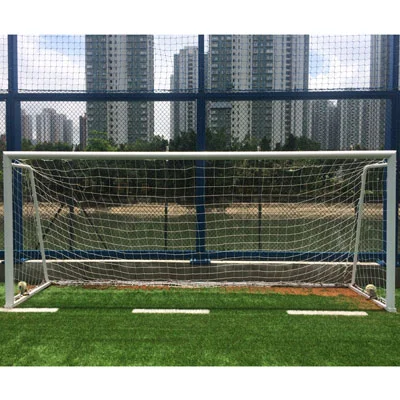
Sports facilities generally choose between two core mounting systems based on pitch usage:
In-ground systems represent the gold standard for permanence, match stability, and alignment:
– Upright posts slide directly into cylindrical steel or aluminum drop-in ground sockets set in concrete foundations.
– Foundation Engineering: In sports facility construction practice, such as guidelines published by the Sports and Play Construction Association (SAPCA), permanent goal sockets are typically set in unreinforced concrete footing blocks (commonly dimensioned around 600mm x 600mm x 600mm, adjusted for site soil bearing capacity).
– Sub-base Drainage: To mitigate frost heave and winter water pooling, socket sleeves standardly feature open drainage bases seated over an estimated 150mm bed of coarse pea gravel or free-draining aggregate.
– When goals are removed for summer pitch renovations, flush-fitting metal socket drop-caps are placed over the openings to prevent tripping.
Where pitches accommodate multiple sports or artificial turf prevents digging socket foundations, freestanding portable goalposts (such as tournament-grade counterweighted aluminum goal systems cataloged by facility suppliers including LDK Sports Equipment) are indispensable:
– Supported by a full ground-level perimeter frame that extends rearward.
– Equipped with heavy-duty cam-action flip-over wheels or pneumatic puncture-proof transport wheels with wide treads to prevent furrowing synthetic turf.
– Requires integrated counterweight backbars or certified ballast weights to prevent tipping.
Unanchored or improperly weighted portable goalposts represent one of the most severe liability hazards in sports facility operations. Historically, strong winds, children hanging on crossbars, and uneven turf have caused unweighted portable goal frames to tip forward, causing traumatic injuries.
To prevent tipping accidents, European Standard BS EN 748:2018 (Playing field equipment – Football goals – Functional and safety requirements, test methods) and parallel standards such as ASTM F2056 establish standard mechanical test methodologies:
1. Vertical Crossbar Deflection Test: Under standardized testing protocols, a vertical test load (standardly specified around 1,800 N / 183 kg) is applied to the crossbar center, requiring that permanent deflection after load release remains within tight structural tolerances (typically capped at 10 mm).
2. Horizontal Anti-Tipping Test: A horizontal pull force (commonly tested at 1,100 N, equivalent to approx. 112 kg force) is applied to the crossbar in the forward direction to confirm that the frame resists overturning.
When portable goals cannot be pegged with ground corkscrew anchors (as on hard ground or 3G/4G synthetic turf), counterbalance weights must be affixed directly across the rear bottom bar:
| Goal Model & Material | Average Bare Frame Weight | Typical Counterweight Ballast (BS EN 748 Guidelines) | Recommended Ballast Method |
|---|---|---|---|
| 7.32m x 2.44m Aluminum Freestanding (Standard Runback) | 65 – 80 kg | Approx. 100 – 112 kg (model dependent) | 6 x 20kg bolt-on internal steel weights or sealed water/sand ballast bars |
| 7.32m x 2.44m Heavy-Duty Steel Portable | 110 – 130 kg | Approx. 80 – 100 kg (model dependent) | Specialized channel counterweight blocks bolted to bottom rear bar |
| In-Ground Socketed 11v11 Goal | 50 – 70 kg | None (Inherent socket retention) | Concrete foundation mass (600x600x600mm) |
| Wheelaway Weighted Base Goals | 180 – 210 kg (Integral) | None required (Weight built-in) | Integrated counterweighted hollow bottom rails |
Groundskeepers must never utilize makeshift counterweights such as loose building bricks, unfastened tires, or cracked curbstones. Ballast must be permanently bolted to the rear ground frame or contained within factory-certified hollow ballast channels.
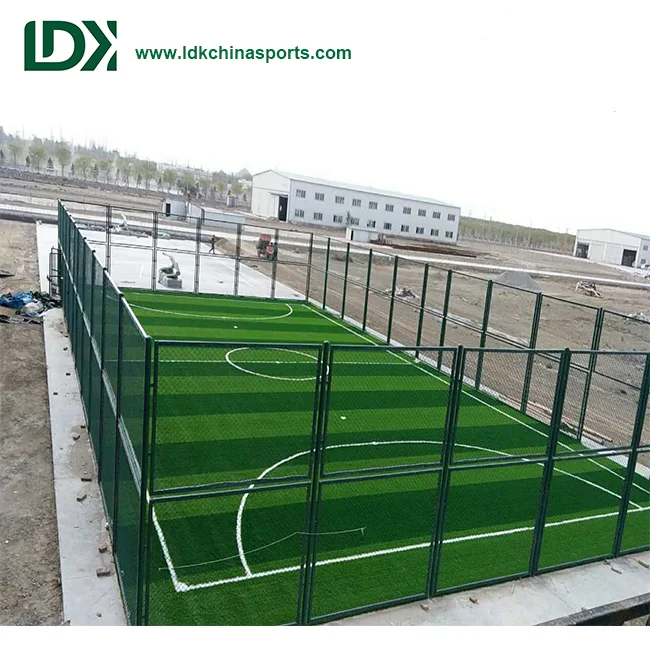
Maintaining pristine 11-a-side goals across decades of harsh outdoor exposure requires attention to metallurgical properties and regular facility maintenance routines.
The official standard size of an adult 11-a-side football goal is exactly 7.32 meters wide by 2.44 meters high, corresponding to 24 feet by 8 feet (8 yards by 8 feet) in imperial measurements. This specification is mandated globally by IFAB Law 1 and FIFA for all official adult competitions.
Under IFAB Law 1, the width and depth of the goalposts and crossbar must be identical and must not exceed 12 centimeters (5 inches). Modern professional goalposts standardly feature an elliptical profile measuring approximately 100mm to 120mm in diameter to ensure structural stability and fair ball rebounds.
The dimensions originated in 1863 when the English Football Association codified the rules using imperial units: 8 yards (24 feet) between the posts and 8 feet under the crossbar. When converted to the metric system, 8 yards equals 7.3152 meters and 8 feet equals 2.4384 meters, which governing bodies officially rounded to 7.32m and 2.44m.
Under FIFA and UEFA technical recommendations, standard match goals require a minimum base net depth (bottom runback) of 1.50 meters and a top horizontal net depth of 0.80 meters. This ensures the net hangs loose enough to absorb the kinetic energy of the ball without causing it to rebound back onto the pitch.
Under European Safety Standard BS EN 748, freestanding portable goals must resist an 1,100 N horizontal pull test at the crossbar without tipping. To satisfy this requirement, portable full-size goals typically require a minimum of 100 to 112 kilograms of ballast secured firmly across the rear bottom bar when ground anchors are not installed.
Yes. On synthetic turf pitches, facilities either install weighted portable aluminum goals equipped with wide puncture-proof cam-lever wheels designed to minimize synthetic turf fiber displacement, or install permanent in-ground sleeves set in concrete beneath the carpet with flush access caps.
The standard 11-a-side football goal size of 7.32 meters by 2.44 meters (24ft x 8ft) has stood as association football’s benchmark since 1863. Adherence to this standard, combined with a maximum 12 cm post profile, 1.50m minimum net runback, and verified BS EN 748 / ASTM F2056 anti-tip safety anchorage, helps ensure alignment with standard safety requirements, fair competition, and player safety across every level of the beautiful game.
AUTH-IFAB-001, AUTH-IFAB-002.AUTH-FIFA-001.AUTH-FA-001.AUTH-BSI-001.AUTH-SAPCA-001.AUTH-FA-001.